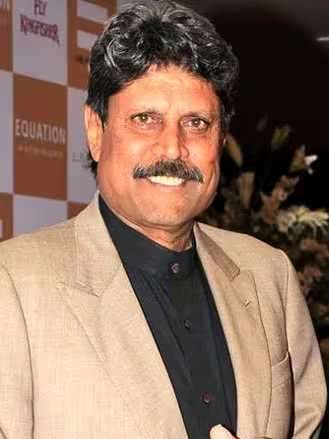
Kapil Dev: The Hurricane Who Lifted a Nation
In the grand tapestry of Indian history, certain moments are woven with threads of pure gold—events that redefine the nation's identity and aspirations. One such moment unfolded on a summer's day at Lord's, London, on June 25, 1983. At its heart was a man who embodied a new, fearless India: Kapildev Ramlal Nikhanj. More than a cricketer, Kapil Dev was a force of nature, an all-rounder whose galloping run-up and electrifying batting shattered stereotypes and taught a billion people to dream. He was the man who led a team of underdogs to the pinnacle of world cricket, and in doing so, transformed a sport into a national religion.
Early Life & Background: Forged in Chandigarh
Kapil Dev was born on January 6, 1959, in Chandigarh, a city that was itself a symbol of modern, post-independence India. His parents, Ram Lal Nikhanj, a prosperous timber merchant, and his wife Raj Kumari, were among the millions whose lives were irrevocably shaped by the Partition of 1947. Having migrated from Shahpur in Pakistan, they rebuilt their lives in India, instilling in their children a spirit of resilience and determination. It was in the planned, open spaces of Chandigarh that young Kapil's raw, untamed energy found its calling.
Unlike the technically precise cricketers emerging from the traditional hubs of Mumbai and Chennai, Kapil was a product of the north—robust, naturally athletic, and instinctively aggressive. He attended D.A.V. School, where his passion for cricket overshadowed his academic pursuits. It was clear from an early age that his destiny lay not in a classroom, but on the sprawling green of a cricket field. His formative cricketing education was under the tutelage of coach Desh Prem Azad, who recognized the prodigious, if unpolished, talent of the boy. Azad worked to channel Kapil’s boundless energy, refining his raw pace and encouraging his natural, free-flowing batting style rather than trying to fit him into a conventional mould.
This period was crucial. It forged the cricketer who would later burst onto the international scene—not a batsman who could bowl a bit, or a bowler who could hold a bat, but a genuine, world-class all-rounder, the likes of which India had never produced.
Career & Major Contributions: The Haryana Hurricane Arrives
Kapil Dev's arrival in Indian cricket was less an entry and more an explosion. He made his first-class debut for his home state of Haryana in November 1975 against Punjab. In that very first match, he tore through the opposition with a spell of 6 for 39, announcing the arrival of a rare commodity in Indian cricket: a genuine fast bowler.
The Test Debut and a New Hope
On October 16, 1978, a 19-year-old Kapil Dev donned the Indian Test cap for the first time against arch-rivals Pakistan in Faisalabad. His very first delivery was a searing bouncer that sent Pakistani batsman Sadiq Mohammad scrambling for his helmet—a clear statement of intent. For decades, Indian cricket had been defined by its mastery of spin. Kapil, with his rhythmic, athletic leap at the crease and a menacing outswinger, represented a paradigm shift. He was the answer to India’s long-standing prayer for a pace bowler who could challenge the world's best.
His rise was meteoric. He became the youngest Test player to achieve the coveted all-rounder's double of 1,000 runs and 100 wickets in 1980, at just 21 years old. A year earlier, he had scored his maiden Test century, a magnificent 126 not out against the mighty West Indies in Delhi, showcasing a batting style that was audacious and thrilling. He didn't just defend; he attacked, using his powerful wrists and exceptional timing to dispatch bowlers to all corners of the ground.
Captaincy and the Miracle of 1983
In 1982, at the age of 23, Kapil Dev was handed the captaincy of the Indian team. It was a team rich in talent but lacking in self-belief on the world stage, especially in the one-day format. When they arrived in England for the third Prudential World Cup in 1983, they were given odds of 66-1 to win. No one, not even their most ardent supporters, gave them a chance.
What followed was one of the greatest underdog stories in sporting history, a saga scripted by the unwavering belief of its captain. The turning point came in a must-win group stage match against Zimbabwe at a small, picturesque ground in Tunbridge Wells.
India, batting first, collapsed catastrophically. The scoreboard read a disastrous 17 for 5 when Kapil Dev walked to the crease. The team was staring at a humiliating exit from the tournament. What Kapil produced that day was not just an innings; it was a resurrection. With no television cameras to broadcast the feat—a BBC strike had blacked out coverage—his performance has become the stuff of legend, passed down through dressing room stories and eyewitness accounts. He single-handedly bludgeoned the Zimbabwean attack, scoring an unbeaten 175 off just 138 balls, including 16 fours and 6 sixes. It was an innings of raw power, calculated aggression, and immense mental fortitude that saved India from elimination and injected his team with the belief that anything was possible.
This newfound confidence carried them to the final at Lord's, where they faced the seemingly invincible West Indies, a team featuring legends like Viv Richards, Clive Lloyd, and a fearsome four-pronged pace attack, who were chasing their third consecutive World Cup title.
India was bundled out for a paltry 183. The dream seemed over. But Kapil Dev refused to let it die. He gathered his team and famously said, “We have nothing to lose. Let’s go out and fight.” He led the fight from the front. The defining moment of the final, and perhaps of Kapil's entire career, was not with the bat or ball, but in the field. The imperious Viv Richards was batting with disdainful ease, threatening to end the match in a hurry. He miscued a pull shot off Madan Lal, the ball soaring high over the mid-wicket region. Kapil, positioned at mid-on, turned and sprinted backwards, his eyes locked on the descending ball. Running away from the pitch, he covered an astonishing distance and plucked the ball from the air in a spectacular, perfectly judged catch. The fall of Richards triggered a West Indian collapse. When Mohinder Amarnath trapped Michael Holding LBW for the final wicket, the unthinkable had happened. India were world champions.
The image of Kapil Dev, beaming with joy, lifting the World Cup trophy on the Lord's balcony is etched into India's collective memory. It was a victory that transcended sport, symbolizing the rise of a new India—confident, capable, and ready to take on the world.
A Career of Enduring Excellence
Beyond 1983, Kapil Dev remained the linchpin of the Indian team for another decade. His career was filled with remarkable achievements. There was the tied Test against Australia in Madras in 1986, and his heroic four consecutive sixes off England's Eddie Hemmings at Lord's in 1990 to save the follow-on, a breathtaking display of power-hitting when his team needed it most.
As a bowler, he was a workhorse, tirelessly running in over after over on unresponsive Indian pitches. His beautiful, late outswinger became his signature weapon, deceiving the best batsmen in the world. On February 8, 1994, in a Test against Sri Lanka, he surpassed Sir Richard Hadlee's world record of 431 Test wickets, cementing his place as one of the greatest bowlers of all time.
He retired in 1994 as the only cricketer in history to have achieved the monumental all-rounder's double of over 4,000 Test runs (5,248) and 400 Test wickets (434), a record that remains a testament to his unique and incredible talent.
Legacy & Influence: The Father of a Cricketing Revolution
To measure Kapil Dev's impact in mere statistics would be to miss the point entirely. His legacy is far more profound. He was a revolutionary who changed the very DNA of Indian cricket.
The 1983 Effect
The World Cup victory was his single greatest contribution. It lit a fire across the country. In small towns and bustling cities, a generation of children, including a young boy in Mumbai named Sachin Tendulkar, began to believe that they too could be world-beaters. Cricket was no longer just a pastime; it became a passion, an ambition, and a unifying force for a diverse nation. The win also triggered a commercial boom, transforming the Board of Control for Cricket in India (BCCI) from a modest organization into the global financial powerhouse it is today.
A New Archetype of Cricketer
Kapil Dev broke the mould of the sophisticated, urban Indian cricketer. Hailing from Haryana, with his rustic charm and straightforward approach, he democratized the sport. He proved that you didn't need to come from a traditional cricketing centre to succeed; you needed heart, grit, and an indomitable will to win. He inspired a wave of fast bowlers from all corners of the country, who finally had a homegrown hero to emulate.
An Enduring Icon
Today, Kapil Dev is revered as an elder statesman of the game. After a brief and challenging stint as the Indian coach, he has found success as a television commentator and businessman. In 2002, Wisden named him the Indian Cricketer of the Century, an honour that placed him above even Sunil Gavaskar and Sachin Tendulkar, acknowledging his game-changing impact.
He is remembered as the "Haryana Hurricane," a name that perfectly captures his energetic, all-action style. But more than that, he is remembered as the captain who taught India how to win. He took a team of hopefuls and turned them into world champions, and in that moment of triumph, he lifted not just a trophy, but the spirit of an entire nation.