K. K. Hebbar: The Master of the Rhythmic Line
In the grand tapestry of Indian modern art, Kattingeri Krishna Hebbar (1911-1996) stands as a unique and vital thread. He was an artist of immense sensitivity, a humanist whose brushwork was guided not just by form and colour, but by the very rhythm of life itself. A painter, draughtsman, and educator, Hebbar forged a visual language that was at once deeply personal and universally understood, successfully bridging the chasm between India’s rich artistic heritage and the dynamic currents of global modernism. His legacy is not merely in the canvases he left behind, but in his profound ability to capture the energy, grace, and enduring spirit of India through his signature, the “singing line.”
Early Life & Background
From Kattingeri to Bombay: An Artist's Awakening
Kattingeri Krishna Hebbar was born on June 15, 1911, in the small coastal village of Kattingeri near Udupi, in present-day Karnataka. He hailed from a Tulu-speaking Brahmin family, and his upbringing was steeped in the region's vibrant folk traditions, religious rituals, and the lush, verdant landscapes of the Konkan coast. These early impressions would become a perennial source of inspiration throughout his long and celebrated career.
Art was not a distant concept in the Hebbar household. His father was a sculptor who specialized in crafting Ganesha idols for local festivals. Watching his father mould clay into divine forms was one of young Krishna’s first and most formative artistic experiences. It instilled in him an appreciation for form, craft, and the sacred power of imagery. However, a formal career in art was not considered a viable path, and his family's modest means presented significant hurdles.
Despite these challenges, Hebbar’s artistic calling was undeniable. He pursued his initial art education at the Chamarajendra Technical Institute in Mysore. But his ambition was set on the bustling, cosmopolitan art world of Bombay (now Mumbai). The city was the crucible of Indian modernism, and its premier institution, the Sir J.J. School of Art, was the gateway for any aspiring artist. In 1934, with limited resources but boundless determination, Hebbar made his way to Bombay.
Life in the metropolis was a struggle. To support his education, he took up a position as an art teacher at his alma mater after a brief period of study. This early experience as an educator would become a parallel and equally important part of his identity. Finally, in 1938, he earned his Diploma in Painting from the Sir J.J. School of Art, a pivotal achievement that formally launched his artistic journey. He was recognized for his talent and was appointed a Fellow at the school, where he would continue to teach until 1945, shaping a new generation of artists even as he was finding his own voice.
The European Sojourn: A New Vision
A transformative chapter in Hebbar's artistic development began in 1949. Supported by a scholarship, he travelled to Europe for a year of study at the prestigious Académie Julian in Paris. This period was an immersion in the very heart of Western modernism. He stood before the works of the Impressionists, the Cubists, and the Expressionists, studying their techniques and absorbing their revolutionary ideas. He was particularly drawn to the intellectual rigor of Paul Klee and the profound humanism of Amrita Sher-Gil, who had made a similar journey a decade earlier.
Crucially, his European experience did not lead to imitation. Instead, it acted as a catalyst, sharpening his own vision and reinforcing his commitment to his Indian roots. He realized that the principles of modern art—abstraction, expression, and a focus on form—were universal tools. The challenge, he understood, was to wield these tools to express a uniquely Indian sensibility. He returned to India in 1950, not as a European painter, but as an Indian modernist armed with a new global perspective.
Career & Major Contributions
The Evolution of a Signature Style
Hebbar’s career can be seen as a continuous quest for a visual language that could articulate the complexities of modern India. His early works, produced in the 1940s, reflected the academic realism of his J.J. School training. They were skillful and composed, but the artist was yet to find his distinctive voice.
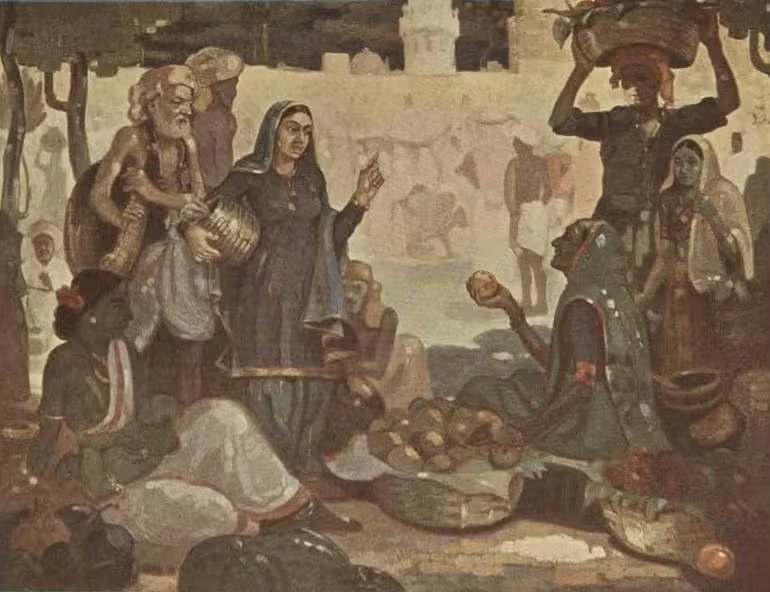
His return from Europe marked a radical departure. He shed the constraints of academicism and began to experiment with form and colour. His subjects remained firmly rooted in the Indian experience: village life, folk dancers, musicians, labourers, and ancient rituals. What changed was his treatment of them. He began to simplify forms, flatten perspective, and use colour for its emotional, rather than purely descriptive, quality.
At the heart of this new style was his mastery of the line. For Hebbar, the line was not a mere contour; it was a living entity, a carrier of energy, rhythm, and emotion. Inspired by the sinuous grace of Indian classical dance (he was a student of Kathak), the sweeping calligraphy of ancient manuscripts, and the dynamic forms of temple sculpture, he developed what came to be known as the “Hebbar Line.” It was a nervous, fluid, and expressive line that danced across his canvases, defining form while simultaneously conveying movement and inner life. This lyrical quality became his unmistakable signature.
Masterpieces of a Modern Master
Hebbar’s body of work is a vibrant chronicle of Indian life. His paintings are celebrated for their dynamism and their deep connection to the cultural soil from which they sprang.
Folk Traditions and Rituals: Works like “Cock Fight,” “Folk Rhythm,” and “Ritual” are powerful depictions of rural energy. In “Cock Fight,” the frenetic, angular lines capture the raw violence and excitement of the moment, transforming a simple village scene into a primal drama of life and death.
Music and Dance: As a connoisseur of classical music and dance, Hebbar translated sound and movement into visual form. In paintings like “Musicians” and “Dancer,” his rhythmic lines seem to vibrate with unheard melodies and unseen steps, capturing the kinetic essence of the performance.
The Human Condition: Hebbar was a profound humanist, and his art often reflected on the social and political realities of his time. “Searching for the Mahatma” is a poignant, symbolic work where countless hands reach out in a dark, chaotic space, a powerful metaphor for a nation grappling with the loss of Gandhi and searching for a moral compass. His series on labourers celebrated the dignity of the common man, depicting their toil with empathy and respect.
The “Singing Line” Series: Perhaps the purest expression of his artistic philosophy is found in his drawings, particularly the series he titled “The Singing Line.” In these works, created with minimal colour, the line is the undisputed protagonist. It flows with incredible confidence and grace, capturing the essence of a form—a bird, a dancer, a bull—with the utmost economy and elegance.
A Leader in the Art World
Hebbar’s contribution to Indian art extended far beyond his studio. He was a respected educator and a pivotal figure in the development of India's post-independence art institutions. While he was a contemporary of the Progressive Artists' Group (PAG) and shared their modernist ideals, he maintained his independent path, respected by all for his integrity and vision.
His leadership was formally recognized when he was appointed Chairman of the Lalit Kala Akademi, India's national academy of fine arts, a position he held from 1980 to 1984. He also served as the President of the Bombay Art Society, further cementing his role as a statesman of the arts. Throughout his life, he exhibited his work extensively across the globe, participating in prestigious international forums like the Venice Biennale and the São Paulo Art Biennial, acting as a cultural ambassador for Indian modern art.
His immense contributions were recognized with numerous accolades, including the National Award from the Lalit Kala Akademi three years in a row (1956, 1957, 1958). The Government of India honoured him with the Padma Shri in 1961 and the Padma Bhushan in 1989, two of the nation's highest civilian awards.
Legacy & Influence
The Gentle Modernist
K. K. Hebbar passed away on March 26, 1996, in Mumbai, leaving behind an indelible mark on the landscape of Indian art. He is remembered as a key figure of the second generation of modernists who successfully navigated the complex challenge of forging an identity that was both modern and authentically Indian. He refused to be a mere derivative of Western art, instead choosing the more difficult path of synthesis.
His historical significance lies in his ability to create an art that was sophisticated in its formal language yet accessible in its humanism. Unlike some of his more radical contemporaries, Hebbar's modernism was never alienating. It was an art that spoke of connection—to the land, to its people, and to its ancient cultural rhythms. He was, in many ways, the “gentle modernist,” an artist who invited viewers into his world with warmth and empathy.
An Enduring Impact
Hebbar's influence continues to resonate in Indian art. His emphasis on the expressive power of the line has inspired countless artists who followed. He demonstrated that drawing was not just a preparatory step for painting but a powerful medium in its own right. His human-centric approach served as an important counterbalance to purely abstract or conceptual trends, reminding the art world of its essential connection to life and society.
Today, his works are treasured possessions of major institutions, including the National Gallery of Modern Art in New Delhi and Mumbai, and are highly sought after by collectors worldwide. The K. K. Hebbar Art Foundation, established to preserve and promote his legacy, continues to support the arts and artists in India.
Kattingeri Krishna Hebbar's life was a testament to the power of a singular vision. From the small village of his birth to the great art capitals of the world, he carried with him an unwavering sense of identity. He looked at the world with the eyes of a modernist but felt it with the heart of an Indian. In his art, the ancient and the modern, the local and the universal, do not clash but dance together, held in perfect, rhythmic harmony by the master’s singing line.