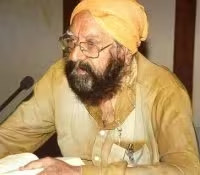
Khushwant Singh: The Last of the Great Dilliwalas
In the grand, often tumultuous, narrative of modern India, few voices were as distinct, audacious, and enduring as that of Khushwant Singh. He was a man of delightful contradictions: a scholar who cultivated the persona of a libertine, a disciplined writer who celebrated idleness, an agnostic who penned one of the most definitive histories of the Sikh faith, and a fierce patriot who was an even fiercer critic of his country's follies. For nearly a century, his pen served as a scalpel, dissecting the political, social, and cultural fabric of India with a mixture of profound love, sharp wit, and, as his famous column was titled, “a little malice.” To understand Khushwant Singh is to understand the journey of post-independence India itself—its triumphs, its tragedies, and its enduring complexities.
He even wrote his own epitaph, a final, self-deprecating flourish that captured the spirit of the man who spared no one, least of all himself:
"Here lies one who spared neither man nor God Waste not your tears on him, he was a sod Writing nasty things he regarded as great fun Thank the Lord he is dead, this son of a gun."
The Forging of a Punjabi Scholar
Khushwant Singh was born Khushal Singh on 2 February 1915, in the village of Hadali, Punjab, now part of Pakistan. His father, Sir Sobha Singh, was a prominent contractor, one of the key builders responsible for raising the imperial capital of New Delhi from the ground up. This unique vantage point gave the young Khushwant an intimate view of the birth of a city that would become central to his identity. Growing up amidst the dust and ambition of Lutyens' Delhi, he was a witness to history in the making.
His early education was at the Modern School in New Delhi, followed by studies at St. Stephen's College and Government College, Lahore—an institution that held a special place in his heart, representing a syncretic, pre-Partition culture he would mourn for the rest of his life. His intellectual horizons expanded further when he travelled to England to study Law at King's College London, eventually being called to the Bar from the Inner Temple in 1938.
He returned to India to practice law at the Lahore High Court, but his legal career was brutally severed by the seismic event that would define his generation and his most significant literary work: the Partition of India in 1947. The horrors he witnessed—the senseless slaughter, the mass displacement, and the sundering of a shared culture—left an indelible scar on his psyche. He saw firsthand how political lines drawn on a map could unleash unimaginable human savagery. This traumatic experience became the crucible in which his literary voice was forged, compelling him to bear witness not to the politics of Partition, but to its devastating human cost.
From Diplomat's Desk to Editor's Chair
After the chaos of Partition, Singh and his family relocated to Delhi. He briefly abandoned law and joined the newly formed Indian Foreign Service in 1947. His diplomatic postings took him to Toronto and London, where he served as a press attaché. However, the staid world of diplomacy proved a poor fit for his restless and irreverent intellect. In 1951, he made a decisive career shift, leaving the foreign service for the world of letters and journalism.
His initial foray was as a journalist with All India Radio. He then founded and edited Yojana (1951-1953), an influential journal of the Planning Commission, which showcased his ability to make dense subjects accessible. Yet, it was his tenure as the editor of The Illustrated Weekly of India from 1969 to 1978 that cemented his legend in Indian journalism.
When Singh took the helm, the Weekly was a respectable but dull publication. He transformed it into the most talked-about magazine in the country. He injected it with his personality—bold, provocative, and unapologetically secular. His editor's column, “With Malice Towards One and All,” became a national institution, a space for his candid observations on politics, society, and everything in between. He published emerging writers, featured sensational stories, and was unafraid to tackle taboo subjects. Under his leadership, the magazine's circulation skyrocketed from a modest 65,000 to over 400,000, a testament to his uncanny ability to connect with the Indian reader. His unceremonious sacking in 1978, following a change in the publication's management, became a major news story in itself.
He later went on to edit the Hindustan Times (1980-1983), further solidifying his reputation as one of India's most influential and widely read editors.
The Pen as a Sword: A Literary Titan
While his journalism made him a household name, it is his literary work that secures his place in the pantheon of Indian writers. His most celebrated work, Train to Pakistan (1956), remains a cornerstone of Indian literature in English. Published less than a decade after Partition, the novel was revolutionary. It eschewed the grand, political narrative of independence and division, focusing instead on the small, fictional border village of Mano Majra, where Sikhs, Muslims, and Hindus had lived in harmony for centuries. The novel unflinchingly documents how this harmony is poisoned by the arrival of the “ghost trains” carrying the bodies of massacre victims, forcing ordinary people to make extraordinary, and often tragic, choices. Its power lies in its raw humanity and its refusal to assign blame to any single community, portraying violence as a collective madness.
His scholarly ambition was realized in the monumental A History of the Sikhs (1963-66). This two-volume work, a product of meticulous research, remains a seminal text on Sikh history, religion, and culture. It showcased the depth of his intellect, a stark contrast to the lighthearted public persona he so carefully curated.
His other notable works of fiction include I Shall Not Hear the Nightingale (1959), a novel exploring the tensions within a Sikh family during the Quit India Movement, and Delhi: A Novel (1990), a sprawling, epic love letter to his adopted city, narrated by a semi-autobiographical, ageing raconteur. In his later years, he continued to write prolifically, publishing novels like The Company of Women (1999) and his candid autobiography, Truth, Love and a Little Malice (2002).
A Conscience in Turbulent Times
Khushwant Singh was never a detached observer; he was an active participant in the life of the nation. From 1980 to 1986, he served as a Member of Parliament in the Rajya Sabha. His political career, however, was marked by controversy. His support for Indira Gandhi's government during the Emergency (1975-77) alienated many of his liberal friends and colleagues. He defended his stance as a belief in the need for discipline, though he later expressed reservations about its excesses.
Yet, his conscience was never for sale. In 1984, he performed an act of profound moral courage. In protest against Operation Blue Star, the Indian Army's storming of the Golden Temple in Amritsar, he returned the Padma Bhushan, an honour awarded to him in 1974. It was a powerful statement from a man who, despite his agnosticism, felt deep pain at the desecration of the holiest Sikh shrine.
Throughout the 1980s, as Punjab was engulfed by the violent Khalistani separatist movement, Singh became one of its most vocal and fearless critics. Despite being a prominent Sikh, he used his column to relentlessly attack religious fundamentalism and extremism, arguing that the militants were betraying the core tenets of the Sikh faith. His staunchly secular stand placed him on a terrorist hit list, and he lived under police protection for years. He refused to be silenced, believing that his duty as a writer and a citizen was to speak truth to power, no matter the cost.
Legacy: The Man Behind the Malice
Khushwant Singh passed away on 20 March 2014, at the age of 99, writing until the very end. His legacy is as vast and varied as his life. He was a pioneering novelist who gave the world an enduring masterpiece on Partition. He was a revolutionary editor who changed the landscape of Indian journalism. He was a historian who documented the story of his people with scholarly rigour.
Above all, he was one of India's great secularists, a relentless champion of pluralism and a fierce opponent of bigotry in all its forms. The carefully constructed persona of a scotch-swilling, girl-ogling “dirty old man” was a brilliant disguise for a deeply disciplined, learned, and sensitive soul who cared profoundly about the idea of India.
He lived by a simple, rigorous routine: waking before dawn to write, work, and read. His life was a testament to the power of the written word to inform, to provoke, and to entertain. Khushwant Singh spared neither man nor God, but in doing so, he held up a mirror to a nation, forcing it to confront its own flaws, celebrate its strengths, and never, ever lose its sense of humour. He was, in the truest sense, the last of the great Dilliwalas, a voice of an era that will not be heard again.