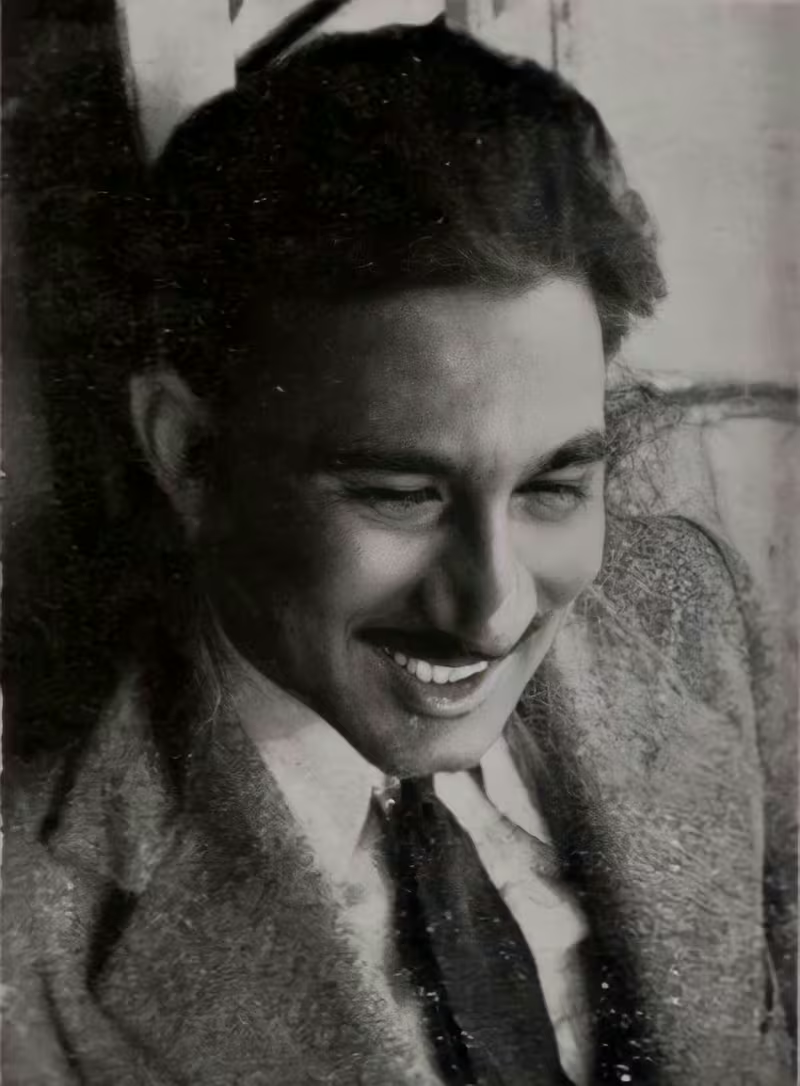
Khwaja Ahmad Abbas - Pioneering Filmmaker and Journalist
In the grand theatre of 20th-century India, few individuals commanded as many stages as Khwaja Ahmad Abbas. He was a filmmaker whose camera sought truth in the grit of city pavements, a journalist whose column was the nation’s conscience, a screenwriter who scripted the dreams and anxieties of a newly independent people, and a novelist who chronicled the churning of a society in flux. K. A. Abbas was not merely a participant in India’s cultural journey; for over five decades, he was one of its most vital and uncompromising narrators. His life’s work, stretching from the hallowed halls of Aligarh to the bustling film studios of Bombay, forms an indelible chapter in the story of modern India.
The Making of a Renaissance Man: Early Life and Influences
Khwaja Ahmad Abbas was born on June 7, 1914, in Panipat, a town in Haryana steeped in history. He was born into a legacy of letters and reformist thought. His paternal grandfather was Khwaja Gulam Abbas, one of the chief witnesses in the trial of the last Mughal Emperor, Bahadur Shah Zafar. More famously, his maternal grandfather was Altaf Hussain Hali, the great Urdu poet and a protégé of Mirza Ghalib, whose reformist zeal shaped modern Urdu literature.
This environment of intellectual inquiry and social responsibility was the crucible in which Abbas’s worldview was forged. His education at Aligarh Muslim University (AMU) further sharpened his political and artistic sensibilities. Graduating with a Bachelor of Arts in English Literature in 1933 and a Bachelor of Laws (LL.B.) in 1935, Abbas was deeply influenced by the fervent nationalism and progressive ideologies sweeping through university campuses in the pre-Independence era. It was here that he became associated with the burgeoning Progressive Writers' Movement, a collective of anti-imperialist and left-leaning writers who believed that art must serve a social purpose. This creed would become the guiding principle of his entire career.
A Pen as a Weapon: The Journalist and Columnist
Armed with his degrees and a burning desire to communicate, Abbas moved to Bombay (now Mumbai) and joined the nationalist newspaper, The Bombay Chronicle, in 1935. After a brief stint as a film critic, he found his true calling in a column that would become a legendary institution in Indian journalism: 'Last Page'.
Starting in the Chronicle and later moving to the popular weekly tabloid Blitz, 'Last Page' ran uninterrupted for over 40 years, making it one of the longest-running columns in history. It was signed off with the pen name "Azad Qalam" (Free Pen). 'Last Page' was more than just a column; it was a weekly conversation with the nation. In a unique diary format, Abbas blended sharp political commentary, social satire, film reviews, and deeply personal reflections. He wrote with an unmatched wit and humanism, championing the underdog, questioning authority, and holding a mirror to society's triumphs and hypocrisies. Through this column, he became the voice of the common man, a fearless commentator who connected the dots between politics, culture, and everyday life.
Crafting the Soul of a New Nation: The Screenwriter
While his journalistic star was rising, Abbas was irresistibly drawn to the most powerful medium of the 20th century: cinema. He began his journey as a screenwriter with the film Naya Sansar (1941), a story that reflected his own journalistic ideals. However, his most profound impact as a writer came through two seminal collaborations.
His association with the Indian People's Theatre Association (IPTA), a cultural wing of the Communist Party of India, led to him writing the screenplay for Dharti Ke Lal (Children of the Earth, 1946). Based on the devastating Bengal Famine of 1943, this starkly realist film, which he also co-directed, was a landmark of social cinema in India. For V. Shantaram, another titan of Indian cinema, he penned the script for Dr. Kotnis Ki Amar Kahani (The Immortal Story of Dr. Kotnis, 1946), a powerful biopic about an Indian doctor who aided China during its war with Japan, embodying a spirit of international solidarity.
It was his legendary partnership with actor-director Raj Kapoor, however, that etched his name into cinematic immortality. Abbas became the ideological and narrative backbone of R.K. Films. He wrote the screenplays for some of Kapoor's most iconic and globally celebrated films, including Awara (The Vagabond, 1951), Shree 420 (Mr. 420, 1955), Mera Naam Joker (1970), and Bobby (1973).
In Awara and Shree 420, Abbas and Kapoor created the archetypal post-Independence hero: the tramp. This character—a charming, Chaplinesque figure from the urban underclass, grappling with questions of nature versus nurture, poverty, and social justice—became a powerful symbol of Nehruvian India's aspirations and anxieties. The films, with their blend of socialist idealism and popular entertainment, resonated not just in India but across the Soviet Union, the Middle East, and Africa, making Raj Kapoor and the stories of K.A. Abbas a global phenomenon.
The Director's Gaze: A Cinema of Conscience
Dissatisfied with the commercial compromises of mainstream cinema, Abbas established his own production banner, 'Naya Sansar', to direct films that were uncompromisingly his own. Working on shoestring budgets with non-professional actors and a neo-realist aesthetic, he became a pioneer of what would later be called India's Parallel Cinema movement.
His directorial ventures were a direct extension of his social concerns:
Shehar Aur Sapna (The City and the Dream, 1963): This poignant film depicted the dehumanizing struggle of a young migrant couple to find a home—even a sliver of pavement—in the sprawling, indifferent metropolis of Bombay. Shot with stark realism, it won the prestigious President's Gold Medal (National Film Award) for Best Feature Film.
Saat Hindustani (Seven Indians, 1969): A passionately patriotic film about seven Indians from different regions and religions who unite to liberate Goa from Portuguese rule. While not a commercial success, the film is now legendary for launching the career of a tall, lanky newcomer whom Abbas had cast as a poet from Bihar: Amitabh Bachchan.
Do Boond Pani (Two Drops of Water, 1971): A prescient film that tackled the issue of water scarcity and the human effort required to build a dam in the deserts of Rajasthan. It won the National Film Award for Best Feature Film on National Integration, highlighting Abbas's commitment to nation-building through his art.
A Battle for a Free Voice: Abbas vs. The Union of India
Abbas was not just a creator but also a fierce defender of artistic freedom. In 1968, his documentary, A Tale of Four Cities, which contrasted the lives of the rich and poor in Calcutta, Bombay, Madras, and Delhi, was refused a 'U' (Unrestricted) certificate by the Censor Board, which objected to scenes depicting the city's red-light districts.
Abbas challenged this decision in the highest court of the land. The resulting case, K. A. Abbas vs. The Union of India, became a landmark judgment in Indian constitutional law. While the Supreme Court ultimately upheld the principle of pre-censorship for films, it laid down strict guidelines, stating that it must be reasonable and exercised only in the interest of well-defined public concerns. Abbas’s legal battle was a courageous stand for the freedom of expression, cementing his role as an artist-activist who fought for his principles both on and off the screen.
The Enduring Legacy of a Storyteller
Khwaja Ahmad Abbas passed away on June 1, 1987, leaving behind a staggering body of work: 74 books in English, Hindi, and Urdu; over 40 years of his 'Last Page' column; scripts for dozens of classic films; and a slate of his own fiercely independent directorial ventures.
His legacy is multifaceted. He was the conscience of mainstream Hindi cinema, infusing it with social purpose and intellectual depth. He was a foundational figure of Indian Parallel Cinema, proving that films could be a medium for serious social inquiry. As a journalist, he was a fearless and consistent voice for the marginalized. He was a bridge, connecting the world of literature with cinema, and the ideals of the freedom struggle with the realities of post-Independence India.
Today, Khwaja Ahmad Abbas is remembered as a true polymath, a committed humanist, and a storyteller who believed in the power of art to not just reflect society, but to shape it. From the dialogues of Raj Kapoor that echoed across the globe to the debut of a future superstar, his influence permeates the cultural fabric of India, a testament to a life lived in the passionate service of a story that needed to be told.