Kiran Bedi: The Making of an Icon
In the deeply entrenched, male-dominated world of Indian bureaucracy in the early 1970s, the entry of a woman into the elite Indian Police Service (IPS) was not just unusual; it was revolutionary. That woman was Kiran Bedi. More than just a statistic, she became a symbol of courage, integrity, and transformative change. From the tennis courts of Amritsar to the notorious corridors of Tihar Jail, and from the streets of Delhi to the global stage of the United Nations, Kiran Bedi’s life is a testament to a relentless will to challenge the status quo and redefine the meaning of public service.
Early Life & Background: Forged in Discipline
Born on June 9, 1949, in Amritsar, Punjab, Kiran was the second of four daughters to Prakash Lal Peshawaria and Prem Lata. Her upbringing was unconventional for the time. Her father, a man of progressive ideals, was determined to provide his daughters with the best education and opportunities, ensuring they were equipped to be independent and self-reliant. He famously told them, "I am giving you an education, not a dowry." This environment fostered a spirit of ambition and fearlessness in young Kiran.
A significant part of her formative years was spent on the tennis court. Under her father's coaching, she began playing the sport at the age of nine. The discipline, strategic thinking, and sheer grit required for competitive sports became the bedrock of her character. She excelled, winning the junior national lawn tennis title in 1966 and the All-India inter-university title for three consecutive years. Her sporting career was not merely a hobby; it was a training ground that instilled in her a competitive edge, mental toughness, and the ability to perform under pressure—qualities that would define her later career in policing.
Her academic journey was equally impressive. She earned a Bachelor of Arts in English (Honours) from the Government College for Women in Amritsar in 1968, followed by a Master's degree in Political Science from Panjab University, Chandigarh, in 1970. Even while serving in the police force, her quest for knowledge never ceased. She later obtained a Law degree (LLB) from the University of Delhi in 1988 and a Ph.D. from the Indian Institute of Technology (IIT), Delhi, in 1993, with her doctoral thesis focusing on drug abuse and domestic violence.
Career & Major Contributions: A Force of Nature in Khaki
In July 1972, Kiran Bedi broke the ultimate glass ceiling, becoming the first woman to join the officer ranks of the Indian Police Service. She was the only woman in a batch of 80 men, an anomaly in a service that was seen as an exclusive male preserve. Her journey was set to be an uphill battle against systemic prejudice and skepticism.
'Crane Bedi': The Uncompromising Traffic Chief
One of her most famous early postings was as Delhi's Deputy Commissioner of Police (Traffic) in 1982. At the time, Delhi's traffic was notoriously chaotic, and rules were flouted with impunity, especially by the influential. Bedi tackled the problem head-on with an iron will. She introduced a system of transparent and firm enforcement, regardless of the offender's status.
It was during this tenure that she earned the moniker "Crane Bedi." She authorized the towing of incorrectly parked vehicles, a common practice today but revolutionary at the time. The most legendary incident involved a car belonging to the Prime Minister's Office that was parked in a no-parking zone. Without hesitation, she had it towed away. This single act sent a powerful message across the country: no one was above the law. It cemented her public image as a fearless and incorruptible officer.
Transforming Tihar: From Hell to Ashram
Perhaps Kiran Bedi's most profound and enduring contribution came in May 1993, when she was appointed Inspector General of Prisons for Delhi. She was given charge of Tihar Jail, one of the largest and most infamous prison complexes in Asia. At the time, Tihar was less a correctional facility and more a cauldron of violence, corruption, and despair, often dubbed a "university of crime."
Bedi saw not a collection of criminals, but a population of human beings in need of reform. She envisioned transforming Tihar from a place of punishment into an 'ashram'—a center for spiritual renewal and positive change. Her approach was radical and deeply humane.
Her reforms were multifaceted and groundbreaking:
- Meditation and Spirituality: She introduced large-scale Vipassanā meditation courses to help inmates manage their anger, stress, and violent tendencies. Yoga and prayer sessions became part of the daily routine, aiming to instill discipline and inner peace.
- Education and Vocational Training: Believing that idleness breeds negativity, she launched extensive educational programs, from basic literacy to higher education. Vocational training centers were set up to equip inmates with marketable skills, enabling them to earn a dignified livelihood upon release.
- Community and Grievance Redressal: She established a panchayat system, where inmates elected representatives to resolve disputes peacefully. A mobile petition box, nicknamed "mobile temple," was placed throughout the prison, allowing inmates to write directly to her with their grievances, bypassing corrupt officials. She would personally read and address these petitions daily.
- De-addiction and Health: A comprehensive de-addiction program was started, along with efforts to improve sanitation and healthcare within the prison walls.
Her efforts yielded spectacular results. The atmosphere within Tihar transformed. Violence rates dropped dramatically, and a sense of hope and purpose began to permeate the complex. This revolutionary work in prison management won her international acclaim, including the prestigious Ramon Magsaysay Award in 1994, often considered Asia's Nobel Prize. The award citation praised her for creating "a model of humane prison management."
A Global Role and a New Path
Her expertise did not go unnoticed on the world stage. From 2003 to 2005, she served as the Police Advisor to the Secretary-General of the United Nations in the Department of Peacekeeping Operations. She was the first woman to hold this high-ranking position, where she was responsible for overseeing police officers in peacekeeping missions worldwide.
In 2007, after a distinguished 35-year career, Kiran Bedi took voluntary retirement from the IPS. Her decision came after being superseded for the post of Delhi's Police Commissioner, a move that sparked considerable public debate. However, her service to the nation was far from over.
Public Life, Politics, and Governance
Freed from the constraints of the uniform, Bedi transitioned into the role of a prominent social activist. She became a leading voice in the 2011 India Against Corruption movement, sharing the stage with Anna Hazare and Arvind Kejriwal. Her powerful speeches and unwavering commitment to the cause of a corruption-free India further solidified her status as a national icon.
In 2015, she entered electoral politics, joining the Bharatiya Janata Party (BJP) and was declared its Chief Ministerial candidate for the Delhi Assembly elections. Though the party lost the election, her entry marked a significant new phase in her public life.
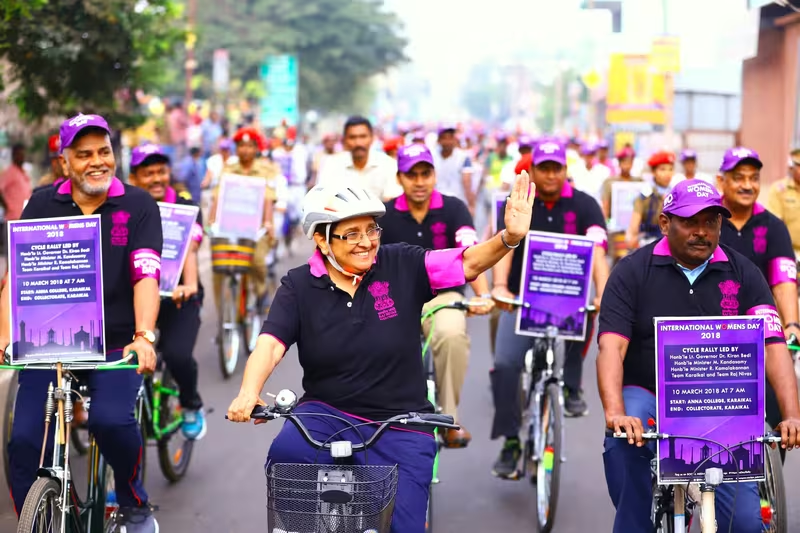
From 2016 to 2021, she served as the Lieutenant Governor of Puducherry. Her tenure was characterized by a hands-on, proactive, and often confrontational style of governance. She initiated programs like 'Mission Swachh Puducherry' and conducted surprise inspections on her bicycle, aiming to bring accountability and efficiency to the administration. Her open-door policy at the Raj Nivas (the Governor's residence) made her accessible to the common citizen, but her administrative style often led to high-profile clashes with the elected government of the Union Territory.
Legacy & Influence
Kiran Bedi's legacy is multifaceted and profound. Her historical significance begins with being the first woman in the IPS, a trailblazer who proved that gender was no barrier to leadership in the toughest of professions. She did not just occupy the post; she excelled in it, setting new benchmarks for courage and operational efficiency.
Her most lasting impact is perhaps in the field of penology. The 'Tihar Model' of prison reform remains a global case study in humane and effective correctional administration. She fundamentally challenged the retributive model of justice, advocating instead for a rehabilitative approach that focused on the human potential for change.
In the cultural imagination of India, Kiran Bedi is more than just a retired police officer. She is an enduring symbol of female empowerment, a household name synonymous with integrity, discipline, and the courage to speak truth to power. Her story has inspired a generation of women to break barriers and enter professions like the police, military, and civil services.
Today, she is remembered as a complex and dynamic figure—a pioneering police officer, a world-renowned reformer, a passionate activist, and a determined administrator. While her methods have sometimes invited debate, her intention to serve the public good has rarely been questioned. Kiran Bedi did not just enforce the law; she sought to humanize it, leaving an indelible mark on the landscape of modern India.