Kirttivarman I: The True Architect of the Chalukya Empire
In the grand tapestry of Indian history, some figures lay the foundation, while others build the magnificent edifice. Pulakeshin I, the founder of the Chalukya dynasty of Vatapi, was the former. His son, Kirttivarman I, who reigned from circa 566 to 592 CE, was unequivocally the latter. While his father carved out a small, sovereign kingdom in the heart of the Deccan, it was Kirttivarman who, with strategic brilliance and relentless military campaigns, transformed this principality into a formidable empire. He was not merely a successor; he was the dynasty's true architect, a ruler whose legacy is etched as deeply in the territories he conquered as it is in the breathtaking rock-cut temples he commissioned at his capital.
Early Life & The Inherited Dream
Born into a family with burgeoning imperial ambitions, Kirttivarman's early life was shaped by the political ferment of the 6th-century Deccan. The once-mighty empires of the Guptas in the north and the Vakatakas in the Deccan had faded, leaving a power vacuum filled by competing regional dynasties. His father, Pulakeshin I, had seized this opportunity around 543 CE, establishing his capital at the strategic hill-fort of Vatapi (modern Badami) and declaring his sovereignty by performing the prestigious Ashvamedha (horse sacrifice) ceremony—a bold statement of imperial intent.
Kirttivarman, along with his younger brother Mangalesha, grew up in this environment of assertion and expansion. He inherited not just a throne but a mission: to make the Chalukya name synonymous with supreme power in the Deccan. When he ascended the throne around 566 CE, he took charge of a kingdom that was secure but surrounded by older, more established powers like the Kadambas of Banavasi and the Mauryas of the Konkan coast. For the fledgling Chalukya dynasty to survive and thrive, it had to dominate.
The Architect of an Empire: A Storm of Conquests
Kirttivarman I was, above all, a military genius. His reign was a whirlwind of campaigns that systematically dismantled the power of his rivals and vastly expanded the Chalukya domains. The most vivid account of his prowess comes from the celebrated Aihole inscription, composed by the court poet Ravikirti during the reign of Kirttivarman's son, Pulakeshin II. This inscription, a masterpiece of Sanskrit poetry, describes Kirttivarman as a "night of doom" (kāla-rātri) to his enemies.
Subjugation of the Kadambas
His first and most significant challenge was the powerful Kadamba dynasty of Banavasi. The Kadambas were the overlords of the Karnataka region, an ancient and proud lineage who would not easily yield to a new power. Kirttivarman launched a decisive campaign against them, shattering their military strength and reducing them to feudatories. While the Kadamba line was not extinguished, their independence was. This victory was a critical turning point, establishing the Chalukyas as the new masters of the western Deccan.
The Conquest of the Konkan Coast
Having secured his southern flank, Kirttivarman turned his attention westward to the Konkan Mauryas. Ruling the prosperous coastal strip of modern-day Maharashtra and Goa, the Mauryas controlled vital sea ports and lucrative trade routes. Their capital, Puri—often identified with Gharapuri, the Elephanta Island near Mumbai, famed for its own magnificent caves—was described as the "Goddess of Fortune of the western sea." Kirttivarman’s forces stormed the Mauryan kingdom, annexing this wealthy coastal territory. This conquest was not just a territorial gain; it gave the Chalukyas control over maritime trade, immensely enriching the imperial treasury and opening a gateway to the wider world.
Campaigns Against the Nalas and Other Powers
Kirttivarman's ambitions were not confined to the west. The Aihole inscription records that he destroyed the 'nilaya' (abode) of the Nalas, who ruled in the region of present-day Chhattisgarh. This eastward campaign demonstrated the vast operational range of his army and his intent to establish Chalukya influence across the breadth of the Deccan plateau.
Later inscriptions, such as the Godachi plates, credit him with victories over an almost impossibly long list of rulers, including those of Vanga (Bengal), Anga, Kalinga, Magadha, and even the Pandyas and Cholas in the far south. Historians largely view these claims as conventional panegyrics—poetic exaggerations meant to glorify the dynasty's formidable ancestor. A literal conquest of such vast and distant territories within a 25-year reign would have been impossible. However, these eulogies underscore the sheer terror and awe his military reputation inspired. The core, verifiable victories against the Kadambas, Mauryas, and Nalas were real, and they were enough to cement his status as an empire-builder.
By the end of his reign, Kirttivarman I had forged an empire that stretched from the Arabian Sea in the west to the Bay of Bengal's sphere of influence in the east, and from the Narmada River in the north towards the Krishna-Tungabhadra region in the south. He had laid the political and military groundwork for the imperial zenith that would be reached under his son.
A Patron of Art: The Caves of Vatapi
Kirttivarman was not only a conqueror of kingdoms but also a conqueror of stone. The wealth and stability secured by his campaigns fueled one of the most significant artistic undertakings of the era: the excavation of the rock-cut cave temples at Vatapi. While his brother Mangalesha is credited with completing one of the caves, the patronage and vision for this grand project began with Kirttivarman.
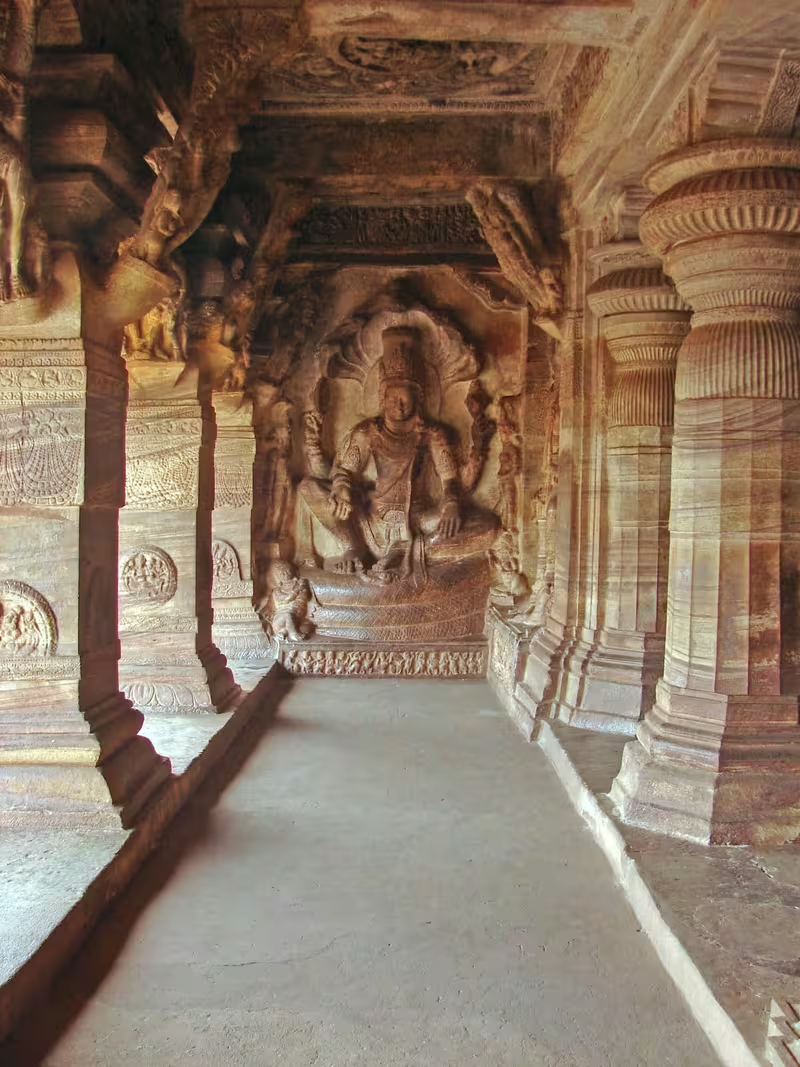
The most spectacular of these is Badami Cave 3, a Vaishnava temple that stands as a masterpiece of early Chalukyan art. An inscription within the cave, dated to 578 CE—the 12th year of Kirttivarman's reign—explicitly records its dedication. The cave is a breathtaking gallery of Hindu mythology carved in sandstone. Its walls feature colossal, dynamic sculptures of Vishnu's avatars:
- Trivikrama: A towering figure of Vishnu spanning the cosmos in three steps.
- Narasimha: The fierce, lion-headed avatar, depicted with raw power and intensity.
- Varaha: The boar avatar, rescuing the earth goddess Bhudevi.
- Harihara: A syncretic deity, half-Vishnu and half-Shiva, symbolizing the unity of the divine.
These sculptures, remarkable for their scale, grace, and emotional depth, mark the dawn of the distinct Chalukyan style of architecture. Kirttivarman’s patronage transformed the sandstone cliffs of his capital into a sacred landscape, a testament to the dynasty's power, piety, and artistic sophistication. This architectural legacy would blossom in the subsequent decades at Aihole and Pattadakal, defining temple art in the Deccan for centuries.
Legacy & Influence
Kirttivarman I's reign came to an end around 592 CE. He died leaving behind young sons, including the future emperor Pulakeshin II. Because the heir was a minor, Kirttivarman's brother, Mangalesha, assumed the role of regent. This arrangement would later lead to a bitter civil war between uncle and nephew, a conflict from which Pulakeshin II would emerge victorious to lead the Chalukyas to even greater heights.
Despite being overshadowed in popular memory by his more famous son, historians accord Kirttivarman I a place of paramount importance. He was the crucial link between the dynasty's founding and its golden age. His reign established the key pillars of Chalukya supremacy:
- Military Dominance: He crushed the major rival powers of the Deccan, creating the political space for the empire to flourish.
- Economic Strength: His conquest of the Konkan coast provided immense wealth through trade, funding both military expansion and cultural projects.
- Cultural Vision: His patronage at Badami initiated a unique and enduring architectural tradition that became a hallmark of the dynasty.
Kirttivarman I was the emperor who gave substance to his father's dream. He inherited a kingdom but bequeathed an empire. He was the true "maker of the Chalukyas," a ruler whose formidable legacy of conquest and creation laid the unshakeable foundation for one of the most glorious chapters in the history of Southern India.