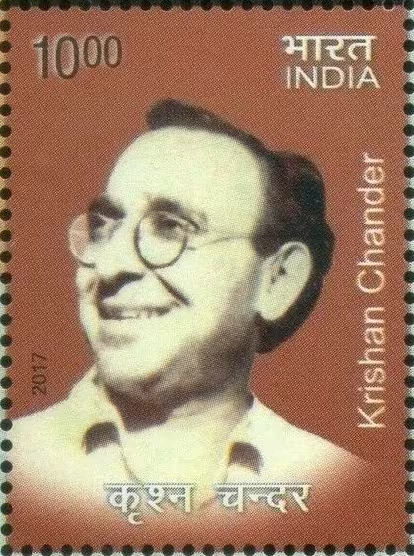
The Conscience of a Generation: The Life and Work of Krishan Chander
In the grand tapestry of 20th-century Indian literature, few threads are as vibrant, compassionate, and resilient as that of Krishan Chander (1914-1977). A titan of Urdu and Hindi prose, he was more than just a writer; he was a chronicler of his time, a humanist who wielded his pen as a surgeon’s scalpel to expose the injustices of society and as a balm to soothe the wounds of the oppressed. As a leading figure in the Progressive Writers' Movement, his vast body of work—spanning over 20 novels, 30 collections of short stories, and countless plays—remains a powerful testament to the enduring struggle for dignity, equality, and a more compassionate world.
Early Life & The Shaping of a Vision
Krishan Chander Chopra was born on November 23, 1914, in Bharatpur, Rajasthan, where his father, Dr. Gauri Shankar Chopra, was employed. However, the landscape that truly shaped his soul was not the arid plains of Rajasthan but the verdant, ethereal valleys of Kashmir. He spent his formative years in Poonch, a district nestled in the majestic Pir Panjal range. The breathtaking beauty of this region—the snow-capped peaks, the whispering chinars, the crystal-clear streams—seeped into his consciousness, instilling in him a deep-seated romanticism and a lyrical sensibility that would grace even his most politically charged writings.
This idyllic setting stood in stark contrast to the poverty and hardship he witnessed among the local populace. This duality—of immense natural beauty and profound human suffering—became a central tension in his work, fostering an early awareness of social and economic disparity.
His formal education took him from the mountains of Kashmir to the bustling intellectual hub of Lahore. He enrolled at the prestigious Forman Christian College, a crucible of new ideas and political ferment in pre-Partition India. In Lahore, Chander's intellectual horizons expanded dramatically. He immersed himself in Western literature, edited the English section of the college magazine, The Folio, and engaged in fervent debates about colonialism, socialism, and the future of India. It was here that he came into contact with the nascent Progressive Writers' Movement, an association that would define his literary career. After completing his Master's in English Literature in 1934, he went on to study law, but his true calling had already found him.
A Career Forged in Ink and Idealism
Krishan Chander’s literary journey began in the late 1930s, and he quickly established himself as a powerful new voice. His work was inextricably linked with the ideals of the Progressive Writers' Association (PWA), which advocated for literature that was socially relevant, realistic, and committed to the cause of the common man. Chander became one of its most ardent and prolific proponents, using his stories to fight against imperialism, feudalism, and social decay.
The Master of the Short Story
While he was a gifted novelist, Krishan Chander's most profound impact was arguably in the realm of the short story. He possessed an uncanny ability to capture a universe of emotion and social commentary within a few pages. His stories were populated by the people who lived on the margins of society: impoverished peasants, exploited workers, forgotten untouchables, and the bewildered victims of history's cruel turns.
One of his earliest celebrated stories, "Annadata" (The Giver of Grain), was a searing indictment of the man-made Bengal Famine of 1943. With gut-wrenching detail and profound empathy, he painted a portrait of a starving nation, exposing the administrative apathy and colonial greed that led to the deaths of millions. The story was a clarion call, shaking the conscience of the Indian literary world.
His humanism shone brightly in stories like "Kalu Bhangi" (Kalu the Sweeper), which explored the life of a man from the lowest rung of the caste hierarchy. Instead of presenting him as a pitiable victim, Chander imbued Kalu with dignity, dreams, and a rich inner life, forcing readers to confront their own prejudices.
Chronicler of the Partition
The Partition of India in 1947 was a cataclysmic event that tore the subcontinent apart, and for writers of Chander's generation, it was an inescapable trauma. He responded with some of the most powerful and heartbreaking literature ever written on the subject. His collection "Hum Vahshi Hain" (We are Savages) laid bare the barbarity that had consumed ordinary people.
His most iconic Partition story, "Peshawar Express," is a masterpiece of narrative technique. The story is told from the perspective of a train, a non-human observer that witnesses the escalating cycle of violence as it travels from Peshawar to India. It sees Hindus and Sikhs slaughtering Muslims, and then further down the line, Muslims slaughtering Hindus and Sikhs. The train, a mere vessel of iron and steel, becomes a silent, horrified witness to the complete collapse of humanity, lamenting the bloodshed without prejudice. Unlike the raw, psychological intensity of Saadat Hasan Manto's Partition tales, Chander’s work often took a wider, more panoramic view, mourning the collective loss of humanity itself.
The Satirist: An Autobiography of a Donkey
Beyond tragedy and social realism, Krishan Chander was a master of satire. His most famous novel, "Ek Gadhe Ki Sarguzasht" (An Autobiography of a Donkey), remains a timeless classic of political and social commentary. The novel's protagonist is a donkey who, through a series of misadventures, finds himself in the corridors of power in New Delhi. Through the donkey’s naive yet perceptive eyes, Chander hilariously lampoons the bureaucracy, the pomposity of politicians, the opportunism of high society, and the absurdities of post-independence Indian life. The satire was so sharp and universal that it found a wide readership and was translated into numerous languages.
Other Major Works and Foray into Cinema
His other notable novels include "Shikast" (Defeat), a poignant love story set against the political landscape of Kashmir, and "Jab Khet Jaage" (When the Fields Awoke), which drew inspiration from the Telangana peasant rebellion. His canvas was vast, covering everything from urban alienation in stories like "Mahalaxmi ka Pul" to the simple aspirations of the poor.
Like many of his contemporaries in the PWA, Chander also contributed to Hindi cinema. He wrote the story for K.A. Abbas's groundbreaking film "Dharti Ke Lal" (1946), based on the Bengal Famine. He later moved to Bombay (now Mumbai) and wrote screenplays and dialogues for several films, including Manzil (1960) and Mamta (1966), bringing his progressive ideals to a wider, mainstream audience.
Legacy and Influence
Krishan Chander passed away at his desk on March 8, 1977, in Mumbai, literally with a pen in his hand. His death marked the end of an era, but his literary legacy is immortal.
The Voice of Humanism
His most enduring legacy is his unwavering humanism. In an age of ideological certainty, Chander’s ultimate allegiance was to the common person. His writing was a constant reminder that behind political slogans and historical events are real people with hopes, fears, and the right to a dignified life. He gave a voice to those who had none, and in doing so, he affirmed the fundamental value of every human life.
A Lyrical Realist
His writing style was a unique blend of realism and romanticism. His prose, influenced by his Kashmiri upbringing, was often lyrical, poetic, and infused with a deep love for nature. Yet, this romantic sensibility never diluted the harshness of his subject matter. Instead, it created a powerful contrast, highlighting the tragic gap between the world as it should be and the world as it was. His language was simple, direct, and accessible, which made his work popular across a wide spectrum of readers.
A Lasting Impact
Krishan Chander's influence can be seen in generations of subsequent writers in Urdu, Hindi, and other Indian languages who continued the tradition of socially conscious literature. He, along with Manto, Ismat Chughtai, and Rajinder Singh Bedi, is considered one of the four pillars of modern Urdu fiction.
In recognition of his immense contribution to Indian literature, he was awarded the Padma Bhushan in 1969, one of India's highest civilian honors. Today, he is remembered as a literary giant—a progressive visionary, a masterful storyteller, and above all, the compassionate conscience of a nation navigating the turbulent waters of the 20th century. His stories continue to be read and cherished, not as historical artifacts, but as timeless explorations of the human condition that remain startlingly relevant in our own times.