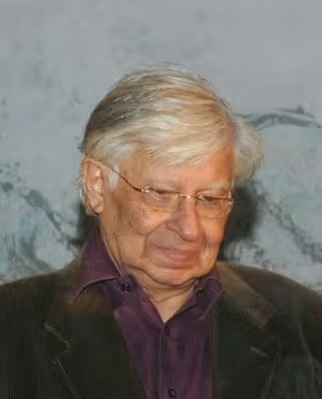
The Chronicler of Modern India: Krishen Khanna
In the pantheon of Indian modern art, Krishen Khanna occupies a unique and revered space. He is a painter of parables, a chronicler of the common man, and a historian on canvas. While his contemporaries in the influential Progressive Artists’ Group (PAG) charted bold new courses in form and abstraction, Khanna remained steadfastly committed to the narrative, finding the epic in the everyday and the universal in the specific. His life, a remarkable journey from the world of high finance to the bohemian circles of post-independence artists, mirrors the complexities of the nation he so poignantly depicts. As one of India’s most distinguished living artists, his work serves as a profound and enduring testament to the resilience, turmoil, and quiet dignity of the human spirit in a rapidly changing world.
Early Life & Background
A Formative Youth between Empires
Krishen Khanna was born in 1925 in Lyallpur (now Faisalabad, Pakistan), a city in the Punjab province of British India. His upbringing was cosmopolitan and intellectually stimulating. His father, Kahan Chand Khanna, was a history graduate who worked for the British administration, a position that afforded the family a comfortable life and instilled in young Krishen a deep appreciation for history and literature. The family home was filled with books, and it was here that the artist's lifelong engagement with grand historical and mythological narratives began.
In 1938, a pivotal chapter of his life began when he was sent to England to study at the Imperial Service College, Windsor. This experience was transformative. Away from the cloistered environment of colonial India, he was exposed to European culture and, most importantly, to its art. During his school holidays, he would travel to London and spend hours at the National Gallery, absorbing the works of the Old Masters. This direct encounter with Western art history, from Renaissance portraiture to the dramatic compositions of the Baroque, provided him with a foundational visual education that was markedly different from that of his Indian peers.
He returned to India in 1942 and enrolled at the Government College in Lahore to study English Literature. Lahore, then a vibrant cultural capital, further honed his sensibilities. He began painting seriously and became part of the city's thriving artistic and literary scene. However, this period of creative awakening was set against the ominous backdrop of escalating political tensions. The dream of independence was intertwined with the nightmare of Partition, a cataclysm that would irrevocably shape Khanna’s life and art.
The Trauma of Partition and a Banker's Life
The year 1947 brought independence, but it also cleaved the subcontinent in two. As a resident of Lahore, Khanna witnessed the horrors of Partition firsthand—the senseless violence, the mass displacement, and the sundering of a shared culture. His family was forced to flee, leaving everything behind to migrate to Shimla in the newly formed nation of India. The deep psychological scars of this event would surface time and again in his work, manifesting in sombre canvases that speak of loss, displacement, and the fragility of human existence.
In the immediate post-Partition years, the path of a professional artist seemed untenable. To support his family, Khanna took a job with Grindlays Bank in 1948. For the next fourteen years, he would lead a remarkable double life. By day, he was a meticulous and successful banker, rising through the ranks and being posted to cities like Bombay and Madras. By night and on weekends, he was a passionate painter, transforming his dining table into a makeshift studio. This period, far from being a creative hindrance, gave him a unique vantage point. His banking career immersed him in the rhythms of urban India, allowing him to observe the lives of ordinary people—clerks, labourers, vendors—who would become the central protagonists of his artistic universe.
Career & Major Contributions
The Progressive and the Reluctant Professional
It was during his posting in Bombay (now Mumbai) that Khanna came into contact with the Progressive Artists' Group. He formed deep and lasting friendships with its key members, including M.F. Husain, S.H. Raza, F.N. Souza, and Tyeb Mehta. Though never a formal member, he was an integral part of their intellectual circle. They would meet for intense discussions, sharing ideas and critiquing each other's work. His friends relentlessly encouraged him to abandon his secure banking job and commit to art full-time.
The legendary M.F. Husain famously chided him, saying his bank job was like “holding on to the tail of a dead cow.” Despite their urgings, Khanna hesitated, burdened by familial responsibilities. Yet, his reputation as a serious artist grew. He participated in numerous exhibitions, and his work, which combined European modernist influences with distinctly Indian themes, garnered critical acclaim.
Finally, in 1961, Khanna made the momentous decision to resign from Grindlays Bank. The leap of faith was almost immediately validated when, in 1962, he was awarded the prestigious Rockefeller Fellowship, allowing him to travel and work in the United States. This marked the true beginning of his career as a full-time artist.
The Canvas as Chronicle: Major Works and Themes
Krishen Khanna’s oeuvre is defined by its deep humanism and its commitment to storytelling. He is a figurative painter who uses the human form to explore complex social, political, and existential themes.
The Bandwalla Series: Perhaps his most iconic body of work, the Bandwallas depicts the ubiquitous brass bands that perform at Indian weddings and processions. Khanna captures not the joyous spectacle, but the men behind the music. He paints them in their garish, often ill-fitting uniforms, their faces etched with weariness, their postures slumped in exhaustion between performances. In these figures, Khanna finds a powerful metaphor for the common man—anonymous, performing a role in a grander ceremony, yet possessing an individual, often melancholic, dignity. The series is a masterful commentary on the absurd pageantry of life and the pathos of the unsung labourer.
Biblical Narratives, Indian Settings: In a move that was both audacious and brilliant, Khanna began re-interpreting Christian allegories within a contemporary Indian context. His depictions of The Last Supper, The Betrayal, and Doubting Thomas are not religious paintings in the traditional sense. Instead, he uses these universal stories of fellowship, betrayal, and faith to explore timeless human dramas. In his version of The Last Supper, Christ and his apostles are not distant haloed figures, but ordinary men gathered around a table in what could be a roadside dhaba. By de-sanctifying the scene, Khanna makes its emotional core—the impending sense of tragedy and betrayal—powerfully immediate and relatable to an Indian audience.
A Witness to History: The memory of Partition and other pivotal moments in India's history are deeply embedded in Khanna’s art. He has created powerful works that respond to national traumas, such as the assassination of Mahatma Gandhi. His massive mural, The Great Procession, depicts a sprawling cross-section of Indian society, from politicians to labourers, capturing the chaotic, vibrant, and often contradictory nature of the nation. During the Emergency in the 1970s, he produced a series of works that served as subtle but potent political allegories, critiquing the suppression of freedom.
The Poetry of the Roadside: Khanna has consistently turned his gaze to the transient life of India's highways. His paintings of truck drivers, roadside tea stalls (dhabas), and resting labourers are imbued with a quiet empathy. He sees these non-places as sites of community and fleeting connection, capturing the grit and grace of lives lived in constant motion.
His artistic style is expressive and gestural, characterized by strong, dynamic lines and a sophisticated, often sombre, colour palette. While one can see the influence of European masters like Goya and Daumier, and the angularity of Picasso, his visual language remains profoundly his own, rooted in the Indian soil.
Legacy & Influence
A Humanist Among Modernists
Krishen Khanna's historical significance lies in his unwavering dedication to narrative and figuration at a time when many of his peers were moving towards abstraction. He demonstrated that modernism was not a monolithic style, and that telling human stories could be as formally and conceptually radical as non-representational art. He ensured that the social and political realities of post-independence India remained a central concern for modern art.
His life story itself is a source of inspiration—a testament to the fact that an artistic calling can be pursued with integrity and passion even alongside the demands of a conventional career. He bridges the gap between the formally trained artist and the self-taught intellectual, his work enriched by his deep knowledge of literature and history.
The Conscience of the Canvas
Today, Krishen Khanna is celebrated as one of India's national treasures. He has been honoured with the nation's highest civilian awards, including the Padma Shri in 1990 and the Padma Bhushan in 2011. The Lalit Kala Akademi, India's National Academy of Art, bestowed upon him its highest honour, the Lalit Kala Ratna, in 2004.
His lasting impact is that of a humanist. He gave a face and a voice to the anonymous millions who form the backbone of Indian society. His paintings are not just aesthetic objects; they are acts of witness. They remind us of the historical traumas that must not be forgotten and celebrate the quiet heroism of everyday existence. In the tired eyes of a bandwalla, the shared meal in a dhaba, or the re-imagined grief of a biblical scene, Krishen Khanna's art finds the profound truth of the human condition, making him not just a great Indian painter, but a timeless storyteller for the world.