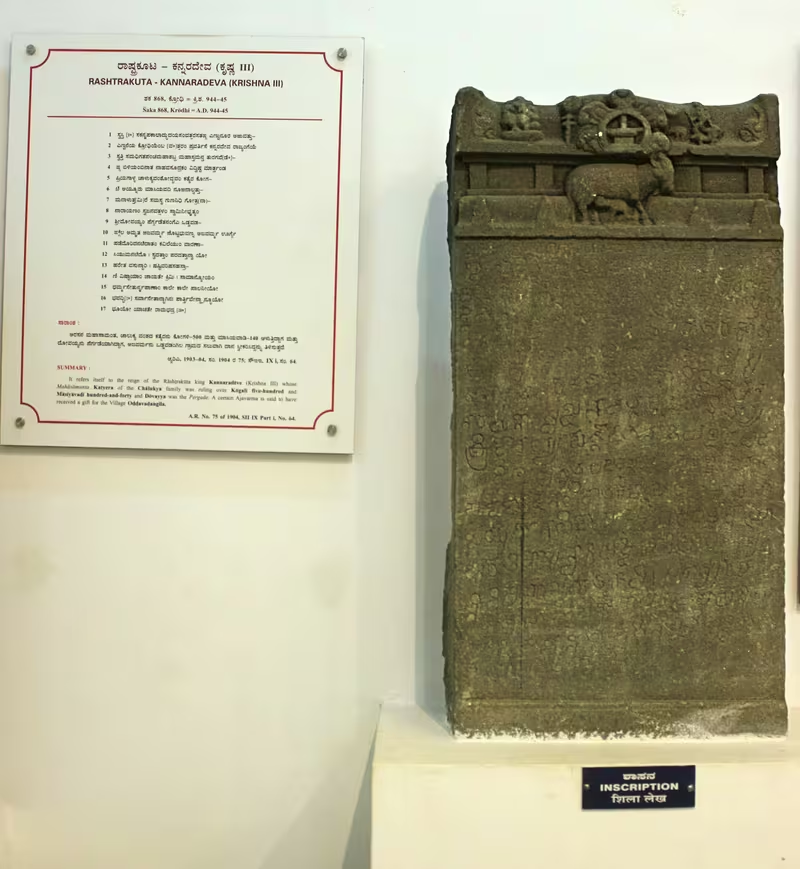
Krishna III: The Last Great Rashtrakuta Emperor
In the grand tapestry of medieval Indian history, some figures blaze across the firmament with the intensity of a comet, their reigns defined by relentless ambition and earth-shaking conquests. Such was Krishna III, the last great emperor of the Rashtrakuta dynasty. Ascending the throne around 939 CE, he inherited an empire that had weathered internal strife and was beset by ambitious rivals. In a reign spanning nearly three decades, he would not only restore the glory of his house but expand its frontiers to an extent never seen before, becoming a sovereign whose ambition redrew the map of 10th-century India.
Early Life & The Forging of a Warrior
Krishna III's early life was spent not in the assured comfort of a crown prince, but in the crucible of political uncertainty. He was the son of Amoghavarsha III (also known as Baddega), and the grandson of the formidable Indra III, whose armies had famously sacked the great northern city of Kannauj. However, the throne had passed from Indra III to his less competent sons, culminating in the chaotic reign of Krishna's uncle, Govinda IV. Govinda IV's misrule and unpopularity created a power vacuum that a coalition of feudatories, led by Krishna's father Amoghavarsha III, rose to fill.
Though his father officially took the throne, the aging Amoghavarsha III was the face of the restoration, while the young and dynamic Krishna was its engine. He was instrumental in deposing his uncle and securing the throne for his father. This experience was his political baptism by fire. It taught him the brutal realities of power, the importance of strategic alliances with feudatories, and the necessity of decisive military action. By the time he formally succeeded his father around 939 CE, Krishna III was not a novice ruler but a seasoned commander and strategist, ready to unleash his ambitions upon the subcontinent.
The Storm of Conquest: A Career of Unmatched Military Brilliance
Krishna III's reign was one of perpetual warfare, a testament to his boundless energy and strategic vision. He saw the Rashtrakuta Empire not merely as a Deccan power, but as the paramount authority of all of Dakshinapatha (the Southern Way) and a challenger for supremacy in the north. His campaigns can be understood as a masterful, three-pronged assertion of this imperial vision.
1. Consolidation and Alliances
His first task was to secure his own heartland. He systematically brought rebellious or overly powerful feudatories to heel. His most crucial early move was the consolidation of his alliance with the Western Ganga dynasty. He aided his brother-in-law, Butuga II, in overthrowing an incumbent rival and securing the Ganga throne. This was a masterstroke. In Butuga II, Krishna III gained not just a loyal feudatory but a formidable military partner whose support would prove decisive in the years to come.
He also turned his attention to the Eastern Chalukyas of Vengi, a kingdom that had long been a theatre of conflict between the Rashtrakutas and the rising power of the south, the Cholas. Through a series of campaigns and deft political manoeuvres, he established Rashtrakuta dominance in the region, setting the stage for his legendary southern campaign.
2. The Southern Triumph: The Battle of Takkolam
Krishna III's most celebrated military achievement was his confrontation with the mighty Chola Empire under Parantaka I. For decades, the Cholas had been expanding their power, building an empire that dominated the Tamil-speaking lands. Krishna III saw them as the primary obstacle to his southern ambitions.
The culmination of this rivalry came in c. 949 CE at the Battle of Takkolam (in the present-day Vellore district of Tamil Nadu). This was not merely a battle; it was a cataclysmic clash of two of the subcontinent's greatest powers. The Chola forces were led by Parantaka's eldest son and heir, the valiant crown prince Rajaditya. The Rashtrakuta army, personally commanded by Krishna III and powerfully supported by his Ganga ally Butuga II, met them in a ferocious encounter.
The battle was fiercely contested, but a single event turned the tide. According to inscriptions, Rajaditya, directing his forces from atop his war elephant, was struck down and killed. The fatal blow is often credited to Butuga II. The death of their commander shattered the Chola army's morale, leading to a complete and devastating rout.
The victory at Takkolam was absolute. It broke the back of Chola power for a generation. In the aftermath, Krishna III’s armies swept through the Chola heartland, a feat unmatched by any previous Deccan power. He captured the great cities of Kanchi (Kanchipuram) and Tanjai (Thanjavur), the very soul of the Chola kingdom. To commemorate this unprecedented victory, he assumed the proud title “Kachchiyum Tanjaiyum konda” — the Conqueror of Kanchi and Thanjavur. His forces marched as far south as Rameswaram, where he is said to have erected a pillar of victory and established a temple, a symbolic act of his dominion over the entire southern peninsula.
3. The Northern Echo: Dominance in Aryavarta
With the south subdued, Krishna III turned his gaze northward, reviving the old Rashtrakuta dream of controlling the Gangetic plains. While the Gurjara-Pratiharas, the traditional rivals of his dynasty, were already in decline, he sought to assert his supremacy over the constellation of powers rising in their wake.
He launched a major campaign into Bundelkhand, targeting the powerful Chandela king Yashovarman. He successfully captured the strategic hill-forts of Kalanjara and Chitrakuta, demonstrating his military reach deep into northern territory. His inscriptions, found far into the north, suggest that his armies watered their horses in the Ganga and Yamuna rivers. While he did not establish permanent administrative control over these distant lands, these campaigns were a powerful statement of his imperial status. He had successfully projected Rashtrakuta power from the southern tip of the peninsula to the heart of Aryavarta, a feat few Indian emperors could claim.
Legacy & The Setting Sun
Krishna III’s reign represents the magnificent, final flowering of Rashtrakuta power. He was an emperor in the truest sense, a chakravartin whose authority was acknowledged, willingly or not, across a vast swathe of the subcontinent. Under him, the empire reached its absolute zenith in terms of territorial influence.
He was not only a conqueror but also a patron of culture. He continued the Rashtrakuta tradition of supporting art and literature. The great Kannada poet Ponna, one of the “three gems” (ratnatraya) of Kannada literature, graced his court. Ponna, who was honoured with the title Ubhaya Kavichakravarti (Emperor among Poets in two languages), composed his famous Jain epic, the Shantipurana, under Krishna III’s patronage.
However, the very scale of his success contained the seeds of the empire’s decline. His constant, far-flung campaigns stretched the state's military and economic resources to their limit. The deep involvement in the complex politics of the Tamil country, while glorious, was a massive drain. The empire was held together by his personal genius and indomitable will. When he died in 967 CE, there was no successor of his calibre to manage the vast, over-extended, and exhausted state.
His death created a power vacuum that his weaker successors could not fill. Within a decade, the empire began to crumble. Feudatories, long suppressed by his iron fist, rose in rebellion. The Western Chalukyas, once feudatories themselves, delivered the final blow, overthrowing the last Rashtrakuta ruler and establishing their own dynasty on the ruins of the great empire.
Krishna III is remembered today as the last of the great imperial Rashtrakutas. He was a brilliant storm of a man, a military strategist and conqueror of the highest order. His reign was a brief but dazzling era when the flag of Manyakheta fluttered from the Himalayas' foothills to the shores of the southern sea. He stands as a powerful testament to the idea that the fortunes of even the mightiest empires are often tied to the life and will of a single, extraordinary individual.