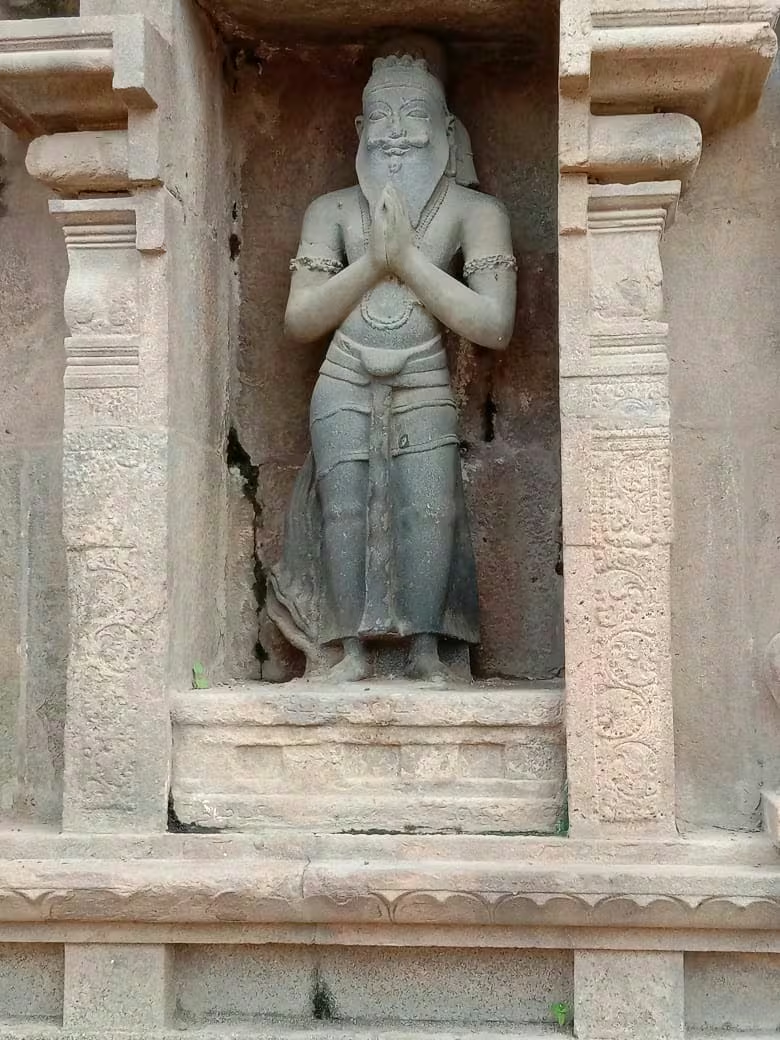
Kulothunga III: The Last Roar of the Chola Tiger
In the grand, sweeping tapestry of Indian history, the Chola dynasty of Southern India stands as a titan. For over four centuries, they were the subcontinent's dominant military, economic, and cultural force, their influence stretching from the river Ganges to the shores of Sumatra. But all empires, no matter how mighty, must face their twilight. The man who presided over the final, brilliant blaze of Chola glory before the long night set in was Emperor Kulothunga Chola III. His reign, from 1178 to 1218 CE, was a paradox—a period of stunning military revival, unparalleled architectural achievement, and fierce imperial pride, which nevertheless contained the very seeds of the empire's imminent collapse. He was, in every sense, the last great Chola.
An Uncertain Dawn: The Rise to Power
Kulothunga III ascended the Chola throne in 1178 CE, succeeding Rajadhiraja II. The political climate he inherited was a far cry from the unshakeable dominance of his imperial ancestors like Rajaraja I or Rajendra I. The Chola state had been rocked by internal succession disputes and the growing assertiveness of its feudatories. His immediate predecessor, Rajadhiraja II, had only secured his throne through the loyal and powerful intervention of his subordinate, Pallavarayar.
Critically, the precise parentage and lineage of Kulothunga III remain one of the unresolved questions of Chola history. Inscriptions from his reign are unusually silent on his direct ancestry, a stark departure from the detailed genealogies often provided by Chola monarchs. While he was undoubtedly of royal blood and the chosen heir, his exact relationship to Rajadhiraja II is not documented. This ambiguity suggests a complex political landscape where the direct line of succession may have been broken, and the choice of ruler depended on a combination of lineage, ability, and the support of powerful court factions. What is certain is that from the moment he took the title of Parakesari, Kulothunga III proved he was not merely a placeholder, but a ruler of immense ambition and formidable will.
Career & Major Contributions: The Resurgent Empire
Kulothunga's four-decade reign was defined by relentless military campaigning and a profound devotion to art and religion. He was a warrior-king in the classical Chola mould, determined to restore the empire's flagging prestige and bring its rebellious vassals to heel.
The Pandya Wars: A Cycle of Subjugation
The central and most defining conflict of his reign was against the Pandya dynasty of Madurai. The Pandyas, long-time rivals of the Cholas, had begun to reassert their independence, challenging the imperial authority. Kulothunga III met this challenge with overwhelming force in a series of three major wars.
The First Campaign (c. 1182 CE): Early in his reign, the Pandya ruler Vira Pandya openly defied Chola suzerainty. In response, Kulothunga marshalled the Chola army and marched south. The campaign was a resounding success. Chola forces stormed and sacked the Pandyan capital of Madurai. Vira Pandya was defeated and driven into exile. In a classic display of imperial statecraft, Kulothunga did not annex the territory but instead installed a rival Pandya claimant, Vikrama Pandya, on the throne as a loyal vassal. To commemorate this victory, he adopted the proud title Maduraiyum Pandiyan muduthalaiyum kondaruliya — "He who was pleased to take Madurai and the crowned head of the Pandya."
The Second Campaign (c. 1190 CE): Peace was short-lived. Following Vikrama Pandya's death, his successor, Jatavarman Kulasekhara I, once again tested the limits of Chola power. Kulothunga, now a seasoned commander, launched a second invasion. The outcome was the same. The Pandya forces were crushed, and Jatavarman Kulasekhara was forced to submit, reaffirming his status as a Chola feudatory.
The Third and Final Campaign (c. 1205 CE): This campaign would prove to be the most consequential. Jatavarman Kulasekhara was succeeded by his fiercely ambitious younger brother, Maravarman Sundara Pandya. He refused to pay tribute, provoking the final Chola invasion. Kulothunga, now in the later years of his reign, unleashed the full might of his empire. The Chola army swept through the Pandya country, sacking Madurai with a fury that surpassed previous campaigns. Coronation halls were demolished, and ancient fortifications were razed. Sundara Pandya fled for his life.
It was here that Kulothunga made a fateful decision. After Sundara Pandya offered his complete and total submission, the Chola emperor, in an act of what he may have considered imperial magnanimity, restored the Pandya kingdom to him. While this act was consistent with the Chola policy of maintaining subordinate rulers rather than direct annexation, it allowed a deeply humiliated and vengeful enemy to survive and rebuild. This single act of clemency would have catastrophic consequences for the Chola empire after Kulothunga's death.
Campaigns Across the Peninsula
Beyond the Pandya lands, Kulothunga’s armies were constantly on the move, asserting Chola dominance across Southern India.
- Against the Cheras: He waged a successful war against the Chera rulers of Venad (in modern-day Kerala), compelling them to pay tribute and acknowledge his supremacy.
- In Sri Lanka: The Cholas had long-standing interests in the island of Lanka. Kulothunga launched a successful expedition to quell rebellions and re-establish Chola influence, which had waned after the reign of the powerful Sinhalese king Parakramabahu I.
- Confronting the Hoysalas: To the west, the Hoysala kingdom of Dwarasamudra was emerging as a major power under the capable King Veera Ballala II. Initial conflicts between the two empires eventually gave way to a pragmatic political and matrimonial alliance. This strategic pivot, recognizing the Hoysalas as a peer power, was crucial for maintaining the balance of power in the Deccan and would play a vital role in the politics of the subsequent generation.
The Great Builder: A Legacy in Stone
While his military victories were spectacular, Kulothunga III’s legacy is equally defined by his contributions to art and architecture. He was one of the most prolific temple-builders of the Chola dynasty, and his reign marked the final, magnificent phase of Dravidian architectural evolution.
His crowning achievement is the magnificent Kampahareswarar Temple at Tribhuvanam, near modern-day Kumbakonam. This temple, dedicated to Shiva, is a treasure of later Chola art. Its soaring vimana (main tower) is a testament to the engineering genius of the era, while its walls are covered in exquisitely detailed sculptures. The intricate narrative panels depicting scenes from the Ramayana are particularly noteworthy, showcasing a dynamism and artistic flair that is breathtaking even today. The temple stands alongside the great Chola temples of Thanjavur, Gangaikonda Cholapuram, and Darasuram as a UNESCO World Heritage Site.
He also commissioned the Sarpeswarar (or Sarabhapureeswarar) Temple, also in Tribhuvanam. This temple is dedicated to the Sarabha form of Shiva—a mythical part-lion, part-bird creature who, according to Puranic lore, pacified the fierce Narasimha avatar of Vishnu. The popularization of this myth during his reign is seen by some historians as a symbolic representation of his own power in vanquishing formidable foes.
Beyond these new constructions, Kulothunga III undertook massive renovations and expansions of many of the most sacred shrines in the Tamil country. He made significant additions to the great temple complexes at Chidambaram, the spiritual heart of Shaivism, as well as to the temples at Thanjavur, Srirangam, Kanchipuram, and Tiruvidaimarudur. His inscriptions are found far and wide, recording grants of land, gold, and cattle, demonstrating his deep piety and his role as the supreme patron and protector of the faith.
Legacy & Influence: The Twilight of an Empire
Kulothunga Chola III died in 1218 CE after a long and glorious reign of forty years. He left behind an empire that was, on the surface, as powerful and prosperous as ever. He had successfully tamed every one of his enemies, expanded Chola political influence, and enriched the kingdom with monumental works of art. He was, without question, the last Chola emperor to wield true, unassailable imperial power.
However, the brilliance of his reign masked a gathering storm. His brutal sacking of Madurai had sown a deep and abiding hatred in the heart of the Pandya dynasty. His fateful decision to restore Maravarman Sundara Pandya to the throne created an enemy who was simply biding his time. Just a year after Kulothunga's death, in 1219 CE, Sundara Pandya exacted his revenge. He invaded the Chola country, defeated Kulothunga's inexperienced successor Rajaraja III, and subjected the Chola capital to the same humiliating destruction that he had suffered.
This catastrophic defeat marked the beginning of the end. The Chola empire would never recover its former glory. It entered a period of rapid decline, becoming a pawn in the power struggles between the ascendant Pandyas and the Hoysalas, until it was finally extinguished later in the 13th century.
Kulothunga III is thus remembered as a tragic and monumental figure. He stands as a testament to the idea that the strength of a single, brilliant ruler cannot always halt the inexorable tides of history. He was a masterful general, a devout patron, and a proud emperor who held his empire together through sheer force of will. His temples still stand as silent, magnificent witnesses to the final, spectacular flourish of Chola power—the last mighty roar of a tiger before the fall of night.