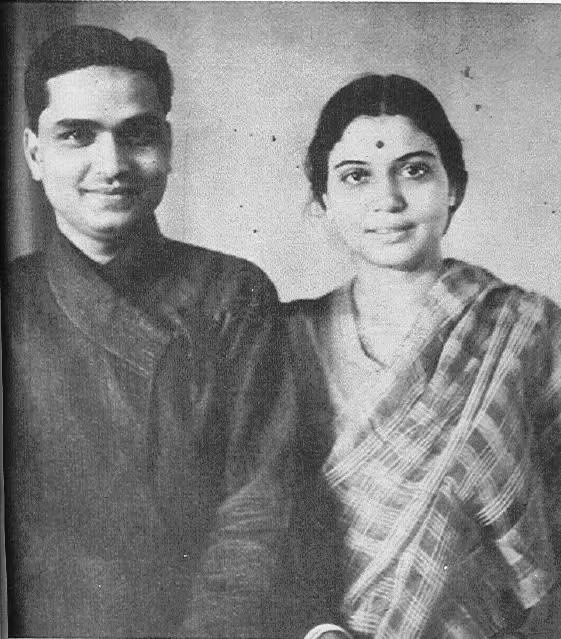
The Uncaged Voice: Kumar Gandharva's Revolution in Sound
In the hallowed, often rigid world of Hindustani classical music, where tradition (parampara) is paramount and lineage (gharana) is identity, one voice dared to sing a different song. It was a voice that had been silenced by fate, only to return with the raw, untamed power of the earth itself. This was the voice of Pandit Kumar Gandharva, a name that translates to 'celestial musician', a title he would spend a lifetime redefining on his own terms. He was not just a singer; he was a musical philosopher, a rebel who broke the cage of convention to let the spirit of his music soar free.
The Prodigy from Sulebhavi
Born Shivaputra Siddharamayya Komkali on April 8, 1924, in Sulebhavi, near Belgaum in present-day Karnataka, the boy was a phenomenon from the start. He was a true child prodigy (baal gayak), demonstrating an uncanny ability to replicate complex musical phrases sung by the masters of the day after hearing them just once. His father, a musician himself, recognized the divine spark in his son. By the age of ten, Shivaputra was already performing on stage, astonishing audiences and seasoned artists alike with his precocious talent.
It was at a music conference in Bombay that his genius was formally christened. After a stunning performance, the young boy was hailed as "Kumar Gandharva"—a young celestial singer. The name stuck, becoming the identity of a musician who would indeed bring a heavenly, yet deeply earthly, quality to his art.
Unlike many of his contemporaries who were born into established musical families and inherited a specific gharana, Kumar Gandharva's training was uniquely modern and intellectual. He was sent to Bombay to study under the tutelage of Professor B. R. Deodhar at his School of Indian Music. Deodhar was not a traditional ustad but a scholar and an open-minded guru. In this environment, Kumar Gandharva was exposed to the finest intricacies of various gharanas—Gwalior, Agra, and Jaipur—without being dogmatically bound to any single one. His primary training was in the Gwalior style, but his education under Deodhar encouraged critical thinking and analysis, planting the seeds of the innovator he was destined to become.
The Silence and the Soil of Dewas
Just as his career was reaching its zenith in the mid-1940s, tragedy struck. Kumar Gandharva, then in his early twenties, was diagnosed with a severe case of tuberculosis. The doctors delivered a devastating verdict: he would likely never sing again. To save his life, one of his lungs had to be rendered inactive. The soaring voice of the celestial musician was abruptly silenced.
On medical advice, he moved from the humid climes of Bombay to the dry, arid landscape of Dewas in Madhya Pradesh. This move, born of a medical necessity, would become the single most transformative event of his musical life. The years that followed—nearly half a decade of forced silence—were not a period of emptiness but of profound listening and introspection.
Unable to practice his art, he turned his ear to the world around him. He listened to the winds sweeping across the Malwa plateau, the calls of street vendors, the rhythmic sounds of daily village life, and, most importantly, the folk music of the region. He absorbed the songs of the farmers, the wandering minstrels, and the spiritual poetry of Kabir, Surdas, and Meera sung in the villages. In this period of quiet contemplation, Kumar Gandharva deconstructed the very essence of music. He began to question the ornamental nature of classical forms and sought the dhun ugam—the very source of a melody. He realized that the sophisticated ragas of the classical tradition had their roots in these simple, powerful folk tunes. The soil of Malwa was seeping into his artistic soul.
Against all odds, Kumar Gandharva recovered. When he began to sing again, with the power of just one lung, his voice was not what it once was. It was transformed. The smooth, flowing virtuosity of his youth was replaced by something more profound: a voice that was raw, powerful, and imbued with an intense, piercing honesty. It was a voice chiselled by silence, carrying the weight of his struggle and the wisdom of his quiet years.
A New Music: The Kumar Gandharva Gharana
When Kumar Gandharva returned to the concert stage, he brought with him a revolution. He refused to be a mere custodian of tradition; he became its interrogator and innovator. He is often credited with founding his own school of thought, a virtual "Kumar Gandharva Gharana" defined not by lineage but by a unique aesthetic and philosophy.
His major contributions were radical and reshaped the landscape of Hindustani classical music:
1. The Primacy of the Word (Sahitya): Traditionally, the lyrics (bandish) in khayal singing often served as a mere vessel for melodic and rhythmic improvisation. Kumar Gandharva challenged this. He believed that the word and its emotion (bhava) were inseparable from the melody. He delved deep into the poetry of his compositions, letting the meaning of the words dictate the musical phrasing and emotional delivery. His renditions were not just displays of vocal acrobatics but profound expressions of the poetic text.
2. The Fusion of Folk and Classical: His most enduring legacy is the bridge he built between the classical stage and the folk traditions of the Malwa region. He composed a series of "Dhun Ugam Ragas," ragas directly inspired by or based on folk melodies. He took the Nirguni bhajans of Kabir, with their profound, earthy philosophy, and presented them with such power and authenticity that they became synonymous with his name. His rendition of "Ud Jayega Hans Akela" (The Swan Will Fly Away Alone) is not just a bhajan; it is a stark, moving meditation on mortality that transcends genre.
3. Thematic Concerts: Kumar Gandharva was a master curator. Instead of presenting a random assortment of ragas, he often structured his concerts around specific themes or seasons, creating a cohesive artistic experience. He created celebrated musical series like Geet Varsha (songs of the monsoon), Geet Hemant (songs of autumn), and Triveni (exploring the poetry of Surdas, Kabir, and Meera). This intellectual approach to performance was pioneering.
4. Creation of New Ragas: An intrepid explorer of melody, he composed a host of new ragas, including Sanjari, Malavati, and Lagan Gandhar. He meticulously documented these compositions in his book, Anup Rag Vilas, providing a grammar for his new musical ideas.
5. A Unique Vocal Style: His singing was marked by its directness and dynamism. He employed short, powerful bursts of notes, often described as goli ki tarah taan (taans like a bullet). There was no unnecessary ornamentation; every note was packed with intent and emotion. His voice could be tender and introspective one moment, and fiercely powerful the next, reflecting the vast emotional landscape of his music.
Legacy of a Fearless Innovator
Pandit Kumar Gandharva passed away on January 12, 1992, but his influence remains indelible. He was a modernist who demonstrated that tradition is not a static monument but a living, breathing entity that must evolve to retain its vitality. He taught generations of musicians that true artistry lies not in imitation but in individual expression (vichar).
His historical significance is immense. He challenged the hegemony of the gharana system, empowering individual artists to find their own voice. By elevating folk music, he democratized the classical space and reminded the world that the most sophisticated art forms are often nourished by the simplest roots. His life story—a prodigy struck down by illness who returned to change the face of music—is a powerful testament to the resilience of the human spirit.
He was honored with India's highest civilian awards, including the Padma Bhushan in 1977 and the Padma Vibhushan in 1990. Today, he is remembered as a fearless genius, a musical intellectual, and a voice that captured the very soul of India. His home in Dewas has become a pilgrimage site for music lovers, and his legacy is carried forward by his wife and fellow musician, the late Vasundhara Komkali, his son Mukul Shivputra, his daughter Kalapini Komkali, and a lineage of students. His recordings continue to be studied, not as relics of the past, but as living lessons in courage, creativity, and the relentless pursuit of truth in art.