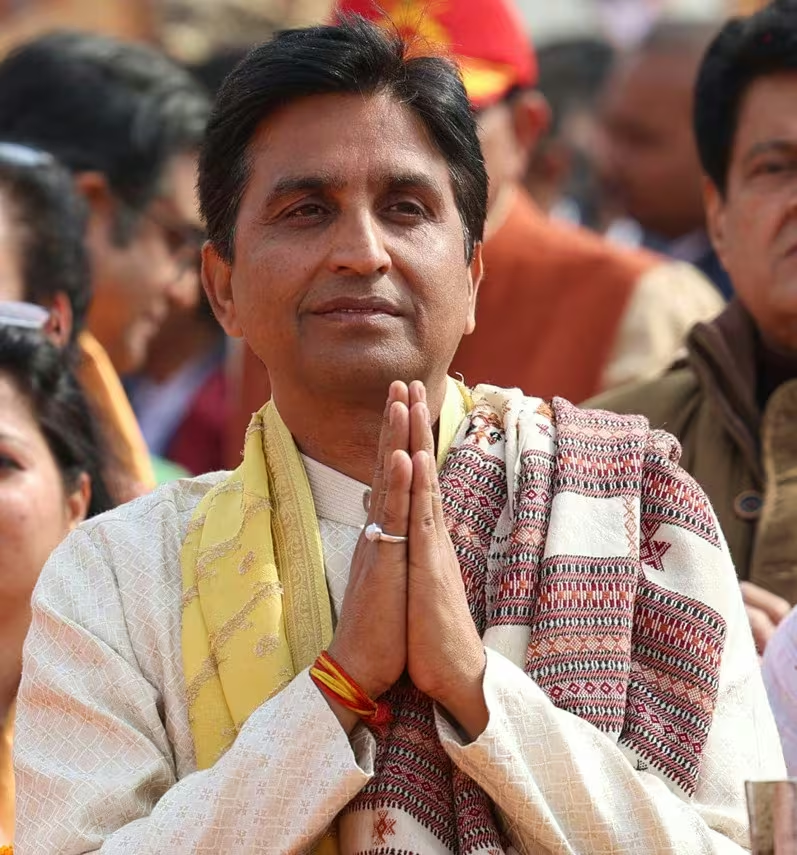
Kumar Vishwas - The People's Poet
In the vast and varied landscape of contemporary Indian culture, few figures have carved a niche as unique and influential as Kumar Vishwas. He is a man of many parts: a poet whose verses on love and longing became an anthem for a generation, a performer who transformed the traditional poetry recital into a stadium-filling spectacle, a fiery orator who played a key role in a major political movement, and a storyteller who brings ancient epics to life for a modern audience. More than a mere writer, Vishwas is a cultural phenomenon, a bridge between the classical gravitas of Hindi literature and the dynamic pulse of 21st-century India. His journey from a small town in Uttar Pradesh to global stages is a compelling narrative of passion, ambition, and the enduring power of the spoken word.
Early Life & Background
Born on February 10, 1970, in the town of Pilkhuwa in Uttar Pradesh, Kumar Vishwas was named Vishwas Kumar Sharma. His father, Dr. Chandra Pal Sharma, was a lecturer, and his mother, Rama Sharma, a homemaker. Growing up in a middle-class Brahmin family, education was paramount, but young Vishwas was drawn more to the world of words and verses than to the sciences. His father dreamt of him becoming an engineer, a common aspiration for bright students of his generation.
Following his family's wishes, Vishwas initially enrolled in an engineering course. However, his heart was not in circuits and mechanics; it was in the rhythm and metre of poetry. In a decisive act of self-determination, he left his engineering studies midway, choosing to follow his true calling. This pivot was a defining moment, setting him on a path that would reshape the landscape of popular Hindi poetry.
He enrolled for a Bachelor of Arts and subsequently pursued a Master's degree in Hindi Literature. It was during these formative years in college that his talent for oratory and poetry began to shine. He became a formidable presence in debates and poetry competitions, honing the charismatic stage presence that would later become his hallmark. To ground his passion in academic rigor, he went on to earn a PhD from Chaudhary Charan Singh University. His doctoral thesis, titled "Kauravi Lokgeeton Mein Lokchetna" (Public Consciousness in Kauravi Folk Songs), reflected a deep-seated interest in the roots of vernacular culture and folk traditions, a theme that would subtly inform his later works.
In 1994, his academic journey led him to a career as a lecturer in Hindi literature in Rajasthan. For years, he balanced the life of an academic with his burgeoning passion for poetry, performing at local and national Kavi Sammelans (poetic gatherings). Little did the world know that this unassuming professor was on the cusp of single-handedly revolutionizing this age-old tradition.
Career & Major Contributions
Kumar Vishwas's career is a tapestry woven from three distinct yet interconnected threads: poetry, politics, and media. Each phase saw him capture the public imagination in a different capacity, yet all were fueled by his exceptional command over language and his innate ability to connect with the masses.
The Poet-Performer: Revitalizing the Kavi Sammelan
The late 20th and early 21st centuries saw the traditional Kavi Sammelan losing its appeal, especially among the youth. It was often perceived as a formal, staid affair. Kumar Vishwas changed that entirely. He infused it with energy, wit, and a contemporary sensibility. His performances were not mere recitations; they were theatrical events. He would stride across the stage, modulating his voice, using humor, satire, and poignant emotion to hold audiences of thousands spellbound for hours.
His poetic style was the key to his mass appeal. He primarily writes in Shringaar Ras (the romantic sentiment), but his poetry is shorn of inaccessible, heavily Sanskritized Hindi. Instead, he employs a fluid, conversational language, weaving in common Urdu words, that resonates deeply with the modern listener. His themes are universal—love, heartbreak, nostalgia, patriotism, and social critique—but his expression is uniquely his own.
His magnum opus, the poem that catapulted him from a popular poet to a national sensation, is "Koi Deewana Kehta Hai, Koi Paagal Samajhta Hai" (Some call me a crazed lover, some think I am insane). The poem, a lyrical exploration of the complexities of love and perception, became a veritable anthem for young Indians. In the pre-social media era, it spread virally through cassettes, CDs, and mobile phone ringtones before conquering YouTube. Its simple yet profound lines captured the angst and romance of an entire generation.
Kumar Vishwas transformed the Hindi poet from a niche literary figure into a mainstream celebrity, a 'rockstar'. He became a global ambassador for Hindi poetry, performing to sold-out auditoriums in over a hundred cities across the world, from the USA and UK to Dubai, Singapore, and Japan.
The Political Activist: Idealism and Disenchantment
In 2011, as the India Against Corruption (IAC) movement, led by Anna Hazare, swept across the nation, Kumar Vishwas stepped off the poetic stage and onto the political one. His fiery, patriotic, and often poetic speeches galvanized the crowds that gathered at Ramlila Maidan in Delhi. He, along with Arvind Kejriwal, Manish Sisodia, and others, became a core member of the movement that promised to cleanse Indian politics.
When the movement transitioned into a political party, the Aam Aadmi Party (AAP), in 2012, Vishwas was one of its most prominent founders and star campaigners. His ability to draw massive crowds and his powerful oratory were invaluable assets for the fledgling party. He was appointed to its National Executive and was a key voice in its initial, meteoric rise.
His political career reached its zenith during the 2014 Lok Sabha elections when he was chosen to contest from the high-profile constituency of Amethi, a bastion of the Gandhi family. He ran a spirited campaign against Congress's Rahul Gandhi and the BJP's Smriti Irani. Though he ultimately lost the election, his campaign was a testament to his popularity and his fearless political ambition.
However, his journey in active politics was short-lived. Over the next few years, ideological and personal rifts began to emerge between him and the AAP leadership, particularly Arvind Kejriwal. Vishwas became a vocal critic of what he perceived as a departure from the party's founding principles. The differences came to a head in 2018 over nominations to the Rajya Sabha (the upper house of the Indian Parliament), where Vishwas felt he was unjustly overlooked. His public expressions of dissent, often laced with poetic sarcasm, led to his complete estrangement from the party he helped build. He has since withdrawn from electoral politics, often remarking that he remains an activist but has left the political arena.
The Media Personality & Storyteller
After stepping back from politics, Kumar Vishwas masterfully reinvented himself, leveraging his immense popularity in the media and digital space. He became a familiar face on television, appearing as a guest judge on shows like Indian Idol and hosting his own successful program, KV Sammelan, on the Aaj Tak news channel. The show was a unique blend of poetry, satire, and social commentary, bringing his signature style to a primetime audience.
He was one of the first Indian poets to recognize and harness the power of social media. His YouTube channel is a massive success, with millions of subscribers who tune in for his poetry recitations, interviews, and, most notably, his ambitious storytelling series.
His most significant recent contribution is "Apne Apne Ram" (Everyone's Own Ram). This is not just a poetry show but a grand musical production where Vishwas narrates the story of the Ramayana. Drawing from various texts, from Valmiki and Tulsidas to regional folk versions, he presents the epic not as a rigid religious text but as a profound human story. He explores the motivations and perspectives of each character—Ram, Sita, Lakshman, and even Ravana—making the ancient tale accessible and relevant to contemporary audiences. The show's success has been phenomenal, with performances held in stadiums across India and the world, cementing his status as a master storyteller.
Legacy & Influence
Kumar Vishwas's legacy is multifaceted. His most enduring impact is undoubtedly the revitalization of popular Hindi poetry. He took the Kavi Sammelan from a dwindling art form to a commercially viable, mass-market spectacle, inspiring a new generation of poets and performers who follow his template.
He crafted a new identity for the Hindi poet: one who is not confined to literary journals but is a charismatic performer, a social media influencer, and a public intellectual. He demonstrated that poetry could be both intellectually stimulating and wildly entertaining.
His foray into politics, though tumultuous, is also a significant part of his story. It represents a moment in Indian history when artists and activists sought to directly intervene in the political process, fueled by idealism. His subsequent disillusionment serves as a cautionary tale about the difficult marriage of art and politics.
Today, Kumar Vishwas stands as a towering figure in India's cultural sphere. He is remembered as the man who made millions fall in love with poetry again. Through "Koi Deewana Kehta Hai," he gave voice to the private emotions of a generation. Through his political speeches, he articulated their public frustrations. And through "Apne Apne Ram," he is reconnecting them with the deepest roots of their civilizational story. He is a poet, a performer, and a narrator of the modern Indian experience, a voice that continues to resonate with millions.