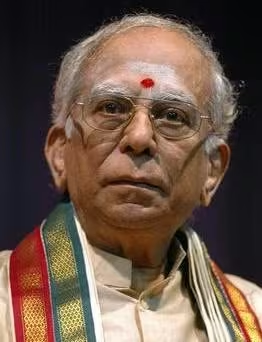
Lalgudi Jayaraman: The Violin that Sang
In the hallowed halls of Carnatic music, the violin, an instrument of European origin, found its most authentic and soulful Indian voice in the hands of one man: Lalgudi Gopala Iyer Jayaraman. He was not merely a violinist; he was a revolutionary, a composer of sublime genius, and the architect of a style so profound and lyrical that it became a school in itself. To listen to Lalgudi Jayaraman was to hear the violin transcend its mechanical form and sing with the emotional depth and intricate ornamentation of the human voice. His life, spanning from September 17, 1930, to April 22, 2013, represents a golden chapter in the history of Indian classical music, a testament to relentless discipline, profound artistry, and a legacy that continues to resonate through the strings of countless musicians today.
Early Life: Forged in the Crucible of Lalgudi
Lalgudi Jayaraman was born in the town of Lalgudi, near the banks of the Kaveri river in the Tiruchirappalli district of Tamil Nadu. This region, the heartland of the old Chola empire, was a fertile ground for Carnatic music, having nurtured countless musicians and composers. Jayaraman was born into this legacy. He was a fifth-generation descendant of the musical lineage of Lalgudi Rama Iyer, a direct disciple of the great saint-composer Tyagaraja. Music was not a choice; it was his inheritance, his environment, and his destiny.
His father and guru, V. R. Gopala Iyer, was a formidable musician and a disciplinarian of the old school. Recognizing the prodigious talent in his young son, Gopala Iyer initiated him into the rigorous world of Carnatic music at a tender age. The training was relentless. Jayaraman’s days were filled with hours of arduous practice, mastering the fundamentals of swara (notes), laya (rhythm), and sahitya (lyrics). His father instilled in him an uncompromising quest for perfection, a quality that would define Jayaraman’s music throughout his life. There were no shortcuts in this tutelage; every gamaka (ornamentation) had to be precise, every note pure, and every phrase imbued with the correct bhava (emotion).
This intense training, combined with his innate genius, saw the young Jayaraman make his concert debut as a violin accompanist at the astonishing age of twelve. The Carnatic world, then dominated by titans, began to take notice of this young prodigy whose violin seemed to be an extension of his very being.
The Art of Accompaniment: A Master in the Making
Before he became a celebrated soloist, Lalgudi Jayaraman spent decades as one of the most sought-after accompanists in Carnatic music. This was his finishing school, where he shared the stage with every legendary vocalist of the era, including Ariyakudi Ramanuja Iyengar, Chembai Vaidyanatha Bhagavatar, Semmangudi Srinivasa Iyer, G. N. Balasubramaniam, and Madurai Mani Iyer.
His accompaniment was a revelation. He did not simply follow the main artist; he anticipated, complemented, and elevated their performance. His violin would echo the vocalist's phrases with uncanny fidelity, provide a beautiful and supportive melodic canvas during their improvisations, and engage in brilliant, sharp-witted rhythmic exchanges. He developed an extraordinary ability to grasp the essence of each vocalist's unique style and adapt his playing, making him the accompanist of choice for the masters. This period honed his skills, deepened his musical understanding, and gave him an encyclopedic knowledge of the Carnatic repertoire.
The Lalgudi Bani: A Revolution in Sound
It was from this deep well of experience that Lalgudi Jayaraman forged his own unique and revolutionary style of playing—the Lalgudi Bani. This was his single greatest contribution to Carnatic music, a paradigm shift that redefined the role and potential of the violin.
The cornerstone of the Lalgudi Bani is the concept of 'Gayaki Ang'—the vocal style. Jayaraman believed that the violin's ultimate purpose in Carnatic music was to emulate the human voice, the original and most expressive of all instruments. He developed innovative bowing and fingering techniques to replicate the subtle glides, slides, and oscillations (gamakas) that are the soul of Carnatic melody. Under his fingers, the violin did not just play notes; it sang the lyrics (sahitya), articulated the emotional content (bhava), and captured the very breath of a vocal performance.
His music was characterized by several distinct features:
- Tonal Purity: An unwavering clarity and sweetness of tone, where every note was perfectly pitched and resonated with crystalline purity.
- Lyrical Grace: A seamless, flowing quality that connected notes into beautiful, coherent melodic phrases, mirroring the cadence of sung poetry.
- Rhythmic Brilliance: A masterful command over rhythm, marked by precision, intricate patterns, and an innate sense of aesthetics. His rhythmic improvisations were both intellectually stimulating and delightful to the ear.
- Intellectual Depth: A profound understanding of the architecture of each raga. He could explore its depths with imagination and authority, revealing new and beautiful facets without ever transgressing its traditional boundaries.
This new style elevated the violin from an accompanying instrument to a solo instrument of immense power and sophistication. Lalgudi Jayaraman's solo concerts became legendary, drawing massive crowds who came to witness the magic of his singing violin.
The Composer's Canvas
Jayaraman's genius was not limited to performance. He was also a composer of extraordinary merit. He enriched the Carnatic repertoire with a stunning array of compositions, particularly his Thillanas and Varnams, which are now staples in both music concerts and Bharatanatyam dance performances.
His Thillanas—rhythmically vibrant and melodically captivating pieces—are considered modern classics. Compositions in ragas like Desh, Mohanakalyani, Madhuvanti, and Revati are celebrated for their intricate rhythmic structures, sparkling melodic runs, and sheer joyfulness. They are a perfect blend of technical challenge and aesthetic beauty.
He also composed several Tana Varnams and Pada Varnams, including the exquisite and highly popular Varnam in the raga Nalinakanthi, 'Neeve Gathiyani'. His compositions, like his playing, are marked by elegance, structural perfection, and a deep-rooted classicism.
In 2006, his genius as a composer received national recognition when he won the National Film Award for Best Music Direction for the period film Sringaram, a remarkable achievement for a classical artist in the cinematic world.
A Global Ambassador
Lalgudi Jayaraman was a true cultural ambassador for India. He was one of the first Carnatic musicians to present its sophisticated beauty to audiences across the world. He performed at prestigious venues and festivals, including the Edinburgh Festival in Scotland.
One of the most famous anecdotes of his international career involves the legendary Western classical violinist Yehudi Menuhin. When Menuhin heard Jayaraman play in Germany in 1965, he was so moved by the performance that he came backstage, presented Jayaraman with his own expensive Italian violin, and famously remarked, “I have not heard such music or such a violinist in all my 40 years of concert experience.” This high praise from one of the 20th century's greatest musicians was a testament to Jayaraman's universal appeal and unparalleled artistry.
Legacy: The Unbroken Melody
Lalgudi Jayaraman’s legacy is monumental and multi-faceted. He was a recipient of India’s highest civilian honors, the Padma Shri (1972) and the Padma Bhushan (2001). In 1986, he was awarded the most prestigious title in Carnatic music, the Sangita Kalanidhi, by the Music Academy, Madras.
His most enduring legacy is the Lalgudi Bani itself, which he passed on meticulously to his children—violinists Lalgudi G. J. R. Krishnan and Lalgudi Vijayalakshmi—who are today the torchbearers of his style. He also trained a host of other disciples, ensuring that his school of violin playing continues to flourish.
He is remembered not just as a virtuoso but as a Nada Rishi—a sage of sound. He was a perfectionist who dedicated his entire life to the pursuit of musical excellence. His music was a form of meditation, a spiritual offering that was at once intellectually profound and emotionally overwhelming. Lalgudi Jayaraman taught the world that the four strings of a violin could contain the vast, timeless ocean of Indian classical music, singing its stories of devotion, beauty, and the eternal quest for the divine.