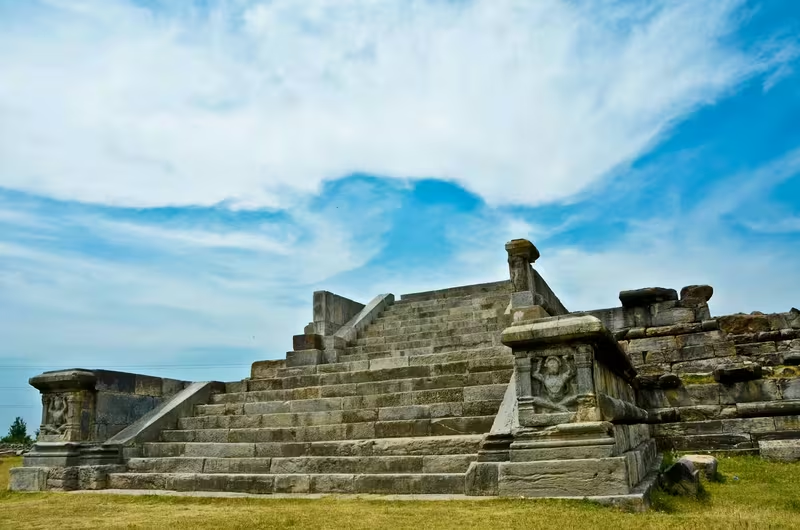
The Sun King of Kashmir: The Imperial Legacy of Lalitaditya Muktapida
In the grand tapestry of Indian history, certain figures blaze with such brilliance that their light continues to illuminate the ages. One such sovereign was Lalitaditya Muktapida, the emperor of Kashmir whose name, for a brief, glorious period in the 8th century, was synonymous with absolute power. Ruling from the heart of the Himalayas, he forged an empire that stretched from Central Asia to the Gangetic plains, yet his legacy is cemented not just in conquest, but in stone. He was a warrior-king, a master diplomat, and a monumental builder whose reign represents the zenith of Kashmiri glory, a golden age chronicled for posterity in the verses of the 12th-century historian Kalhana's Rajatarangini (The River of Kings).
While Kalhana’s account often weaves historical fact with poetic embellishment, it remains the principal window into the life of this extraordinary ruler. Through it, and corroborated by other sources, emerges the portrait of a king whose ambition reshaped the political map of his time and left behind architectural marvels that continue to defy it.
Early Life & The Karkota Inheritance
Lalitaditya ascended the throne of the Karkota dynasty around 724 CE. He was the youngest son of King Durlabhaka-Pratapaditya II, and his path to power was not immediate. He followed the reigns of his two elder brothers, Chandrapida and Tarapida, whose rule was marked by a mix of piety and tyranny. When Lalitaditya finally took control, he inherited a kingdom that was already a significant regional power, established by his ancestor Durlabhavardhana in the 7th century.
Kashmir, during this period, was not an isolated mountain kingdom. It was a strategic crossroads, a vibrant hub where intellectual, religious, and commercial currents from India, Tibet, China, and Central Asia converged. The Karkotas had positioned it as a center of Sanskrit learning and Shaivite philosophy. However, the world Lalitaditya inherited was fraught with peril. The powerful Tang Dynasty of China exerted influence from the east, the formidable Tibetan Empire was aggressively expanding from the north, and the Arab Caliphates were pressing in from the west. Survival, let alone supremacy, required a leader of exceptional vision and military genius. Lalitaditya would prove to be that leader.
Career & Major Contributions: The Conqueror, Diplomat, and Builder
Lalitaditya’s reign, spanning nearly four decades, was a whirlwind of ceaseless activity. His ambition was not merely to defend Kashmir, but to project its power across the known world. His career can be understood through his three defining roles: the unyielding conqueror, the shrewd diplomat, and the visionary builder.
The World Conqueror: The Campaigns of a Military Genius
Kalhana dedicates a significant portion of his chronicle to Lalitaditya’s digvijaya, a traditional 'conquest of the world'. While the sheer scale described may be a product of epic poetry, the core events highlight a series of brilliant military campaigns that fundamentally altered the geopolitics of 8th-century India.
His most significant and historically corroborated campaign was against Yashovarman, the powerful ruler of Kannauj, the imperial heartland of northern India. Initially forming an alliance, the two rulers campaigned together, but their relationship soon soured. The ensuing conflict saw Lalitaditya emerge victorious, decisively defeating Yashovarman and annexing his vast territories. This victory made Lalitaditya the undisputed master of northern India, a feat no Kashmiri king had ever achieved.
From this pivotal victory, Kalhana describes a grand sweep across the subcontinent. Lalitaditya’s armies are said to have marched east, subjugating the kingdoms of Gauda (Bengal), Kalinga (Odisha), and the southern realms of the Karnatas, who were then ruled by the Chalukyas. His campaign then reportedly turned west, moving through Avanti (Malwa) and marching across the sands to Dwarka (Gujarat). While modern historians debate the extent and permanence of these conquests, the account in the Rajatarangini paints a picture of a king with continental ambitions, whose army was a multi-ethnic force drawn from the very lands he subdued.
Beyond the Indian subcontinent, Lalitaditya’s military focus was on the formidable powers of Central Asia. He pushed north into the territories of the Turks (Turushkas) and the Dardas, securing Kashmir’s frontiers. His most crucial struggle was against the Tibetan Empire (Bhauttas), whose expansion posed a direct threat. Lalitaditya inflicted several defeats upon them, checking their advance and securing the remote, high-altitude regions of Ladakh and Baltistan. This northern campaign was not just for glory; it was a strategic masterstroke to secure the vital trade routes that passed through the region.
The Astute Diplomat: The Alliance with Tang China
Lalitaditya understood that military might alone was not enough. In a world of shifting alliances, diplomacy was a crucial weapon. His most notable diplomatic achievement was forging a strategic alliance with the Tang Dynasty of China. The official Chinese chronicle, the Tangshu (New Book of Tang), records that an embassy from the king of Kashmir, identified as “Mu-to-pi” (Muktapida), arrived at the court of the great Emperor Xuanzong.
Lalitaditya presented himself as a vassal to the Tang Emperor, a common diplomatic practice of the time to secure an alliance with a superpower. He reported his victories over the Tibetans and requested a formal alliance against their mutual foe. The Emperor acknowledged his request, conferred upon him the title of 'King', and recognized him as a key partner in Central Asia. This alliance provided Kashmir with immense prestige and a powerful ally, effectively creating a pincer movement against the Tibetan Empire.
The Visionary Builder: A Legacy in Stone
If his conquests were ephemeral, his architectural legacy was eternal. Flush with the immense wealth and resources from his campaigns, Lalitaditya embarked on an ambitious building program that transformed the Kashmiri landscape. He was not just a patron; he was a founder of cities and a creator of monumental art.
His magnum opus is the spectacular Martand Sun Temple. Perched on a plateau with a breathtaking view of the Kashmir valley, this temple dedicated to Surya (the Sun God) was an architectural marvel. It represented a sublime fusion of diverse styles—the Gandharan art of the northwest, the classical Gupta traditions of the Indian plains, and even echoes of Chinese and Roman design in its colonnades. With its grand central shrine, imposing gateway, and a vast peristyle courtyard lined with 84 smaller shrines, Martand was a statement of imperial power and profound devotion. Though now in ruins, its scale and artistry continue to astound visitors, a silent testament to the genius of its creator.
Lalitaditya also founded a new capital, Parihasapura, the 'City of Laughter', near modern-day Srinagar. Kalhana describes it as a city of unparalleled splendor, filled with grand temples and monasteries. He built massive shrines dedicated to Vishnu in his various forms, installing colossal images of the deities made of gold and silver. Reflecting his religious tolerance, he also constructed the magnificent Rajavihara, a Buddhist monastery, and several stupas, making his capital a center for both Hindu and Buddhist worship.
Legacy & Influence: The Sun Sets on a Golden Age
Lalitaditya Muktapida’s reign of nearly 37 years (c. 724 – 760 CE) was the undisputed high-water mark of Kashmiri power. He elevated a regional kingdom to the status of a pan-Indian empire, a feat that would never be repeated.
His historical significance lies in his ability to masterfully combine military conquest with strategic diplomacy and cultural patronage. He secured Kashmir from foreign threats and projected its influence far beyond its mountain borders. His campaigns checked the advance of the Tibetan Empire and established a balance of power in a volatile region.
His lasting impact on Indian culture is most profoundly felt through his architectural contributions. The Martand Sun Temple became the pinnacle of the Kashmiri architectural style, influencing temple construction in the region for centuries. The ruins of Parihasapura and Martand are among the most important archaeological sites in India, offering invaluable insight into the art, religion, and engineering of the 8th century.
Even the end of his life is shrouded in legend. Kalhana offers two accounts of his death. One states that he perished during a difficult military expedition into the far northern lands, trapped by an untimely and heavy snowfall. Another, more dramatic version, suggests he committed ritual suicide to escape capture after being led into a treacherous, impassable territory. This ambiguity only adds to his mythic status.
After his death, the vast empire he had built with sword and strategy quickly crumbled. His successors lacked his vision and strength, and the Karkota dynasty soon fell into decline. Yet, the memory of Lalitaditya endured.
Today, Lalitaditya Muktapida is remembered as the greatest indigenous ruler in Kashmir’s long history. He is a figure of immense pride, a symbol of a time when Kashmir was not a contested periphery but the powerful center of an empire. In the wider narrative of Indian history, he stands as one of the last great classical emperors, a brilliant military strategist and a patron of the arts on par with the likes of the Guptas, whose reign was a final, dazzling burst of imperial glory before the subcontinent fragmented into the regional powers of the medieval era.