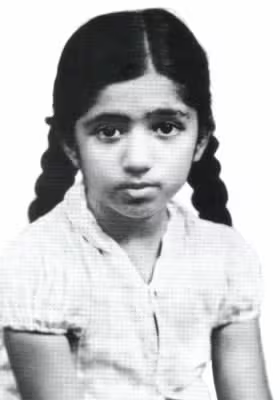
Lata Mangeshkar - The Nightingale of India (1929 - 2022)
In the grand tapestry of Indian culture, few threads are as luminous or as universally recognized as the voice of Lata Mangeshkar. For over seventy years, her singing was not merely a feature of Indian cinema; it was its soul. A voice that could convey the innocence of first love, the agony of heartbreak, the piety of a prayer, and the fierce pride of a nation, she was rightfully christened the Swar Kokila (The Singing Nightingale) and the Queen of Melody. Lata Mangeshkar was more than an artist; she was a cultural institution, a unifying sound in a nation of a billion hearts, whose legacy remains etched in the annals of modern Indian history.
Early Life & Background: The Crucible of a Maestro
Lata Mangeshkar was born Hema Mangeshkar on September 28, 1929, in Indore, then the capital of the princely Indore State in British India. Music was the very air she breathed from birth. Her father, Pandit Deenanath Mangeshkar, was a towering figure in his own right—a celebrated classical singer of the Gwalior gharana and a respected Marathi theatre actor. Her mother, Shevanti, was his second wife. Lata was the eldest of five siblings—Meena, Asha, Usha, and Hridaynath—all of whom would go on to carve their own distinguished careers in music.
Her father became her first and most influential guru. The formal training began serendipitously. As a five-year-old, Lata overheard one of her father’s students making mistakes while practicing a raga. Unafraid, she stepped in and corrected the student’s rendition, flawlessly demonstrating the intricate notes. Her father, witnessing this prodigious talent, immediately began her formal tutelage. Her days were steeped in rigorous practice, learning the nuances of classical music that would form the unshakeable foundation of her future career. Her formal schooling was brief; she reportedly attended school for only a single day, her focus dedicated entirely to the world of music and her role in her father's musical plays (Sangeet Nataks).
This idyllic world of learning was shattered in 1942 with the untimely death of her father. At the tender age of thirteen, the responsibility of providing for her mother and four younger siblings fell squarely on Lata’s young shoulders. The family’s financial situation was dire, forcing them to move from Pune to the bustling, unforgiving city of Bombay (now Mumbai).
It was Master Vinayak Damodar Karnataki, a close family friend and the owner of Navyug Chitrapat film company, who provided the Mangeshkar family with a lifeline. He took Lata under his wing, giving her small roles as an actress and singer in his Marathi films to ensure she had a steady income. Her first recorded song was "Naachu Yaa Gade, Khelu Saari Mani Haus Bhaari" for the Marathi film Kiti Hasaal (1942), though it was ultimately cut from the film. Her first publicly released song came a year later, "Mata Ek Sapoot Ki Duniya Badal De Tu," for the Marathi film Gajaabhaau (1943). The path was arduous, but the journey of India's most iconic voice had begun.
Career & Major Contributions: The Voice of a Nation
The early years in Bombay were a struggle. The Hindi film industry was dominated by robust, nasal voices like those of Shamshad Begum and Noor Jehan. Producers, including the influential Sashadhar Mukherjee, initially dismissed Lata’s voice as "too thin" and "too high-pitched." Yet, her sheer talent and perseverance could not be denied. Music director Ghulam Haider was one of her staunchest early supporters, famously telling a skeptical Mukherjee, "Let me foretell today that this girl will soon put to shame everyone else, including Noor Jehan. Producers and directors will fall at her feet and beg her to sing in their movies."
His prophecy came true in 1949. The film was Mahal, the actress was the ethereal Madhubala, and the song was "Aayega Aanewala." The song, with its haunting melody and Lata’s ethereal vocals, became a nationwide phenomenon. It was a watershed moment that catapulted her to stardom, forever changing the soundscape of Hindi film music. The era of Lata Mangeshkar had arrived.
The Golden Era (1950s - 1970s)
What followed was an unparalleled period of creative output and dominance. Lata Mangeshkar became the undisputed queen of playback singing, collaborating with every major composer of the golden age. Her voice became the on-screen voice for generations of leading ladies, from Nargis and Meena Kumari to Waheeda Rehman and Hema Malini.
Her collaborations are the stuff of legend:
With Naushad Ali: Together, they created timeless classical-based soundtracks for epics like Baiju Bawra (1952), Mother India (1957), and the magnum opus Mughal-e-Azam (1960). The defiant and passionate strains of "Pyar Kiya To Darna Kya" remain an anthem of rebellious love.
With Shankar-Jaikishan: This partnership produced an astonishing number of popular hits, defining the romantic sound of the Raj Kapoor era with films like Barsaat (1949), Awaara (1951), and Shree 420 (1955).
With S. D. Burman: A creatively fertile but famously tempestuous relationship, it yielded some of Hindi cinema’s most beloved songs. After a rift in the late 1950s, they reunited for masterpieces like Guide (1965), with songs like "Aaj Phir Jeene Ki Tamanna Hai" becoming symbols of freedom and self-discovery.
With C. Ramchandra: Their collaboration produced peppy, western-style numbers that showcased her versatility, but it was a non-film song that would immortalize their partnership.
With Madan Mohan: This was a partnership of profound mutual respect. Madan Mohan, the "King of Ghazals," found his perfect muse in Lata. Her voice brought an unparalleled depth of emotion to his intricate and soulful compositions, resulting in immortal classics like "Lag Jaa Gale" (Woh Kaun Thi?, 1964), "Naina Barse Rimjhim Rimjhim" (Woh Kaun Thi?, 1964), and "Aap Ki Nazron Ne Samjha" (Anpadh, 1962).
The Anthem that Moved a Prime Minister
On January 27, 1963, in the somber aftermath of the Sino-Indian War, Lata Mangeshkar stood on stage at the National Stadium in New Delhi. In the audience sat India’s first Prime Minister, Jawaharlal Nehru. She sang "Aye Mere Watan Ke Logo" (O' People of My Country), a poignant tribute to the soldiers who had lost their lives. Penned by Kavi Pradeep and composed by C. Ramchandra, the song’s raw emotion and her heart-rending delivery moved the entire nation. It is famously documented that Prime Minister Nehru was brought to tears. The song transcended cinema, becoming a revered patriotic anthem, a permanent fixture at national events, and a powerful reminder of sacrifice and love for the motherland.
Adapting and Enduring
As the decades passed, Lata Mangeshkar seamlessly adapted her voice to evolving musical styles. She forged powerful new partnerships with the next generation of composers. Her work with Laxmikant-Pyarelal was extraordinarily prolific, resulting in over 700 songs and countless chart-toppers. With R. D. Burman, she explored more contemporary, westernized tunes, while her collaborations with Kalyanji-Anandji and Salil Chowdhury continued to produce musical gems.
Even in the 1990s and 2000s, she remained a relevant and sought-after voice, working with composers like Anu Malik, Jatin-Lalit, and most notably, A. R. Rahman. Her song "Jiya Jale" in Rahman’s soundtrack for Dil Se.. (1998) demonstrated her incredible ability to remain timeless, her voice as pure and evocative as it was fifty years prior.
Her work was not confined to Hindi cinema. She recorded songs in over thirty-six Indian languages, with a particularly significant body of work in Marathi, her mother tongue. She also briefly ventured into music direction for Marathi films under the pseudonym Anandghan.
Legacy & Influence: The Immortal Melody
Lata Mangeshkar’s legacy is immeasurable. It is not just in the staggering, though often debated, number of songs she recorded, but in the profound and lasting impact she had on India’s cultural and social fabric.
A Unifying Voice: In a country of immense linguistic and cultural diversity, her voice became a common thread. From a radio in a remote village to a festival in a bustling metropolis, her songs were a shared experience, a source of collective joy, sorrow, and celebration. She was, in essence, the voice of post-independence India.
Elevating an Art Form: Before her, playback singers were often uncredited artisans. Lata Mangeshkar fought tirelessly for their recognition. In the 1950s, she insisted that singers' names appear on film credits and on gramophone records. Her protest against the Filmfare Awards for not having a category for playback singing led to the introduction of the Best Playback Singer award in 1959. She later championed the cause of royalties for singers, ensuring they received a share of the profits from their timeless creations.
The Benchmark of Excellence: Her technical mastery was absolute. Her perfect pitch (sur), impeccable diction, and the ability to infuse each word with the precise emotion required by the on-screen narrative set an impossibly high standard. For decades, she has been the benchmark against which every aspiring singer in India is measured.
Her contributions were recognized with India's highest honors. She received the Dadasaheb Phalke Award in 1989, the Padma Vibhushan in 1999, and in 2001, she was awarded the Bharat Ratna, India’s highest civilian award, becoming only the second vocalist to receive this honor.
When Lata Mangeshkar passed away on February 6, 2022, at the age of 92, India observed a period of national mourning. She was accorded a state funeral, an honor reserved for the highest dignitaries, as leaders and citizens from all walks of life paid tribute to the voice that had accompanied them through their lives.
Today, Lata Mangeshkar is not just remembered; she is lived. Her songs are an inseparable part of India’s collective memory—a lullaby for a child, a lover's serenade, a patriot’s hymn. Her voice, a divine gift honed by discipline and dedication, remains a timeless echo, a melody that will continue to resonate for generations to come.