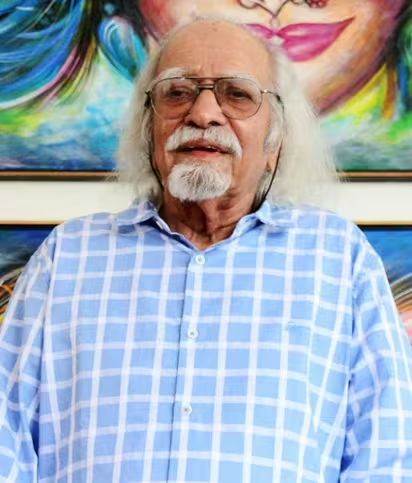
Laxman Pai: The Lyrical Line of Modern India
In the grand tapestry of Indian modern art, few threads are as vibrant, rhythmic, and distinctly personal as that of Laxman Pai. An artist whose life was as colourful as his canvases, Pai (1926-2021) was a master of the line, a poet of colour, and a profound interpreter of the Indian soul. From the sun-drenched landscapes of his native Goa to the hallowed art studios of Paris and back, his journey was one of relentless creation, shaping a visual language that was both deeply rooted in Indian tradition and fearlessly modern. A recipient of the Padma Bhushan, India's third-highest civilian honour, Laxman Pai left behind a legacy not just in his paintings, but in the very fabric of art education in his beloved homeland.
Early Life & Background: A Brush with Revolution
Laxman Pai was born on January 21, 1926, in the bustling town of Margao, Goa. At the time, Goa was a Portuguese colony, a cultural enclave distinct from the rest of British-ruled India. This unique environment became the first canvas for the young artist's imagination. He grew up surrounded by the rich sensory experiences of Goan life: the lush green paddy fields, the ornate architecture of temples and churches, the vibrant pageantry of local festivals, and the dramatic performances of folk theatre like the Dashavatara. These early sights and sounds embedded in him a deep appreciation for colour, form, and narrative, which would echo throughout his artistic career.
His talent was evident from a young age, but his path was not merely that of a quiet artist. Pai came of age during a period of intense nationalistic fervour, and the struggle for freedom was not confined to British India. A parallel movement for liberation from Portuguese rule was gaining momentum in Goa. As a passionate young man, Pai was drawn into this struggle. In 1946, he participated in the Satyagraha movement, a non-violent civil disobedience campaign demanding an end to colonial rule. His activism led to his arrest by the Portuguese authorities, a formative experience that instilled in him a resilient spirit and a lifelong commitment to his principles.
Seeking a formal education in art, Pai moved to Bombay (now Mumbai) and enrolled at the prestigious Sir J.J. School of Art in 1943. Here, he honed his skills under the tutelage of eminent artists and teachers. He was a brilliant and diligent student, mastering the academic techniques of the time. His talent was so undeniable that by the end of his course in 1947, he was widely expected to receive the Mayo Medal, the institution's highest honour. However, in a cruel twist of fate, the medal was denied to him. The official reason cited was his past involvement in the Goan freedom struggle, a 'black mark' on his record in the eyes of the administration. This injustice, though disheartening, did not break his spirit; instead, it reinforced his resolve to carve his own path, independent of institutional validation.
Career & Major Contributions: The Parisian Sojourn and an Indian Symphony
After a brief stint as a teacher, Pai's artistic journey took a momentous leap. In 1951, he moved to Paris, the undisputed epicentre of the global art world. For the next ten years, he lived and worked in this crucible of modernism, studying fresco and etching at the renowned École des Beaux-Arts. Paris was a revelation. He immersed himself in the city's artistic ferment, absorbing the influences of European masters like Paul Klee, Joan Miró, and Marc Chagall. Klee's lyrical use of the line and Chagall's dreamlike, floating figures particularly resonated with him.
This decade was transformative. Pai's style underwent a radical evolution, shedding the academic realism of his training for a more fluid, abstract, and deeply personal visual vocabulary. The line became the central element of his work—dynamic, rhythmic, and expressive. He held over ten solo exhibitions in Paris and other European cities like London and Munich, gaining international recognition. His work from this period reflects a synthesis of his Indian sensibilities with the formal innovations of European modernism.
Upon his return to India in 1961, Pai's focus shifted decisively towards his roots. He embarked on a prolific phase, creating some of his most significant and celebrated series of works, which drew inspiration from the vast wellspring of Indian culture, philosophy, and music.
The 'Musical Moods' (Raagmala Series): Perhaps his most iconic contribution, this series was a groundbreaking attempt to visually interpret Indian classical music. Pai translated the auditory experience of ragas—the melodic modes of Indian music—into a symphony of colour and line. Each painting sought to capture the specific mood (rasa), time of day, and emotional essence of a particular raga. Pulsating lines, symbolic colours, and abstract forms danced on his canvases, creating a visual equivalent of the music's vibrations. This series showcased his unique ability to synthesise different art forms, creating a multisensory experience for the viewer.
Philosophical Explorations: Pai was deeply interested in Indian philosophical concepts. His 'Purusha and Prakriti' series explored the cosmic duality of the male (consciousness) and female (energy/nature) principles, a central theme in Samkhya philosophy. Through abstracted human forms and vibrant natural imagery, he delved into the creative tension and ultimate harmony between these two forces.
Narrative Masterpieces: He also proved to be a master storyteller. He created extensive series based on the epic 'Ramayana' and Jayadeva's lyrical poem 'Gita Govinda'. Rather than creating literal illustrations, he captured the emotional core and dramatic essence of these timeless stories. Another significant work was his series on the 'Life of Mahatma Gandhi', where he used his distinct style to chronicle the journey of the Father of the Nation.
An Institution Builder: Beyond his personal artistic practice, Laxman Pai made a monumental contribution to art education. In 1977, he was appointed the Principal of the Goa College of Art, a position he held for a decade until 1987. He was instrumental in transforming the institution into a modern and dynamic centre for the arts, nurturing a new generation of Goan artists and shaping the cultural landscape of his home state.
Throughout his illustrious career, Pai was showered with accolades. He won the Lalit Kala Akademi National Award three times (1961, 1963, 1972). The Government of India honoured him with the Padma Shri in 1985 and the Padma Bhushan in 2018. He also received the Nehru Award in 1995 and the Gomant Vibhushan Award, Goa's highest civilian honour, in 2016.
Legacy & Influence: The Master of the Lyrical Line
Laxman Pai's legacy is etched in his singular artistic style. He is remembered as the 'master of the line'. In his works, the line is not merely an outline; it is an entity in itself—alive, energetic, and full of rhythm. It dances, swirls, and defines form with an effortless grace. This linear quality, combined with his brilliant and often non-naturalistic use of colour, gives his paintings a unique vibrancy and a sense of perpetual motion.
His work represents a powerful and successful synthesis. He elegantly wove together the precision and intricacy of Indian miniature painting, the vitality of folk art, and the expressive freedom of Western modernism. He belonged to the generation of post-independence artists who were tasked with forging a modern artistic identity for a new nation. While he was a contemporary of the Progressive Artists' Group, he consciously chose not to be part of any collective, preferring to cultivate his own individualistic path. In doing so, he demonstrated that Indian art could be modern without being derivative, and traditional without being archaic.
As an educator, his influence is immeasurable. At the Goa College of Art, he was more than an administrator; he was a mentor who inspired his students to find their own voices while remaining connected to their cultural heritage. He built an institution that continues to be a cornerstone of art in the region.
Laxman Pai passed away on March 14, 2021, at his home in Dona Paula, Goa, at the age of 95. His life had come full circle, ending in the land that had first sparked his artistic vision. Today, his works are held in prestigious collections in India and around the world. He is remembered not just as a painter, but as a cultural visionary who saw the world as a symphony of lines and colours, and dedicated his life to translating its music onto canvas for all to see.