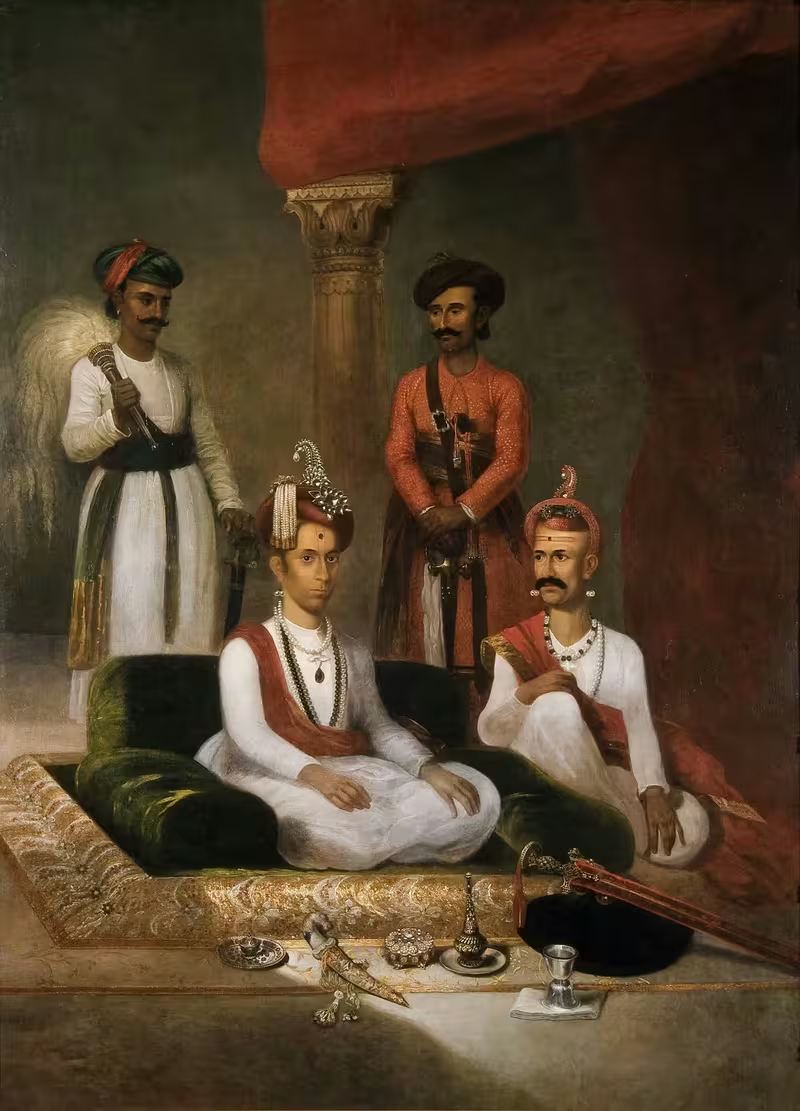
The Boy-King in a Gilded Cage: The Reign of Sawai Madhavrao
In the grand, turbulent theatre of 18th-century India, few lives were as steeped in paradox as that of Sawai Madhavrao Narayan, the twelfth Peshwa of the Maratha Empire. Born into the highest seat of power, his name presided over a period of stunning Maratha resurgence, a time when the saffron flag flew defiantly from the walls of Delhi to the plains of the Deccan. Yet, the Peshwa himself was a sovereign in name only, a lonely figurehead whose life was meticulously scripted by others. His story is not one of conquests and decrees, but of a gilded cage, a poignant struggle for autonomy, and a tragic end that heralded the twilight of a mighty empire.
A Son of Prophecy and Politics
The story of Sawai Madhavrao begins with a murder. In August 1773, his father, the reigning Peshwa Narayanrao, was brutally assassinated within the fortified walls of Pune's Shaniwar Wada. The conspiracy implicated his ambitious uncle, Raghunathrao (popularly known as Raghoba), who promptly seized the Peshwai. For a moment, it seemed his ambition was fulfilled. But there was a complication: Narayanrao's young wife, Gangabai, was pregnant.
This unborn child became the focal point of a powerful political movement. A council of twelve influential Maratha ministers and chieftains, led by the brilliant and astute statesman Nana Phadnavis, formed a regency council known as the Barbhai Council. Their single, unifying purpose was to protect the unborn heir and challenge Raghunathrao's usurpation. The fate of the Maratha Empire hung in the balance, waiting for a birth.
On April 18, 1774, Gangabai gave birth to a healthy baby boy in the formidable Purandar Fort, a safe distance from the plotting in Pune. The child was named Madhavrao Narayan. His arrival was not merely a family event; it was a political masterstroke. He was the legitimate heir, the symbol of continuity. The Barbhai Council immediately invested him as the new Peshwa, a ceremony performed when he was merely forty days old. To invoke the memory of his revered grand-uncle, the great Peshwa Madhavrao I, the honorific 'Sawai'—meaning 'one and a quarter', or a step above—was added to his name. The infant was now Sawai Madhavrao, a king destined to be greater than the greatest.
His childhood, however, was anything but royal in its freedom. Raised under the suffocatingly protective and controlling gaze of Nana Phadnavis, his every move was monitored. Shaniwar Wada was his home, but also his prison. He received an excellent education in statecraft, warfare, and administration, but was never given the chance to apply it. He was the sun around which the Maratha universe orbited, yet he cast no light of his own.
A Reign of Vicarious Victories
Sawai Madhavrao’s reign was, in reality, the reign of Nana Phadnavis and the military genius of generals like Mahadji Shinde. The young Peshwa was the official sanction, the sacred authority, but the hands that moved the levers of power belonged to his regent.
The First Anglo-Maratha War (1775-1782)
The defining conflict of his early years was a direct result of the succession struggle. A furious Raghunathrao, ousted from Pune, did the unthinkable: he sought help from the British East India Company. The resulting Treaty of Surat (1775) saw him cede the valuable territories of Salsette and Bassein in exchange for British military aid to install him as Peshwa.
Nana Phadnavis and the Barbhai Council responded with diplomatic and military fury. They condemned the treaty and declared war. What followed was a long, arduous conflict that tested the resilience of the Maratha state. The early stages of the war culminated in a spectacular Maratha victory at the Battle of Wadgaon in January 1779. Under the brilliant command of Mahadji Shinde and Tukojirao Holkar, the Maratha forces encircled a British contingent from Bombay, forcing them into a humiliating surrender. The resulting Treaty of Wadgaon required the British to relinquish all territories they had captured.
Though the war dragged on for three more years, the victory at Wadgaon was a massive morale booster. It proved that the Maratha Confederacy, even with an infant Peshwa, was more than a match for the rising British power. The war finally concluded with the Treaty of Salbai (1782). This landmark treaty was a diplomatic triumph for the Marathas. It formally recognized Sawai Madhavrao as the legitimate Peshwa, granted Raghunathrao a pension, and returned most territories to the Marathas. For the next two decades, it established an uneasy peace between the two major powers in India.
The Diarchy of Power: Nana and Mahadji
With the British threat neutralized, the post-war era was dominated by two colossal figures: Nana Phadnavis in Pune and Mahadji Shinde in the north. Nana, the meticulous administrator and diplomat, managed the empire’s finances and held the political center together. Mahadji, the charismatic and powerful general, expanded Maratha influence across northern India, capturing Delhi and becoming the de facto protector and regent of the powerless Mughal Emperor, Shah Alam II. He commanded a modern, European-trained army and ruled a vast, semi-autonomous domain, though he always publicly deferred to the authority of the Peshwa in Pune.
This delicate balance of power between the statesman and the general defined the era. For Sawai Madhavrao, growing from a boy into a young man, it meant he was doubly overshadowed. He was a student of two masters, both of whom were his nominal subordinates, yet he held no real authority over either.
The Peshwa's Anguish and the Last Great Triumph
As Sawai Madhavrao entered his late teens, he grew increasingly resentful of his powerlessness. Intelligent, sensitive, and proud, he yearned to step out of Nana Phadnavis’s shadow and rule in his own right. Contemporary accounts describe him as chafing under the regent's constant surveillance and micromanagement. Nana, ever the cautious guardian, perhaps feared the young Peshwa's impulsiveness or, more cynically, was unwilling to relinquish the control he had held for two decades.
This simmering tension was the backdrop for the final, magnificent display of unified Maratha power. The Nizam of Hyderabad, feeling emboldened, had refused to pay his annual tribute (chauth) to the Marathas. In 1795, Nana Phadnavis called upon all the feudatory chiefs of the empire to unite.
In an awe-inspiring spectacle, the great houses of the Confederacy answered the call. The armies of Scindia, Holkar, Gaekwad, and Bhonsle converged, marching as one under the saffron standard. Sawai Madhavrao, now a 21-year-old man, rode with his armies, the symbolic commander-in-chief of this grand coalition. In March 1795, the Maratha host met the Nizam’s forces at Kharda. The battle was swift and decisive. The Nizam’s army was routed, and he was forced to sign a treaty ceding vast territories and agreeing to pay enormous arrears and indemnities.
The Battle of Kharda was the zenith of Nana Phadnavis’s statesmanship. It was a resounding declaration that the Maratha Empire, thirty-four years after the catastrophe of Panipat, was once again the undisputed paramount power of India. For Sawai Madhavrao, it must have been a moment of immense pride, a glimpse of the imperial glory that was his birthright.
Legacy: A Fall from the Heights
The triumph of Kharda was tragically short-lived. The unity it forged would soon shatter, and the life of the young Peshwa at its center would come to a shocking end.
On October 25, 1795, just seven months after the victory, Sawai Madhavrao fell from a high balcony within the Shaniwar Wada. He suffered grievous injuries, including broken limbs, and lingered in agony for two days before succumbing to his wounds on October 27, 1795. He was only 21.
The circumstances of his death remain one of history's great, sorrowful mysteries. The official version was that it was an accident, that he was delirious with a high fever and fell. However, the shadow of suicide hangs heavily over the event. Many historians believe that, consumed by depression and despair over his perpetual confinement and lack of real power, the young Peshwa took his own life. The victory at Kharda, instead of empowering him, may have only underscored his own irrelevance.
Sawai Madhavrao’s historical significance is therefore a tragic paradox. His reign was a period of immense success for the Maratha Empire. The regency of Nana Phadnavis successfully navigated the treacherous political waters of the late 18th century, fended off the British, and reasserted Maratha dominance. But the Peshwa himself is remembered as a symbol of profound personal failure—not of his own making, but of the circumstances that imprisoned him.
His death without an heir plunged the empire into a catastrophic succession crisis. The ensuing power vacuum unleashed the pent-up rivalries between the Maratha chieftains. Nana Phadnavis's authority crumbled as Raghunathrao’s sons, particularly the infamous Baji Rao II, vied for the throne. The infighting that followed fatally weakened the Confederacy from within. The unity of Kharda was a forgotten dream.
When the British returned, they found not a united empire but a collection of warring factions ripe for exploitation. The death of Sawai Madhavrao was the trigger that began the rapid and final decline of the Maratha Empire, leading to its eventual subjugation in the subsequent Anglo-Maratha Wars.
Today, Sawai Madhavrao is remembered as the boy-king, the tragic sovereign whose name was attached to great victories he did not command, and whose personal despair mirrored the impending doom of the empire he was born to rule.