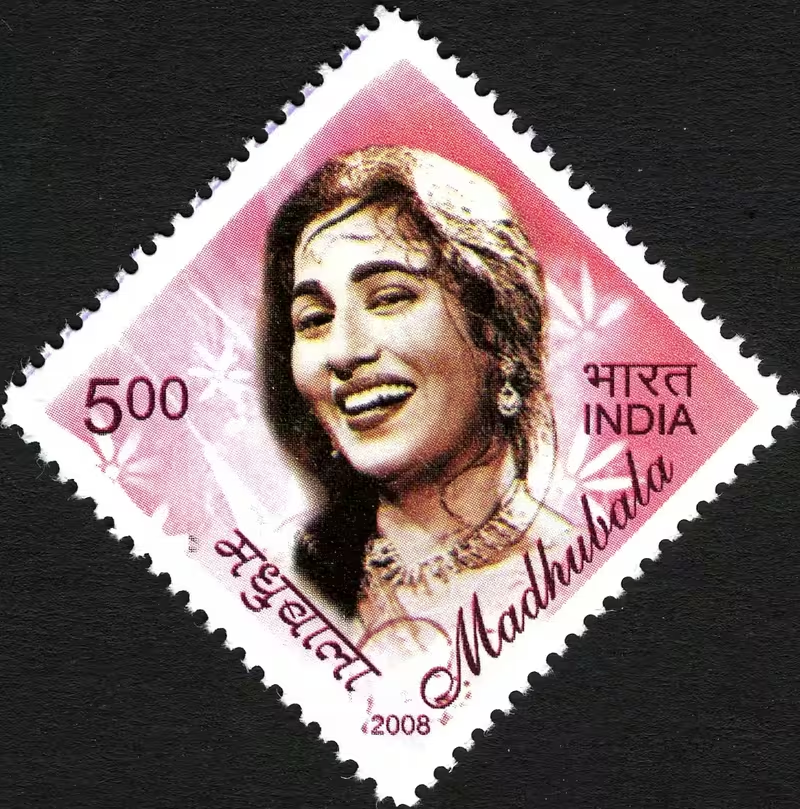
Madhubala: The Venus of Indian Cinema
In the glittering pantheon of Indian cinema, few stars shine with the tragic, incandescent brilliance of Madhubala. Born Mumtaz Jehan Begum Dehlavi on Valentine's Day, 1933, her life was a dramatic tapestry of staggering fame, profound talent, and heart-wrenching sorrow. In a career that spanned just over two decades, she became more than an actress; she became an icon, an ethereal presence whose luminous smile could light up the darkest tragedy and whose expressive eyes held a universe of unspoken emotions. Dubbed "The Venus of Indian Cinema," her story is a defining chapter of Bollywood's Golden Age, a poignant tale of a woman who gave her all to the silver screen, even as life dealt her a cruel hand.
Early Life: From Mumtaz to Madhubala
Mumtaz Jehan was born in Delhi into a conservative Pashtun family, the fifth of eleven children of Ataullah Khan and Aayesha Begum. Her early life was marked by hardship. After her father lost his job at the Imperial Tobacco Company, he moved the entire family to Bombay in search of work, where they faced severe poverty, at one point living in a cowshed near the Bombay film studios. The city was both a place of struggle and nascent opportunity. A defining moment of this period was the catastrophic Bombay dock explosion of April 14, 1944. The family lost their small home and all their belongings in the disaster, surviving only because they had gone to see a film at a local theatre.
This life of precarity pushed young Mumtaz into the workforce at a tender age. Her father, recognizing her striking looks and potential, began taking her to film studios. At the age of just nine, she made her debut as a child artist, credited as Baby Mumtaz, in the 1942 film Basant. The film was a success, and the young girl’s earnings became the primary source of income for her large family. This early entry into the world of cinema meant she had no opportunity for formal schooling, a fact that she would later work hard to overcome by learning to speak fluent English on her own.
Her transition from child artist to leading lady was swift. In 1947, at the age of 14, she was cast opposite another rising star, Raj Kapoor, in Neel Kamal. It was during this time that the veteran actress and studio head Devika Rani, impressed by the young girl's talent and on-screen charisma, suggested she adopt the screen name 'Madhubala,' meaning 'honey belle.' The name stuck, and with it, a star was born.
Career: The Reign of a Superstar
The film that truly catapulted Madhubala into the stratosphere of stardom was Kamal Amrohi's gothic noir masterpiece, Mahal (1949). Playing a mysterious, ghost-like woman, her haunting performance, coupled with Lata Mangeshkar's iconic song "Aayega Aanewala," captivated the nation. The film was a runaway success and established the 16-year-old Madhubala as one of India's most sought-after actresses.
What followed was the Golden Era of the 1950s, a decade Madhubala dominated with her versatility and charm. She was a director's dream and a co-star's delight, working with every major male lead of her time, including Ashok Kumar, Dilip Kumar, Dev Anand, and Guru Dutt. Her filmography from this period showcases an incredible range. She could be the effervescent, mischievous comedienne in films like Guru Dutt’s Mr. & Mrs. '55 (1955), the iconic Chalti Ka Naam Gaadi (1958) alongside the Ganguly brothers, and the delightful Half Ticket (1962) with her future husband, Kishore Kumar. Her comedic timing was impeccable, a natural flair that made her on-screen antics feel both spontaneous and utterly charming.
Yet, she was equally adept at portraying deep, tragic emotion. Her on-screen chemistry with Dilip Kumar was legendary, fueled by a well-documented, real-life romance that played out over several years. Their collaborations in films like Tarana (1951) and Sangdil (1952) were imbued with a palpable passion that audiences adored. Her ability to convey vulnerability made her the perfect tragic heroine, a role she would unfortunately come to mirror in her own life.
By the early 1950s, Madhubala's fame had crossed Indian borders. In 1952, the American magazine Theatre Arts featured her in an article with the headline, "The Biggest Star in the World - and she's not in Beverly Hills." Famed American photographer James Burke also did an extensive photo feature on her for Life magazine, capturing her candid, off-screen beauty. Even the acclaimed Hollywood director Frank Capra expressed a desire to cast her, but her career was tightly controlled by her father, who managed her contracts and finances. He turned down the offer, and Madhubala remained in India, a decision that has since fueled much speculation about what might have been.
The Magnum Opus: Mughal-e-Azam
If one film defines Madhubala's legacy, it is K. Asif's historical epic, Mughal-e-Azam (1960). The film, which took nearly a decade to make, was a monumental undertaking, and Madhubala's role as the doomed courtesan Anarkali became the crowning achievement of her career. By the time filming was in full swing, her health had already begun to fail. In 1954, she had been diagnosed with a ventricular septal defect—a hole in her heart—a condition with no cure at the time.
Despite her debilitating illness, she poured her soul into the role. She endured immense physical hardship, wearing heavy real-iron chains for prison scenes that left her bruised and in pain, and performing grueling dance sequences while her body was failing her. The iconic song "Pyaar Kiya To Darna Kya," filmed in a stunning replica of the Lahore Fort's Sheesh Mahal (Palace of Mirrors), shows Anarkali's defiant declaration of love to Prince Salim (played by Dilip Kumar). The poignancy of this performance was amplified by the fact that Madhubala and Dilip Kumar's own epic romance had ended tragically before the film's completion.
Mughal-e-Azam was released on August 5, 1960, to unprecedented acclaim. It broke every box office record and remains a towering landmark of Indian cinema. Madhubala's portrayal of Anarkali—a blend of fierce defiance, delicate grace, and heartbreaking vulnerability—is considered one of the finest performances in film history. The film was her zenith, but also her swan song. Though she was the star of the biggest film India had ever seen, her failing health prevented her from attending most of the premiere. Her brief, frail appearance was a heartbreaking glimpse into the private battle she was fighting.
Legacy and Influence: An Enduring Light
Following the release of Mughal-e-Azam, Madhubala's health declined rapidly. In 1960, she married the singer-actor Kishore Kumar and traveled to London for treatment, where doctors delivered a grim prognosis: she had only two years to live. She defied their prediction, living for another nine years, but they were years of pain and seclusion. She became a recluse, largely bedridden and unable to work, a tragic fate for a woman who had once been the vibrant heart of the film industry.
On February 23, 1969, just nine days after her 36th birthday, Mumtaz Jehan Begum Dehlavi passed away, leaving behind a nation in mourning. Her life was tragically short, but her legacy is immortal.
Madhubala is remembered today not just for her breathtaking beauty, but for her immense talent and the professional fortitude she displayed in the face of personal tragedy and illness. She was a consummate artist who elevated every film she was in, bringing a unique blend of vivacity and depth to her roles. Her smile, often called the most beautiful in cinema, could convey both innocent joy and profound sadness.
Her influence continues to permeate Indian culture. Her image is a symbol of the Golden Age, her films are celebrated as classics, and her life story—a blend of fairy-tale success and Greek tragedy—continues to fascinate generations. In 2008, the Indian postal service issued a commemorative stamp in her honor. In 2018, The New York Times posthumously published an obituary for her in its "Overlooked" series, finally giving her the global recognition she had long deserved.
Madhubala remains an eternal, luminous figure in the history of Indian cinema—a woman who lived and loved with an intensity that burned brightly on screen, and whose light, though extinguished far too soon, has never truly faded.