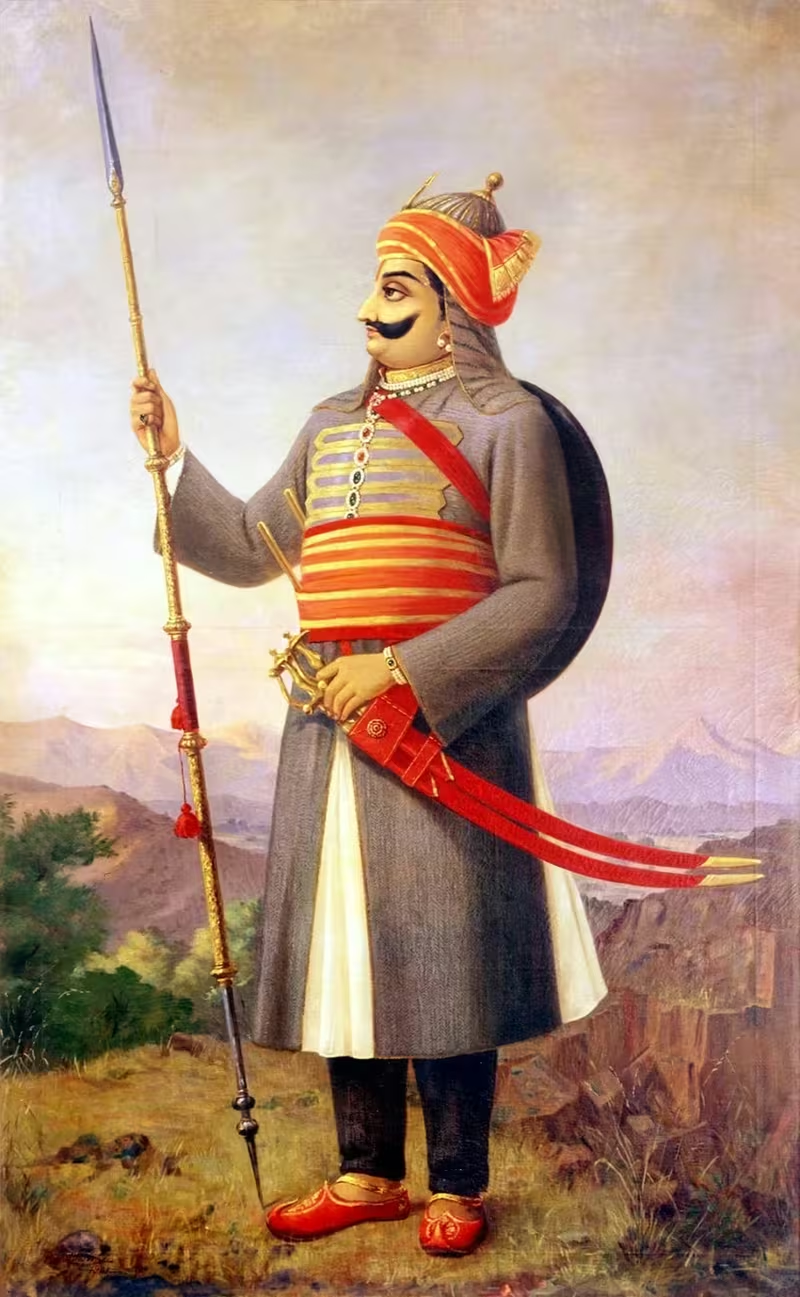
Maharana Pratap: The Crimson Sun of Mewar
In the grand tapestry of Indian history, few figures shine with the intensity and unwavering light of Maharana Pratap Singh I of Mewar. In an age when the Mughal Empire under Emperor Akbar was at its zenith, absorbing kingdom after kingdom through conquest or diplomacy, one ruler stood as a bastion of defiance. His story is not merely a chronicle of battles won and lost; it is the epic saga of an indomitable spirit, a testament to the enduring human will to fight for freedom, dignity, and self-respect against overwhelming odds. For centuries, his name has been a clarion call for courage, a symbol of Rajput valor and the unyielding defense of one's homeland.
The Making of a Maharana: Early Life and Ascension
Pratap Singh was born on May 9, 1540, within the formidable walls of the Kumbhalgarh fort in Rajasthan. He was a scion of the illustrious Sisodia clan of Rajputs, a lineage that traced its ancestry to the sun god and boasted legendary warriors like Bappa Rawal and Rana Sanga. His father was Maharana Udai Singh II, the founder of the city of Udaipur, and his mother was Maharani Jaiwanta Bai, a princess known for her piety and wisdom. Pratap’s early years were spent not in the luxury of a peaceful court, but amidst the constant turmoil of Mughal expansionism.
His formative experience was the catastrophic siege of Chittorgarh in 1567-68. The fall of Mewar’s ancestral capital to Akbar’s forces was a deep wound inflicted upon the psyche of the Sisodias. The tragic rite of Jauhar, where the Rajput women self-immolated to protect their honor, and the subsequent Saka, where the men rode out for a final, fatal charge, left an indelible mark on the young prince. It instilled in him a lifelong resolve to never bow before the power that had desecrated his ancestral home.
His education was that of a Rajput prince, honed in the arts of war. He was a master equestrian, an expert swordsman, and a brilliant military strategist, intimately familiar with the rugged Aravalli terrain that would later become his greatest ally.
Upon Maharana Udai Singh II’s death in 1572, a crisis of succession arose. The Maharana, under the influence of his favorite wife, Rani Bhatiyani, had named her son, Jagmal Singh, as his successor, bypassing his eldest and most capable son, Pratap. However, the nobles of Mewar, recognizing the perilous times and the need for a strong leader, collectively overruled their late king’s wishes. In a dramatic turn of events, they physically removed Jagmal from the throne and, in a simple ceremony at Gogunda, crowned Pratap Singh as the 13th Maharana of Mewar. At that moment, he inherited not a crown of jewels, but a crown of thorns—a diminished kingdom, a powerful enemy, and a sacred duty to reclaim the honor of Mewar.
A Stand for Swaraj: Defiance Against the Mughals
By the time Pratap ascended the throne, the political landscape of Rajputana had been transformed. One by one, the major Rajput states—including Amber (Jaipur), Bikaner, and Jodhpur—had accepted Mughal suzerainty. They had entered into strategic alliances, often sealed by marriage, and served as high-ranking commanders (mansabdars) in the Mughal army. Akbar was a master diplomat who offered wealth, power, and prestige in exchange for loyalty.
For Mewar, however, the price of peace was submission, a price Pratap was unwilling to pay. Akbar, respecting Mewar’s historical significance and Pratap’s reputation, first chose diplomacy over war. Between 1572 and 1573, he sent a series of four envoys to persuade the Maharana to accept a treaty. The emissaries were notable figures: Jalal Khan Qurchi, Raja Man Singh of Amber, Raja Bhagwant Das (Man Singh’s father), and Raja Todar Mal. Each came with generous offers: Pratap could retain control of his territory, would be granted a high rank in the Mughal court, and would be excused from personal attendance at the court in Agra. All he had to do was formally acknowledge Akbar as his emperor.
Pratap met each envoy with courtesy but remained resolute. He was willing to be an ally of the Mughals, but not a vassal. His refusal to compromise on Mewar's sovereignty, to bow his head before any earthly power, made conflict inevitable. The die was cast for one of history’s most iconic confrontations.
The Crimson Valley: The Battle of Haldighati
The culmination of this diplomatic standoff was the legendary Battle of Haldighati, fought on June 18, 1576. The very name evokes images of clashing swords, valiant charges, and supreme sacrifice. The battlefield was a narrow, turmeric-colored (hence Haldi-ghati) mountain pass in the Aravalli Range—terrain that Pratap had chosen to neutralize the Mughals' advantage in numbers and heavy cavalry.
The Mughal army, numbering around 5,000-10,000 men, was commanded by Raja Man Singh of Amber, a fellow Rajput. This was a masterstroke of psychological warfare by Akbar, pitting Rajput against Rajput. He was supported by the seasoned general Asaf Khan I and a host of Mughal veterans.
Maharana Pratap’s force was smaller, approximately 3,000 strong, but it was a diverse and fiercely loyal coalition. It included Rajput warriors, an Afghan contingent led by Hakim Khan Sur (a descendant of Sher Shah Suri who considered the Mughals a common enemy), and, most critically, hundreds of Bhil archers from the Aravalli hills, led by Rana Punja. These archers, masters of guerrilla warfare, were positioned on the clifftops overlooking the pass.
The battle began with a ferocious, near-suicidal charge by the Mewari cavalry. They smashed into the Mughal vanguard, creating chaos and confusion. For a few hours, it seemed the smaller Mewari force might achieve the impossible. Pratap, atop his magnificent white stallion Chetak, fought like a lion, cutting his way towards Man Singh to engage in personal combat. But the Mughals' superior numbers and reserve forces eventually began to turn the tide.
In the heat of the battle, Pratap was wounded. Seeing their leader in peril, a nobleman named Jhala Man (also known as Bida Jhala) made the ultimate sacrifice. He seized the royal insignia and parasol from Pratap, drawing the attention of the Mughal forces upon himself. Mistaking him for the Maharana, the Mughals surrounded and killed him, giving the real Maharana precious time to escape.
It was here that the legend of Chetak was forged. The loyal horse, himself grievously wounded, carried his master to safety, leaping across a wide stream in a final, heroic effort before collapsing and dying. The spot where he fell is today a sacred monument, a tribute to an animal's unwavering loyalty.
Tactically, Haldighati was a victory for the Mughals. They occupied Gogunda and other key towns. But strategically, it was a failure. They had neither captured nor killed Maharana Pratap. He had melted away into the Aravalli hills, his spirit unbroken, ready to continue the fight.
The Lion in the Hills: Years of Guerrilla Warfare
What followed Haldighati was a long and arduous struggle that truly defined Pratap’s greatness. He took a solemn vow to sleep on straw, eat from leaf plates, and live an austere life until he had liberated Chittor. For years, he waged a relentless guerrilla war from the rugged hills and dense forests of the Aravallis. His soldiers, masters of the terrain, launched surprise raids on Mughal outposts, disrupted supply lines, and made the cost of occupying Mewar unbearably high for the imperial forces.
This period tested his resolve to the limit. There were times when his family faced starvation, hiding in caves to evade capture. Yet, his people’s loyalty never wavered. The Bhil tribes remained his steadfast allies, and his cause was financially revitalized by his minister, Bhamashah, who pledged his entire personal fortune to fund the Maharana’s army.
The Marathon of Mewar: The Victory at Dewair and Reconquest
The turning point came in 1582 at the Battle of Dewair. This engagement, often overlooked in popular history but hailed by historian James Tod as the “Marathon of Mewar,” was a decisive victory. Pratap’s revitalized army launched a surprise attack on a major Mughal garrison at Dewair. In the ensuing battle, Pratap's son, Amar Singh, famously killed the Mughal commander in single combat. The victory was so complete that it triggered the collapse of the Mughal presence in the region, with over 36 Mughal garrisons being abandoned overnight.
From 1585 onwards, Akbar’s attention was diverted to campaigns in the Punjab and the northwest frontier. This gave Pratap the opportunity he needed. Systematically, and with relentless determination, he began to recapture his lost territories. By the time of his death, Maharana Pratap had successfully liberated almost all of Mewar from Mughal control, with the significant exceptions of the great forts of Chittor and Mandalgarh.
He established a new capital at Chavand, near modern Dungarpur, where he spent his final years rebuilding his kingdom and fostering a cultural revival. The famous Chavand school of painting, a distinct style of Mewari art, flourished under his patronage.
The Undefeated Spirit: Final Years and Legacy
Maharana Pratap did not die on the battlefield. On January 19, 1597, at the age of 56, he passed away in Chavand from an injury sustained while tightening the string of a bow on a hunting expedition. It is said that on his deathbed, he made his son and successor, Amar Singh, swear that he would never submit to the Mughals and would continue the fight to reclaim Chittor.
According to Rajput chronicles, when news of Pratap’s death reached Akbar’s court, the Emperor fell into a silent, somber mood. He recognized that in Pratap, he had faced an adversary of unparalleled spirit, a man who had sacrificed every comfort for the sake of his principles. Pratap was the one king who had looked the might of the Mughal Empire in the eye and had never blinked.
Maharana Pratap’s legacy transcends the geography of Mewar and the timeline of medieval India. He is remembered not as a king who amassed wealth or expanded an empire, but as a timeless symbol of patriotism, self-sacrifice, and the unyielding fight for freedom. His life story demonstrates that victory is not always measured in territory won, but in the spirit that refuses to be conquered. He remains an inspirational figure for millions, a shining example of a ruler who chose the difficult path of honor over the easy road of submission, forever etching his name in history as the unconquered sun of Mewar.