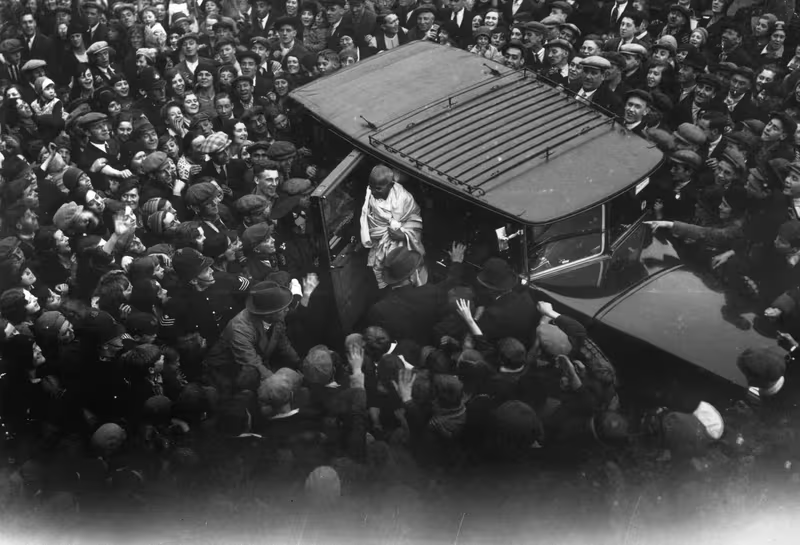
A Soul in Quest of Truth: The Life of Mohandas Karamchand Gandhi
In the grand tapestry of the 20th century, few figures stand as tall or as complex as Mohandas Karamchand Gandhi. He was a man of profound contradictions—a Western-educated lawyer who championed homespun cloth, a shrewd political strategist who spoke the language of the soul, and a frail man whose unwavering will brought the mighty British Empire to its knees. Known to the world as Mahatma, the 'great soul', and to his people as Bapu, the 'father', Gandhi's life was a relentless experiment with truth, non-violence, and the spiritual potential of political action. His journey from a shy boy in coastal Gujarat to the architect of India's freedom is a story of radical self-transformation that would, in turn, transform a nation and inspire the world.
Early Life & The Making of a Man
Mohandas was born on October 2, 1869, in Porbandar, a coastal town in the Kathiawar Peninsula of British-ruled India. He was born into a modest but respectable Modh Bania family. His father, Karamchand Gandhi, served as the diwan (chief minister) of Porbandar state, a position that commanded respect but not great wealth. His mother, Putlibai, was Karamchand's fourth wife and a woman of deep piety. It was from her that Mohandas imbibed his earliest lessons in religious devotion, fasting for self-purification, and a compassionate regard for all living beings—tenets deeply rooted in the Vaishnavism and Jain traditions prevalent in Gujarat.
His childhood was unremarkable. By his own admission in his autobiography, The Story of My Experiments with Truth, he was a mediocre student, painfully shy and timid. In 1883, at the tender age of 13, he was married to Kasturbai Makhanji Kapadia in an arranged marriage, a custom he would later criticize. The young couple would grow together through a lifetime of struggle, with Kasturbai becoming his steadfast, if sometimes critical, partner in his life's work.
At 18, against the prevailing norms of his community, Gandhi resolved to sail to London to study law. The decision, made in 1888, was a turning point. In the bustling, imperial metropolis, he grappled with loneliness and cultural alienation but also experienced an intellectual awakening. He joined the London Vegetarian Society, where he met intellectuals and reformers who introduced him to a wide array of philosophical and religious texts. It was here, thousands of miles from home, that he first read the Bhagavad Gita in English translation, which he would later call his "spiritual dictionary." He also studied the Bible, particularly the Sermon on the Mount, whose teachings on humility and forgiveness resonated deeply with his burgeoning philosophy. He was called to the Bar in 1891 and returned to India, only to find his legal career in Bombay and Rajkot floundering due to his crippling shyness.
The Crucible of South Africa: Forging Satyagraha
A job offer to act as legal counsel for an Indian merchant in Natal, South Africa, provided an escape. He arrived in 1893, intending to stay for a year. He would remain for twenty-one. South Africa was the crucible where Mohandas the lawyer was forged into Gandhi the Mahatma. Within days of his arrival, he came face to face with the brutal reality of racial discrimination. On a train journey to Pretoria, he was unceremoniously thrown out of a first-class carriage at Pietermaritzburg station, despite holding a valid ticket, simply because a white passenger objected to his presence. Shivering in the cold of the station's waiting room that night, he made a fateful decision: he would not flee but would stay and fight the deep-seated 'disease of colour prejudice'.
This incident galvanized him. He organized the Indian community, founding the Natal Indian Congress in 1894 to protest discriminatory laws. He shed his English barrister's attire for the simple clothes of an activist. It was in South Africa that he developed his most powerful weapon: Satyagraha, which translates to 'truth force' or 'soul force'. It was not passive resistance but an active, yet non-violent, form of civil disobedience. It demanded that its practitioners resist unjust laws openly and lovingly, and willingly accept the punishment—be it imprisonment, fines, or physical assault—without retaliation.
He first deployed this method during the 1906 campaign against the Transvaal government's Asiatic Registration Act, which required all Indians to be fingerprinted and carry registration certificates. Thousands of Indians, under Gandhi's leadership, courted arrest by refusing to register. During these years, he also established two communal settlements, Phoenix Farm (1904) and Tolstoy Farm (1910), where residents lived a simple, self-sufficient life dedicated to equality, manual labour, and spiritual discipline. By the time he left South Africa in 1914, he had secured significant concessions for the Indian community and had honed a revolutionary philosophy of resistance that he was now ready to deploy on a much larger stage.
The Mahatma in India: Leading a Nation to Freedom
Gandhi returned to India in January 1915, a seasoned activist with a formidable reputation. Following the advice of his political mentor, Gopal Krishna Gokhale, he spent his first year travelling the length and breadth of the country, observing the conditions of the Indian masses with the eyes of a pilgrim. He was appalled by the poverty and helplessness he witnessed.
His first major interventions in Indian politics were localized but highly effective demonstrations of Satyagraha:
Champaran Satyagraha (1917): In the Champaran district of Bihar, he took up the cause of indigo farmers who were being forced by British landlords to grow indigo on a portion of their land and sell it at fixed, exploitative prices. His methodical investigation and campaign of civil disobedience led to the government appointing an inquiry committee (with Gandhi as a member), which ultimately abolished the unjust system.
Kheda Satyagraha (1918): In Kheda, Gujarat, he organized peasants to demand the suspension of revenue collection after a crop failure. Despite mass arrests, the peasants, guided by Gandhi and his lieutenant Sardar Vallabhbhai Patel, held firm until the government agreed to a compromise.
Ahmedabad Mill Strike (1918): He intervened in a dispute between textile workers and mill owners, advising the workers to strike non-violently. To bolster their flagging morale, he undertook his first fast for a public cause, a tactic he would use to great effect in the future. The fast pressured the mill owners to agree to arbitration.
These successes established him as a leader who could mobilize the masses. His true ascent as the undisputed leader of the Indian National Congress began with his opposition to the repressive Rowlatt Act of 1919. His call for a nationwide hartal (strike) received an overwhelming response. The movement, however, took a tragic turn on April 13, 1919, when British troops under General Dyer fired on a peaceful, unarmed crowd at Jallianwala Bagh in Amritsar, killing hundreds. The massacre was a seismic shock that destroyed any remaining faith Gandhi had in British justice and set him firmly on the path of complete self-rule (Swaraj).
In 1920, he launched the Non-Cooperation Movement, a nationwide campaign to boycott British courts, schools, and goods. He urged Indians to spin their own cloth using the charkha (spinning wheel) and wear Khadi as a symbol of self-reliance (Swadeshi) and national pride. The movement united Indians across class and religious lines as never before. However, in February 1922, when a protest in Chauri Chaura turned violent and resulted in the death of 22 policemen, Gandhi, a staunch believer in Ahimsa (non-violence), abruptly called off the entire movement. His decision stunned many of his colleagues, but it underscored his non-negotiable principle: the means were as important as the end.
The defining act of his leadership came in 1930 with the Salt Satyagraha. To protest the deeply unpopular British tax on salt, Gandhi, then 61 years old, embarked on a 240-mile march from his Sabarmati Ashram to the coastal village of Dandi. He began with just 78 followers, but by the time he reached the sea 24 days later, thousands had joined him. On April 6, he broke the law by picking up a lump of natural salt. It was a brilliantly simple act of defiance that captured the imagination of the world and triggered a massive wave of civil disobedience across India, leading to the imprisonment of over 60,000 people.
Throughout the 1930s and 40s, Gandhi remained the moral centre of the freedom struggle. In 1942, with the British embroiled in World War II, he launched his final major campaign, the Quit India Movement, with the electrifying slogan, "Do or Die." The British responded with swift and brutal repression, imprisoning the entire Congress leadership, including Gandhi, for the duration of the war.
Legacy & Enduring Influence
When India finally achieved independence on August 15, 1947, it was a moment of both triumph and tragedy. The country was partitioned into India and Pakistan, a division Gandhi had fought against with all his might. The ensuing communal violence broke his heart. While the rest of the country celebrated freedom, Gandhi was in Calcutta, fasting and walking through riot-torn areas to bring peace. His last years were spent trying to heal the wounds of Partition.
His unwavering commitment to Hindu-Muslim unity, however, angered Hindu extremists. On January 30, 1948, while on his way to a prayer meeting in New Delhi, he was assassinated by Nathuram Godse. His death sent a shockwave of grief across the nation and the world.
Mohandas Gandhi's legacy is vast and multifaceted. For India, he is the Father of the Nation, the man who transformed the freedom struggle from an elite debate into a mass movement that empowered millions of ordinary people. He gave Indians a renewed sense of pride in their own culture and the tools of non-violent action to win their freedom. His emphasis on Sarvodaya (welfare of all), social justice, and rural self-sufficiency continues to shape public discourse in India.
He fought tirelessly against the practice of untouchability, which he called a "blot on Hinduism," renaming those deemed 'untouchable' as Harijans (children of God). While his approach is now debated, his efforts undeniably forced the issue into the national consciousness.
Globally, Gandhi's philosophy of Satyagraha became a beacon for oppressed people everywhere. His methods directly inspired the American Civil Rights Movement led by Martin Luther King Jr., the anti-apartheid struggle in South Africa led by Nelson Mandela, and numerous other movements for justice and peace around the world. The United Nations now observes his birthday, October 2, as the International Day of Non-Violence.
Today, Gandhi is remembered not just as a political leader but as a profound moral and spiritual guide. In a world still rife with violence, inequality, and environmental crises, his teachings on non-violence, sustainability, and the search for truth remain as relevant as ever. He was a man who proved that one's spirit, armed with nothing but courage and conviction, could indeed change the world.