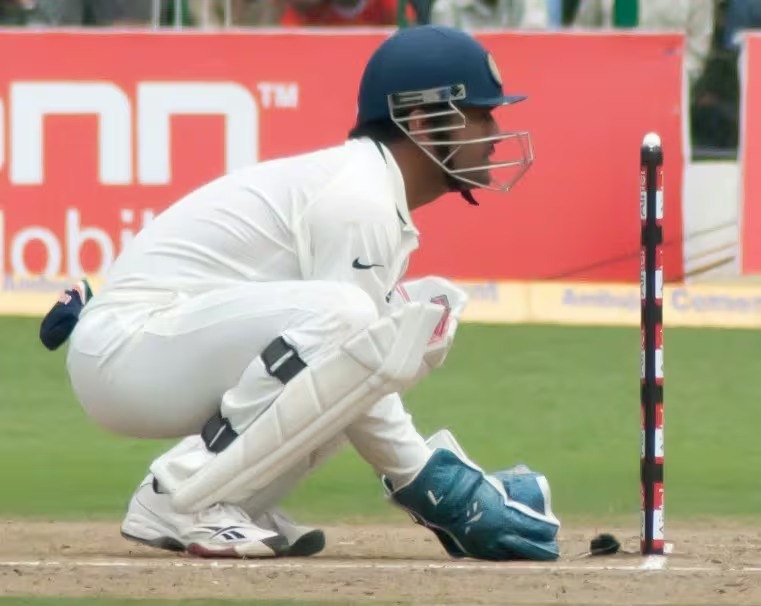
Mahendra Singh Dhoni - Indian Cricketer and Captain
In the annals of Indian history, certain moments are etched not just in record books, but in the collective memory of a billion people. One such moment is the night of April 2, 2011. At the Wankhede Stadium in Mumbai, with the nation holding its breath, a man from the cricketing backwaters of Ranchi swung his bat, launching the ball into the roaring stands. That six, which sealed India's victory in the ICC Cricket World Cup after 28 long years, was more than just a winning shot. It was the coronation of a leader, the culmination of a journey, and the defining image of Mahendra Singh Dhoni—the man who made a habit of finishing things off in style.
Dhoni is not just a cricketer; he is a cultural phenomenon. His story is a testament to the idea that talent, coupled with an unshakeable self-belief and a tranquil mind, can surmount any obstacle. He is the stoic captain who never let the pressure of a billion expectations show, the unorthodox batsman who tore up the coaching manual, and the small-town hero who became the heartbeat of a nation.
Early Life & Background
Mahendra Singh Dhoni was born on July 7, 1981, in Ranchi, then a part of Bihar (now the capital of Jharkhand). His father, Pan Singh, worked as a pump operator for MECON, a public-sector engineering firm. Growing up in a modest family in the MECON colony, young Mahi’s first love was not cricket, but football. His agility and sharp reflexes made him a natural goalkeeper for his school team at DAV Jawahar Vidya Mandir, Shyamali.
It was this goalkeeping prowess that caught the eye of Keshav Ranjan Banerjee, the school’s cricket coach. In need of a wicketkeeper, Banerjee saw potential in Dhoni's safe hands and quick movements and persuaded him to take up the gloves. Though initially hesitant, Dhoni soon fell in love with the game. He honed his skills on the matting wickets of Ranchi, developing a homespun, powerful, and utterly unique batting technique, far removed from the classical elegance taught in the country's traditional cricketing metropolises like Mumbai or Delhi.
His journey was one of immense struggle and perseverance. While his talent was evident in local and state-level tournaments for the Bihar (and later Jharkhand) team, breaking into the national echelon was a formidable challenge. For a period between 2001 and 2003, Dhoni worked as a Travelling Ticket Examiner (TTE) at the Kharagpur railway station under the South Eastern Railway. The monotonous life of checking tickets and managing a demanding sports career was a true test of his resolve. He would finish his shifts and rush to the grounds for practice, his dream of wearing the Indian blue fuelling his relentless efforts.
Career & Major Contributions
Dhoni's breakthrough came through the India A tours. In a 2004 tour of Kenya and Zimbabwe, his explosive, back-to-back centuries against the Pakistan A team made the national selectors sit up and take notice. Here was a wicketkeeper who could not just keep but could single-handedly dismantle bowling attacks. The call-up to the senior national team was inevitable.
The Arrival of a Phenomenon
He made his One Day International (ODI) debut on December 23, 2004, against Bangladesh, an inauspicious start where he was run out for a duck. But his potential was undeniable. On April 5, 2005, in Visakhapatnam, the world witnessed the full fury of MS Dhoni. Promoted to number three against arch-rivals Pakistan, he bludgeoned their famed bowling attack to score a breathtaking 148 off just 123 balls. His long hair, raw power, and fearless attitude made him an instant icon.
Later that year, on October 31, 2005, he further cemented his reputation by scoring an unbeaten 183 against Sri Lanka in Jaipur, the highest score ever by a wicketkeeper in ODI cricket. This innings showcased his other great talent: the art of the chase. He was no longer just a pinch-hitter; he was India’s designated finisher.
The 'Captain Cool' Era
Following India’s disastrous exit from the 2007 ODI World Cup, the team was in disarray. The selectors, looking for a fresh start, handed the captaincy of a young, untested team to Dhoni for the inaugural ICC World Twenty20 in South Africa. This was a masterstroke.
Dhoni, with his calm and unflappable demeanor, led the team with stunning intuition. His leadership was a departure from the norm—it was based on process, not emotion; on gut-feel, not convention. The most memorable example was his decision to give the final, high-pressure over of the final against Pakistan to the inexperienced Joginder Sharma. The gamble paid off, and India were crowned the first-ever T20 World Champions. This victory not only healed the wounds of the ODI World Cup but also sparked a T20 revolution in India, directly leading to the creation of the Indian Premier League (IPL).
Under his leadership, India embarked on an era of unprecedented success:
No. 1 in Test Cricket: In December 2009, Dhoni led India to the pinnacle of Test cricket, becoming the No. 1 ranked team in the world for the first time in its history, a position they held for over 18 months.
2011 ICC Cricket World Cup: This was Dhoni's magnum opus. Playing at home, he marshalled his troops brilliantly throughout the tournament. In the final at the Wankhede, chasing Sri Lanka’s formidable total of 274, he made a crucial tactical decision. He promoted himself up the order ahead of the in-form Yuvraj Singh to counter the Sri Lankan spinners. He then played a captain’s knock, an unbeaten 91 runs, culminating in the historic six that sent a billion people into euphoria.
2013 ICC Champions Trophy: Leading a new-look team in England, Dhoni guided India to victory in the final against the hosts. With this win, he became the first and only captain in history to win all three major ICC trophies: the T20 World Cup, the ODI World Cup, and the Champions Trophy.
The Thala of Chennai
Dhoni's leadership extended to the IPL, where he has been the captain of the Chennai Super Kings (CSK) since its inception in 2008. He forged a deep, emotional connection with the city and its fans, earning the affectionate title "Thala" (Leader). Under his captaincy, CSK became one of the most successful franchises in T20 history, winning the IPL title five times (2010, 2011, 2018, 2021, 2023).
He announced his retirement from international cricket on August 15, 2020, in his characteristically understated manner—a simple Instagram post with a montage of his career, ending a glorious chapter in Indian cricket.
Legacy & Influence
Mahendra Singh Dhoni's legacy is not merely in the trophies that fill his cabinet; it is in the profound and lasting way he changed Indian cricket.
A New Brand of Leadership: Dhoni's captaincy was a case study in emotional detachment and strategic clarity. His on-field calmness in the most chaotic situations earned him the moniker "Captain Cool." He trusted his instincts, making bold, unconventional moves that often turned matches on their head. He backed his players unconditionally, creating a positive and secure dressing room environment that allowed talents like Virat Kohli, Rohit Sharma, and Ravindra Jadeja to flourish.
The Ultimate Finisher & Innovator: He redefined the role of a finisher in limited-overs cricket. His formula was simple yet devastatingly effective: take the game to the final over and then back yourself to win it. His signature "Helicopter Shot," a powerful whip of the wrists learned from his friends in Ranchi, became a symbol of his unorthodox genius. As a wicketkeeper, he was not the most technically polished, but his lightning-fast hands, incredible game awareness, and penchant for no-look run-outs made him one of the most effective keepers in modern history.
The Boy from the Heartland: Perhaps Dhoni’s most significant contribution was shattering the glass ceiling for cricketers from non-traditional centers. His incredible journey from Ranchi to the pinnacle of world cricket proved to millions of aspiring youngsters in small towns that geography was no barrier to ambition. He became the face of a new, confident India—an India where talent and tenacity were the only currencies that mattered.
Today, Mahendra Singh Dhoni is remembered as more than just a great cricketer. He is a revered leader, a national icon, and a symbol of hope. His story—of the ticket collector who became a trophy collector—continues to inspire a generation. He remains a towering figure, not for the runs he scored or the matches he won, but for the belief he instilled: that with a calm mind and a strong heart, you can finish any race, no matter how difficult the chase.