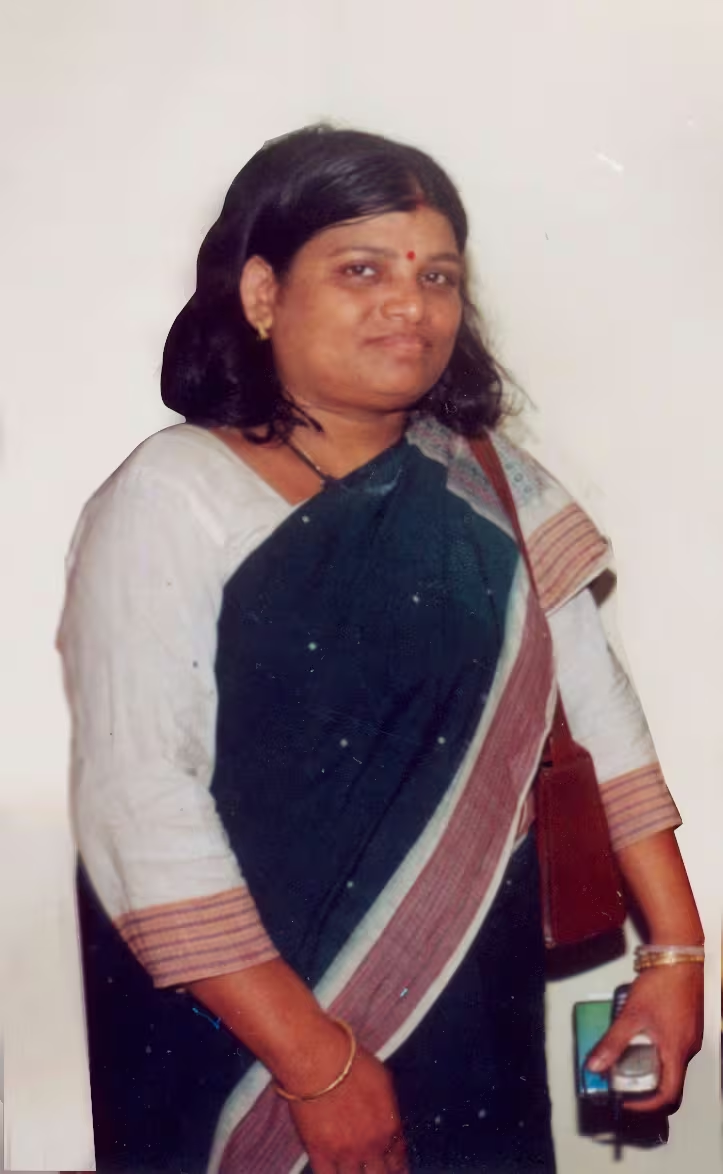
Manasi Pradhan: A Voice for the Voiceless
In the vast, complex tapestry of modern Indian history, certain threads shine with the unwavering brilliance of courage and conviction. Manasi Pradhan is one such thread. An acclaimed author, poet, and one of India's most formidable women's rights activists, she has dedicated her life to dismantling the patriarchal structures that perpetuate violence against women. From a remote village in Odisha where girls' education was a distant dream, she rose to become a national voice, founding the Honour for Women National Campaign and challenging the conscience of a nation. Her story is not merely one of personal triumph over adversity; it is a testament to the power of a single, determined will to forge a more just and equitable world.
Early Life & Background: Forging a Path Through Adversity
Manasi Pradhan was born on October 4, 1962, in Ayatapur, a small, isolated village nestled in the Banapur block of Odisha's Khordha district. Her world was one of stark contrasts—breathtaking natural beauty set against a backdrop of deep-seated poverty and rigid social hierarchies. Born to Hemalata and Godabarish Pradhan, she was the eldest of three children in a family that faced the dual burdens of economic hardship and the social ostracism that came with being from a lower-caste community.
In Ayatapur, the future for a young girl was predetermined and severely limited. The prevailing mindset dictated that a woman's place was within the home, and education was considered an unnecessary, even dangerous, indulgence. The village lacked a high school, a physical manifestation of its low regard for higher learning, especially for its daughters. But within young Manasi, a fierce spirit of defiance was already taking root. She refused to accept the destiny society had written for her.
To continue her education, she embarked on a daily odyssey. Each morning, she would traverse 15 kilometers of rugged, swampy terrain—a solitary figure on a path that few girls in her village dared to tread—to reach the nearest high school. Her journey was a daily act of rebellion against the norms that sought to confine her. Her perseverance paid off when she became the first girl from her village to pass the high school examination, a monumental achievement that sent ripples through her community and set a new precedent for what was possible.
This early success only fueled her ambition. Recognizing her potential, her family made the difficult decision to move to the city of Puri, enabling her to pursue a college education. The transition was not easy. Manasi shouldered the responsibility of supporting her studies and contributing to her family's income, juggling work with her academic pursuits. Her relentless drive saw her earn a Bachelor of Arts in Economics from the Government Women's College in Puri, followed by a Master of Arts in Odia literature from the prestigious Utkal University. She further fortified her understanding of justice and rights by obtaining a Bachelor of Laws (LL.B.) from G.M. Law College, Puri.
Her education was not just an accumulation of degrees; it was the forging of the intellectual and moral armour she would need for the battles that lay ahead. The discrimination, poverty, and systemic injustice she had witnessed and experienced firsthand were not just memories; they became the fuel for a lifelong mission.
Career & Major Contributions: From Poet to Pioneer
Manasi Pradhan's early career began in the conventional corridors of government and finance, with stints at the finance department of the Government of Odisha and later at Andhra Bank. While these roles provided stability, her true calling lay elsewhere. A gifted writer and poet, her creative spirit found its first public expression in 1983 with the publication of her book of poems, Urmi-O-Uchchwas (The Wave and the Aspiration). Yet, she soon realized that her words needed to do more than just capture emotion; they needed to inspire action.
The Genesis of OYSS Women (1987)
In 1987, at the age of 25, Manasi Pradhan took a decisive step that would define her legacy. She founded OYSS Women, the women's wing of the Organization for the Youth and Students of the State. Initially, its mission was focused on empowering young women, helping them overcome barriers to higher education and cultivating their potential as future leaders. Under her guidance, OYSS Women organized leadership workshops, vocational training camps, and legal awareness seminars. Crucially, it also pioneered self-defense training for women, a practical tool for empowerment in a society where they were increasingly vulnerable. OYSS Women became the crucible where her vision for a grassroots women's movement was forged.
The Honour for Women National Campaign (2009)
After two decades of dedicated grassroots work, Manasi Pradhan launched her most ambitious and impactful initiative. In 2009, the Honour for Women National Campaign was born. It was a nationwide movement with a clear, uncompromising goal: to end violence against women in India. Pradhan understood that tackling this deep-rooted issue required a multi-pronged strategy that went beyond reactive measures and addressed the systemic failures that allowed such violence to flourish.
The campaign's core was a meticulously crafted 'Four-Point Charter of Demand' that was presented to state governments across the country. This charter was a blueprint for systemic change:
- A Complete Clampdown on the Liquor Trade: The campaign identified alcohol abuse as a major catalyst for domestic violence and sexual assault, demanding stricter regulation and control.
- Self-Defense Training as Part of the Curriculum: Moving from a model of protection to one of empowerment, the charter called for mandatory self-defense training for all girls in schools and colleges.
- Special Protection Forces for Women: It demanded the establishment of dedicated security forces in every district, specifically trained to handle crimes against women and ensure their safety in public spaces.
- Fast-Track Courts and Special Investigative Units: To combat the culture of impunity, the charter insisted on the creation of fast-track courts and special police units in every district to ensure swift investigation and justice for victims of gender-based violence.
The movement employed a wide range of tools to galvanize public support and pressure policymakers. Volunteers set up stalls at public places, organized women's rights festivals, and distributed literature to raise awareness. Street plays and public rallies took the message directly to the people, transforming the conversation around women's safety from a private issue to a public crisis.
Nirbhaya Vahini and National Impact
The horrific 2012 Delhi gang rape case, which shook the nation to its core, served as a powerful catalyst for the Honour for Women National Campaign. In the wake of the tragedy, the movement gained unprecedented momentum. In 2014, Manasi Pradhan launched the Nirbhaya Vahini (Fearless Brigade), a corps of over 10,000 volunteers spread across India. This dedicated force acted as a powerful pressure group, relentlessly campaigning for the full implementation of the Four-Point Charter and ensuring that the issue of women's safety remained at the forefront of the national agenda.
Her tireless work did not go unnoticed. Manasi Pradhan's contributions have been recognized with some of India's highest honors. In 2013, she was conferred the Rani Lakshmibai Stree Shakti Puraskar by the President of India. She also received the 'Outstanding Women Award' from the National Commission for Women in 2011. Her influence has extended globally, with international publications like Bustle magazine and Welker Media listing her alongside global icons as one of the most inspiring feminists who have changed the world.
Legacy & Influence: A Blueprint for a Safer Future
Manasi Pradhan's legacy is defined by her revolutionary shift in the discourse on women's rights in India. She moved the conversation from a post-incident focus on punishment to a pre-emptive focus on systemic prevention and empowerment. Her Four-Point Charter provided a concrete, actionable roadmap for governments, transforming vague promises of safety into specific, measurable policy demands.
Her historical significance lies in her ability to build a truly grassroots movement that connected with people from all walks of life. She demonstrated that activism is not the exclusive domain of urban elites but can be nurtured in the villages and towns where the problems are most acute. The Honour for Women National Campaign has left an indelible mark on Indian society. The demands for fast-track courts, better policing for women's security, and the inclusion of self-defense in education have become mainstream talking points, influencing policy and public opinion.
Today, Manasi Pradhan continues her work with the same passion and determination that drove her to walk 15 kilometers to school each day. Her journey from the dusty lanes of Ayatapur to the corridors of power in New Delhi is a powerful inspiration. She is remembered not just as an activist but as a visionary—a woman who saw a future where every girl and woman could live with dignity, free from fear. Her life's work serves as a powerful reminder that the fight for justice is a marathon, not a sprint, and it is won by those who refuse to be silenced.