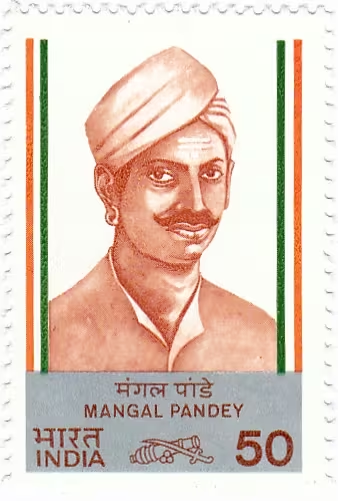
Mangal Pandey: The Spark of the Great Rebellion
In the sweltering heat of an Indian afternoon on March 29, 1857, the sprawling parade ground of the Barrackpore cantonment near Calcutta lay deceptively calm. Yet, beneath the surface, a storm of discontent, religious anxiety, and wounded pride was about to erupt. The man who would light the fuse was not a king or a general, but an ordinary sepoy, a foot soldier named Mangal Pandey. His actions on that fateful day would transform him from an anonymous soldier of the 34th Bengal Native Infantry into a martyr and the first name synonymous with the great and terrible conflagration that would become known as the Indian Rebellion of 1857.
His story is not one of grand strategy or political maneuvering, but of a single, explosive act of defiance. It is the story of a man pushed to his breaking point, whose personal crisis of faith and duty became the rallying cry for a subcontinent simmering with resentment against foreign rule. Mangal Pandey was the spark, the first visible flame of a fire that would engulf northern India and irrevocably change the course of its history.
Early Life & A Sepoy's Identity
Historical records of Mangal Pandey’s early life are sparse, a common fate for many non-elites of his era. What is known is that he was born on July 19, 1827, in the village of Nagwa, in the Ballia district of what is now Uttar Pradesh. He hailed from a high-caste Bhumihar Brahmin family, a detail of immense significance in understanding the events that would unfold. For a Brahmin, adherence to religious purity and caste rules was not merely a social custom but the very foundation of their spiritual and worldly existence.
In 1849, like many young men from the Gangetic plains, Pandey sought a career in the army of the British East India Company. He was enrolled as a sepoy in the 6th Company of the 34th Bengal Native Infantry (B.N.I.). The Bengal Army was a formidable institution, largely composed of high-caste recruits like Pandey from the regions of Awadh and Bihar. The British had, for a time, respected their caste sensibilities, creating an effective fighting force that was also a complex, self-regulating society of its own. Pandey was, by all accounts, a good soldier—part of the machinery of British power in India, yet deeply rooted in the traditions it was beginning to threaten.
The Greased Cartridge: A Crisis of Faith
The India of the 1850s was a land of profound tension. Lord Dalhousie's aggressive policy of annexation, particularly the seizure of Awadh in 1856—the homeland of a vast number of sepoys in the Bengal Army—had bred deep political resentment. A growing sense of cultural and religious assault, fueled by the activities of Christian missionaries and a series of disruptive social reforms, created an atmosphere of deep suspicion. The sepoys feared a grand British design to destroy their dharma (faith) and izzat (honour) and forcibly convert them to Christianity.
Into this volatile mix, the British introduced a new weapon: the Pattern 1853 Enfield rifled musket. A significant technological advancement, it required the soldier to bite open a paper cartridge to pour the gunpowder down the barrel. In early 1857, a rumour began to circulate with terrifying speed through the cantonments of northern India: the grease used to waterproof these cartridges was made from a mixture of beef tallow and pork lard.
For the Hindu sepoys, including the Brahmin Mangal Pandey, beef was sacrilegious. For their Muslim comrades, pork was forbidden. To bite such a cartridge was to commit a profound act of religious pollution, one that would result in the loss of caste and eternal damnation. It was seen not as an oversight but as a deliberate, insidious plot to defile them and break their faith. The cartridge became the focal point for all the accumulated fears and grievances against British rule. The Company’s assurances were dismissed as lies, further deepening the chasm of mistrust.
The Outburst at Barrackpore
By March 1857, the 34th B.N.I. at Barrackpore was seething with discontent. The sepoys had already refused to accept the new cartridges, and the air was thick with conspiracy and anger. On the afternoon of March 29, Mangal Pandey learned that a detachment of British soldiers was arriving by ship, a move he and his comrades interpreted as a prelude to their disarmament and punishment.
What happened next is a matter of historical record, though Pandey's exact state of mind remains a subject of debate. Some accounts suggest he had fortified himself with bhang (a cannabis preparation), but whether it was to steel his nerves or a sign of an agitated mind, the effect was explosive. Arming himself with his loaded musket and a talwar (a curved sword), he strode onto the parade ground near the quarter-guard, the post that held the regiment's weapons and colours.
He began to pace back and forth, a man possessed, calling out to his fellow sepoys in a loud, agitated voice. He urged them to rise up and defend their religion. “Come out, you blackguards! You have seduced me, and now you will not follow me!” he shouted, exhorting them to join him in a preemptive strike against the Europeans. “For the sake of your religion, come out!”
His shouts soon attracted the attention of the British officers. The adjutant, Lieutenant Baugh, galloped to the scene on his horse. Seeing him approach, Pandey took aim and fired. The bullet missed Baugh but struck his horse, bringing both rider and animal crashing to the ground. Baugh, undeterred, drew his pistol and fired at Pandey, but he too missed. He then charged at the sepoy with his sword drawn.
Before Baugh could strike, Pandey lunged forward with his heavy talwar, wounding the lieutenant. Sergeant-Major Hewson joined the fray, but Pandey was a formidable opponent and managed to injure him as well. Throughout this desperate struggle, hundreds of Indian sepoys from the 34th B.N.I. stood watching from the barracks. They offered no assistance to their officers. The quarter-guard, under the command of Jemadar Ishwari Prasad, made no move to intervene, with the Jemadar reportedly threatening any sepoy who tried to help the British.
In this moment of collective inaction, one man broke ranks: a sepoy named Shaikh Paltu. He rushed forward to defend the British officers, grabbing hold of Pandey and giving Baugh and Hewson a chance to escape. As his comrades taunted and threatened him, Paltu held on until the British officers were clear.
Seeing that his moment was lost and his capture imminent, Mangal Pandey turned his musket on himself. He placed the muzzle to his chest and pulled the trigger with his toe. The ball, however, only inflicted a glancing wound, burning his coat and injuring his shoulder. He was quickly overpowered and arrested, his singular rebellion having lasted less than an hour.
Trial and Execution
Mangal Pandey’s court-martial was swift. It began on April 6. He was asked to plead, and his response was simple: he was guilty. When questioned about his motives, he stated that he had been taking opium and bhang and was not in his right mind. He insisted that he had acted alone and refused to name any co-conspirators, thus protecting his comrades. Whether this was the whole truth or a final act of loyalty, it sealed his fate.
He was sentenced to death by hanging. The execution was set for April 18, but the British authorities, sensing the dangerous mood in the cantonment and fearing that Pandey’s continued existence might inspire a wider mutiny, moved the date forward. On the morning of April 8, 1857, Mangal Pandey was led to the gallows at Barrackpore. The professional hangmen of the cantonment refused to perform the execution, and four low-caste sweepers had to be brought in from Calcutta to carry out the sentence. At the age of just 29, Mangal Pandey was executed.
His actions had immediate and severe repercussions. Jemadar Ishwari Prasad, who had commanded the quarter-guard, was also tried, sentenced to death, and hanged on April 21. As a collective punishment for their “passive mutiny,” the entire 34th Bengal Native Infantry was disbanded in disgrace on May 6. The act was meant to be a terrifying warning. Instead, it was perceived as a gross injustice, and the story of Pandey’s defiance and the subsequent punishment spread like wildfire across the military stations of the Gangetic plain.
Legacy: The Proto-Martyr of 1857
Mangal Pandey’s rebellion at Barrackpore was, in military terms, a failure. He acted alone, failed to incite his regiment, and was quickly captured and executed. Yet, history is shaped as much by symbols as by victories. In death, Pandey became a far more powerful figure than he had been in life.
His name became a legend. The story of his solitary, heroic stand against the British officers in defense of his faith resonated deeply with sepoys across northern India. He was no longer just a man; he was an idea. He was the first sepoy to shed blood—both the enemy’s and his own—in the conflict over the greased cartridges.
Just over a month after his execution, on May 10, 1857, the sepoys at the cantonment of Meerut rose in open, violent rebellion. After freeing their imprisoned comrades, they marched to Delhi, declared the aged Mughal emperor Bahadur Shah Zafar their leader, and the Great Rebellion began in earnest. Mangal Pandey’s name was on their lips. His act, once isolated, was now seen as the first blow in a larger war for dharma and freedom.
In the years that followed, the British attempted to erase or tarnish his memory. The term “Pandey” became a pejorative slang used by British soldiers to refer to any rebel sepoy. But in the Indian consciousness, his status as a hero only grew. For the nascent nationalist movement of the late 19th and early 20th centuries, he was the first martyr of the “First War of Indian Independence.” He represented pure, selfless courage in the face of overwhelming power.
Today, Mangal Pandey is firmly enshrined in the pantheon of India’s freedom fighters. His story is told in school textbooks, and his name graces parks and streets. The 2005 film Mangal Pandey: The Rising brought his story to a global audience, cementing his image as a conscious revolutionary. While historians may debate the precise motivations of his actions—was he a premeditated revolutionary or a devout man pushed to a breaking point?—his historical significance is undeniable. He was the catalyst. His defiant roar on the Barrackpore parade ground was the first thunderclap of a storm that would end the rule of the East India Company and lay the long, bloody groundwork for India’s eventual independence.