Overview
In the grand tapestry of early medieval Deccan history, few figures are as compelling and complex as Mangalesha. As a ruler of the Early Chalukya dynasty of Vatapi (modern Badami), his reign (c. 597–610 CE) was a period of formidable military expansion and brilliant artistic patronage. He was a conqueror who pushed the boundaries of the nascent Chalukyan kingdom, a devout Vaishnava who completed one of the most splendid rock-cut temples in India, and ultimately, a tragic figure whose ambition led to his own demise. While often overshadowed by his more famous nephew and successor, Pulakeshin II, it was Mangalesha who solidified the foundations upon which the Chalukyan empire would be built, making his story an essential chapter in the history of Southern India.
The Chalukyan Context: A Kingdom on the Rise
To understand Mangalesha, one must first understand the world he inherited. The Chalukya dynasty, founded by Pulakeshin I around 543 CE, had carved out a kingdom in the heart of the Deccan, with their capital at the strategically located fortress of Vatapi. Pulakeshin I had declared his sovereignty by performing the prestigious Ashvamedha (horse sacrifice) ceremony. His son and successor, Kirtivarman I (r. c. 566–597 CE), was a great warrior who further expanded the kingdom by subjugating neighboring powers like the Nalas, Mauryas of Konkan, and Kadambas of Banavasi.
However, when Kirtivarman I died, his own sons—including the future Pulakeshin II—were too young to rule. In such situations, the responsibility of governance typically fell to a capable male relative. Kirtivarman I’s younger brother, Mangalesha, was the natural choice. He was a seasoned man, likely experienced in both administration and warfare, and was entrusted with the kingdom's reins not as a king in his own right, but as a regent for his young nephews. This arrangement was meant to be a temporary stewardship, a sacred trust to protect the kingdom until the rightful heir came of age.
Ascension to the Throne: A Regent's Responsibility
Mangalesha ascended the throne around 597 CE, taking on the title of regent. His primary duty was to consolidate the gains made by his brother and defend the kingdom from external threats. Early in his reign, he appeared to be a loyal and dutiful uncle. The records, including the later Aihole inscription commissioned by his rival Pulakeshin II, do not suggest any impropriety at the outset. Mangalesha was, by all accounts, an effective ruler from the very beginning.
He adopted regal titles such as Prithvi-vallabha ("Lord of the Earth"), Parama-bhagavata ("Devout Devotee of Vishnu"), and Rana-vikranta ("Valorous in War"), signaling his sovereign authority and personal faith. He governed the kingdom with a firm hand, ensuring that the administrative machinery continued to function smoothly and that the military remained prepared. For a time, it seemed that the Chalukyan state was in safe hands, with a powerful regent steering the ship while the young prince learned the ways of the world.
A Reign of Conquest and Expansion
Mangalesha proved to be more than just a caretaker; he was an ambitious and highly successful military commander who actively sought to expand Chalukyan influence. His reign is remembered for two major, well-documented military campaigns that cemented the Chalukyas as the paramount power in the western Deccan.
The Kalachuri Campaign: Triumph in the North
The most significant military achievement of Mangalesha's career was his decisive victory over the powerful Kalachuris of Tripuri. The Kalachuris, under their king Buddharaja, were a major power whose territory lay to the north of the Chalukyan kingdom, encompassing parts of modern-day Gujarat, Maharashtra, and Madhya Pradesh. A confrontation between these two expanding powers was inevitable.
According to the Mahakuta pillar inscription, Mangalesha launched a massive campaign against Buddharaja. The inscription paints a vivid picture of the Chalukyan victory. The battle was fierce, and the Kalachuri army, which possessed a formidable force of elephants, was utterly routed. Mangalesha is said to have slain the Kalachuri commander and seized an immense amount of booty. The inscription boasts that the Chalukyan forces captured the Kalachuri king's entire treasury, along with his elephants, horses, and infantry. Buddharaja was forced to flee, and his power was shattered.
This victory was a landmark event. It not only neutralized a major rival but also brought vast territories and immense wealth into the Chalukyan fold. More importantly, it established the Chalukyas as the undisputed masters of the western Deccan and sent a clear message to other regional powers. This conquest provided the strategic depth and resources that would be crucial for the empire's future campaigns under Pulakeshin II.
The Conquest of Revatidvipa
Not content with his land-based victories, Mangalesha also turned his attention to the strategically important coastal regions. His second major campaign was directed at Revatidvipa, an island fortress identified with modern-day Goa. This territory was likely under the control of the Mauryas of the Konkan, who had been subdued but not fully annexed by Kirtivarman I.
The Aihole inscription describes this campaign with dramatic flair, stating that the Chalukyan army was like a great ocean that overwhelmed the island fortress. The capture of Revatidvipa was significant as it demonstrated Chalukyan naval capabilities and gave them control over a vital port on the western coast. This would have opened up new avenues for maritime trade and further secured their western flank. This victory, combined with the defeat of the Kalachuris, showcased Mangalesha's strategic vision and military prowess.
Patron of Art and Faith: The Vishnu Cave of Badami
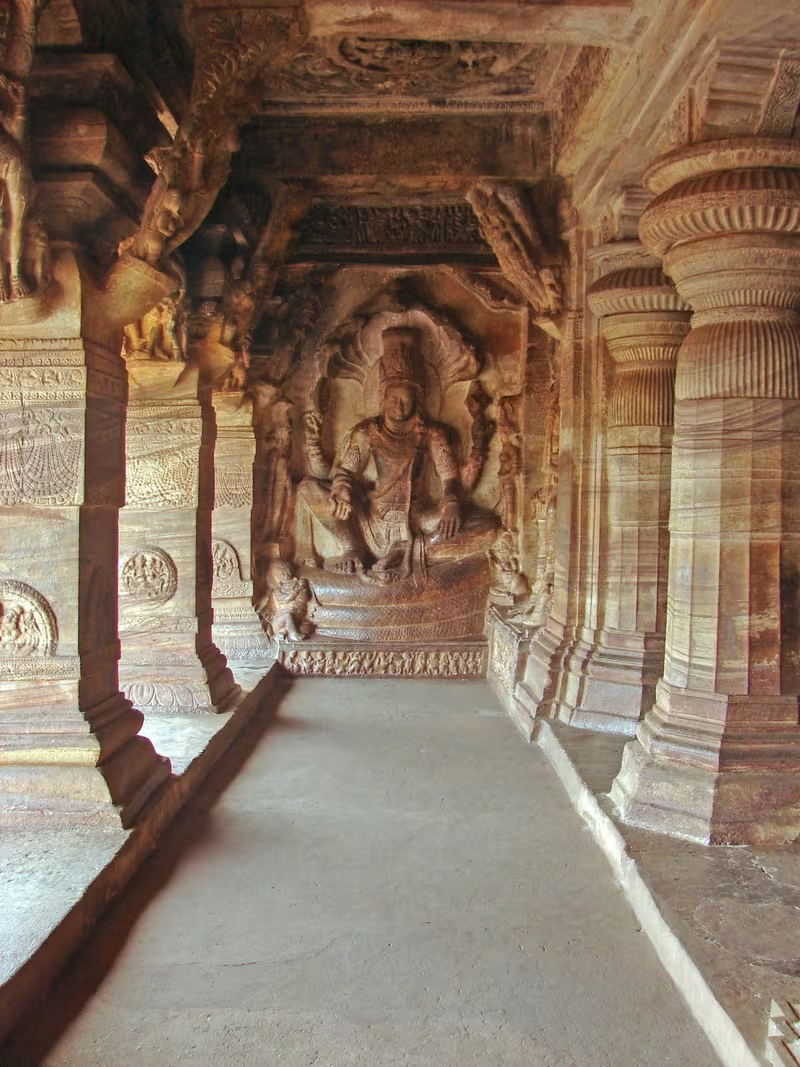
Beyond his military exploits, Mangalesha left a permanent legacy as a great patron of art and architecture. His most celebrated contribution is the completion of the magnificent rock-cut cave temple at Vatapi (Badami), now known as Cave 3. This grand project was initiated by his brother Kirtivarman I, but it was Mangalesha who saw it through to its glorious completion.
Dedicated to Vishnu, the temple is a masterpiece of early Chalukyan art. Its facade is adorned with massive, intricately carved pillars, and the interior sanctum houses breathtaking, colossal reliefs of Vishnu's various forms, including Trivikrama, Varaha, and Narasimha. The artistry is a testament to the skill of the Chalukyan sculptors and the grand vision of their royal patron.
A crucial historical artifact, the Badami cave inscription, is carved into a pillar of this temple. Dated to the 12th year of his reign, corresponding to 578 CE, it is one of the most important records of his time. The inscription provides invaluable information:
- Confirmation of Patronage: It explicitly states that Mangalesha excavated and completed this magnificent cave temple dedicated to Vishnu.
- Religious Devotion: It refers to him as a Parama-bhagavata, a devout follower of Vaishnavism, confirming his personal faith.
- Royal Generosity: The inscription records a grant of the village of Lanjishvara to a group of sixteen Brahmins for the performance of specific rituals, showcasing his support for the Brahminical tradition.
The Vishnu cave temple stands today as a powerful symbol of Mangalesha's piety and his commitment to creating lasting monuments of cultural and religious significance. It is a direct, tangible link to his reign and a highlight of the Deccan's artistic heritage.
The Seeds of Conflict: Ambition and Succession
For all his successes as a regent, a fatal flaw began to emerge in Mangalesha's character: ambition. As his power grew and his reign lengthened, the idea of simply handing over the throne to his nephew, Pulakeshin II, became less appealing. He had ruled the kingdom as his own, expanded its borders, and enriched its culture. Perhaps he felt he had earned the right to establish his own dynasty.
Our primary source for this turn of events is the Aihole inscription of Pulakeshin II. It must be read with caution, as it is a victor's account designed to legitimize Pulakeshin's rule and vilify Mangalesha. According to this record, Mangalesha became envious of his nephew's virtues and popularity. As Pulakeshin II came of age, he likely displayed the qualities of a charismatic and capable leader, which Mangalesha may have perceived as a threat to his own authority.
The breaking point came when Mangalesha attempted to secure the succession for his own son. By seeking to bypass the rightful claim of Kirtivarman I's heir, he violated the sacred trust placed in him as regent. This act transformed him from a loyal uncle into a usurper in the eyes of Pulakeshin II and his supporters. For the young prince, this was an unforgivable betrayal that left him with no choice but to fight for his birthright.
The Inevitable Clash: The Civil War
Faced with his uncle's treachery, Pulakeshin II was forced to flee the capital of Vatapi. He began to rally allies and build an army, preparing for the inevitable conflict. The kingdom was plunged into a civil war, pitting uncle against nephew in a struggle for the Chalukyan throne.
Details of the war are sparse, but the Aihole inscription provides a summary of the outcome. It states that Mangalesha possessed a large and powerful army, complete with formidable elephant corps. However, Pulakeshin II, despite having fewer resources, had two key advantages: superior strategy (mantra-shakti) and boundless energy (utsaha-shakti). He outmaneuvered his uncle, and in the ensuing conflict, Mangalesha was defeated and killed.
The inscription states that Mangalesha's kingdom, along with his life, was lost in the very act of trying to secure it for his son. The regent who had so successfully expanded the kingdom's frontiers was ultimately consumed by his own internal ambition. Around 610 CE, the civil war concluded, and Pulakeshin II, having vanquished his rival, ascended the throne of Vatapi.
Legacy: A Complicated Figure
Mangalesha remains one of the most intriguing figures of the Chalukya dynasty. His legacy is a study in contrasts. On one hand, he was a brilliant and effective ruler. His military victories against the Kalachuris and the conquest of Revatidvipa were not minor skirmishes; they were foundational achievements that significantly strengthened the Chalukyan state and paved the way for the imperial ambitions of his successor.
His cultural contribution is equally undeniable. The Vishnu cave at Badami is a world heritage monument, a testament to his artistic vision and religious devotion. He was, for most of his reign, a successful steward of the kingdom, protecting and expanding it as a regent should.
On the other hand, his legacy is forever tainted by his final, fatal act of ambition. His attempt to subvert the line of succession led to a destructive civil war and his own death. In the annals of history, written by the victor, he is remembered not just as a conqueror and builder, but as a usurper who was rightfully overthrown. He serves as a powerful cautionary tale of how personal ambition can undo a lifetime of achievement. Though his reign ended in tragedy, the kingdom that Mangalesha helped build would, under his nephew, rise to become one of the greatest empires in Indian history.