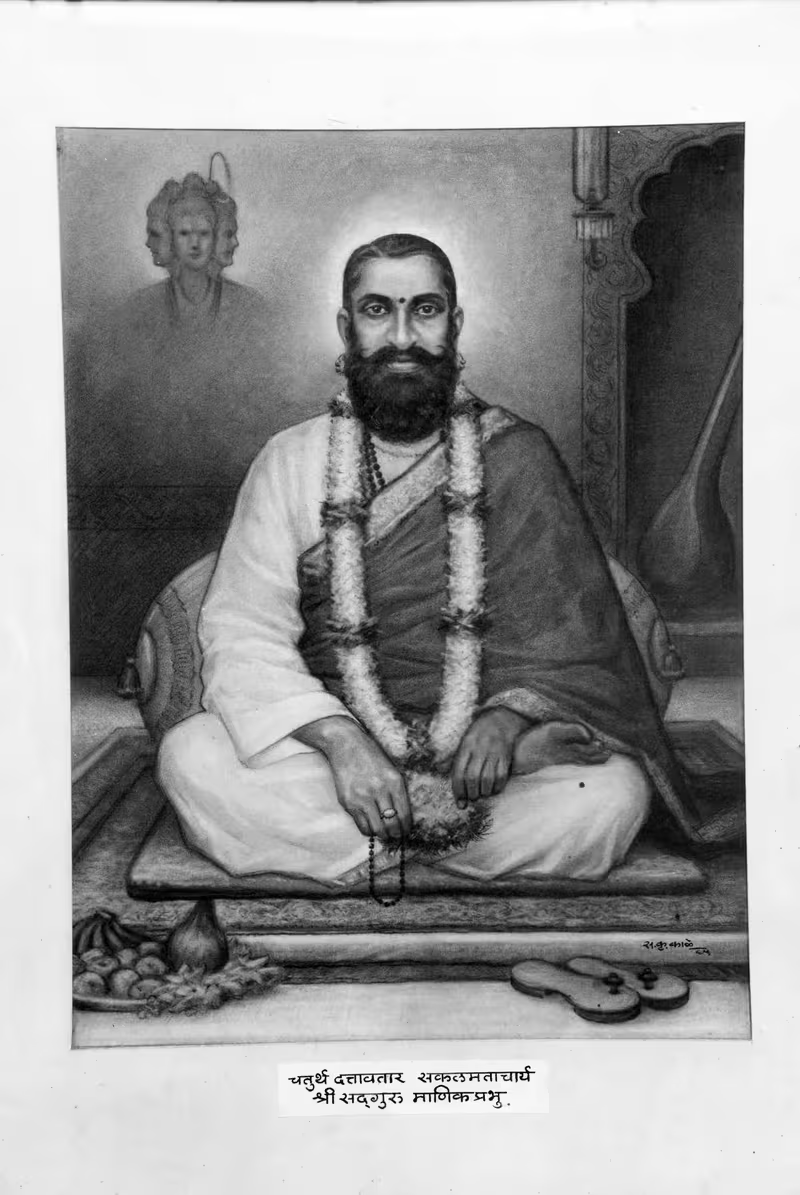
Manik Prabhu Maharaj: The Sage of Universal Harmony
In the heart of the 19th-century Deccan plateau, a region of complex cultural and political currents, there emerged a spiritual luminary whose message of universal love and non-duality transcended the rigid boundaries of caste and creed. Manik Prabhu Maharaj (1817-1865) was more than a saint; he was a philosopher, a poet, and the architect of a unique spiritual path known as the Sakalamata Sampradaya, or the 'Path of All Faiths'. His life, though brief, became a powerful testament to the Advaita Vedanta philosophy, demonstrating that the ultimate truth could be approached through any sincere path, a message that continues to resonate from the hallowed grounds of Maniknagar, the spiritual abode he established.
Early Life & Background
A Child of Divine Disposition
Manik Prabhu was born on December 22, 1817, a day of great auspiciousness, coinciding with Datta Jayanti, the birth anniversary of the Hindu deity Lord Dattatreya. His birthplace was the village of Ladwanti, near Kalyan in the Bidar district of what is now Karnataka, a region then under the suzerainty of the Nizam of Hyderabad. Born into a Deshastha Brahmin family to Manohar Naik and Bheemabai, he was named Manik, a jewel, a name that would prove prophetic.
From his earliest years, Manik displayed a disposition that set him apart from his peers. While other children engaged in youthful games, he was drawn to solitude and introspection. He showed little interest in formal education, often wandering off into the nearby forests and hills, where he would sit for hours in deep meditation, seemingly absorbed in a world beyond the grasp of others. His parents, though devout, were initially perplexed and concerned by his unconventional behaviour.
An incident from his childhood, documented in his hagiographies, provides a profound insight into his nascent worldview. At the age of seven, having been missing for some time, he was found by his uncle meditating in a dense forest. When chided for abandoning his home and family, the young Manik is said to have replied with a wisdom far beyond his years: "The entire world is my home, and all its men and women are my parents." This statement was not mere childish fancy but the foundational principle of a philosophy he would later champion—the essential oneness of all creation.
The Wandering Ascetic
As he grew, his spiritual yearning intensified. Feeling the call of a higher purpose, he left his home as a young man, embarking on an extensive pilgrimage across the Indian subcontinent. Like the great sages before him, he traveled as a wandering ascetic, his only possessions being the clothes on his back and an unshakeable faith. His journey took him to some of the most sacred spiritual centers of the time, including Pandharpur, the seat of Lord Vithoba; Tuljapur, home of the goddess Bhavani; and Gangapur, a major center for the worship of Lord Dattatreya.
These travels were his true education. He engaged with saints, scholars, and common folk from diverse traditions, absorbing the varied spiritual currents of the land. This period of itinerant life solidified his conviction in the unity of all religious experience. He saw firsthand that while the rituals, languages, and deities differed, the underlying quest for the divine was universal. He came to believe that Hinduism, Islam, and all other faiths were simply different streams flowing towards the same infinite ocean of truth.
Career & Major Contributions
The Founding of Maniknagar and the Sakalamata Sampradaya
After years of wandering, in 1845, Manik Prabhu Maharaj arrived at a humble village called Maniyur, situated near Humnabad. The tranquil atmosphere of the place, located at the confluence of two small streams, appealed to his meditative spirit. He decided to end his travels and establish a spiritual center here. Over time, as his fame grew, Maniyur came to be known as Maniknagar—the city of Manik.
It was here that he formally established his unique philosophical and spiritual movement: the Sakalamata Sampradaya. The name itself was a declaration of his mission. 'Sakala Mata' translates to 'all faiths' or 'all doctrines'. It was not a new religion but a syncretic spiritual platform that welcomed seekers from every background. Its core tenet was that all religions are valid paths to the one, formless, attributeless Ultimate Reality, or Brahman, as described in the Advaita Vedanta tradition.
This was a revolutionary concept in a society often fractured by religious and caste-based divisions. Manik Prabhu actively dismantled these barriers. His followers included Brahmins, Lingayats, Marathas, and a significant number of Muslims, who saw in him a true Pir or holy man. At Maniknagar, devotion, not birthright, was the only criterion for acceptance.
The Guru's Darbar: A Court of Spiritual Sovereignty
One of the most distinctive traditions established by Manik Prabhu was that of the Darbar (royal court). Each day, he would sit on a Gadi (throne) in a hall open to all. This was not an act of temporal kingship but a powerful spiritual metaphor. The Gadi did not represent his personal authority but symbolized the seat of the Supreme Guru, Lord Dattatreya, with Manik Prabhu acting as its humble occupant and spiritual guide.
In this Darbar, he was accessible to everyone. Peasants and princes, scholars and the illiterate, Hindus and Muslims—all could approach him with their worldly troubles and spiritual questions. He would offer counsel, resolve disputes, and deliver profound discourses on the nature of reality. The atmosphere was one of divine grace and unconditional acceptance. A central feature of life at Maniknagar was the Annadana, a community kitchen that served free meals to every visitor, regardless of their social standing, embodying the principle of selfless service and equality.
Philosophical Teachings and Literary Works
Manik Prabhu Maharaj's philosophy was a masterful blend of the high metaphysics of Advaita Vedanta and the accessible path of Bhakti (devotion). He taught that the ultimate goal of human life was to realize one's true identity with the non-dual Brahman. However, he recognized that the path of pure knowledge (Jnana Marga) was difficult for most. Therefore, he championed devotion to a personal God, particularly Lord Dattatreya—whom his followers revere him as an incarnation of—as the most effective means to purify the mind and attain enlightenment.
He was also a gifted poet and composer. He expressed his philosophical insights through hundreds of devotional songs known as padas and abhangas. Composed in the vernacular languages of the people—Marathi, Kannada, and Hindi—these songs made the profound truths of Vedanta accessible to the common person. His compositions are collected in a volume titled Padyamala. His core teachings were later compiled by his disciples into works such as Guru Jnana Sudha and Anubhava Marga, which serve as foundational texts for the Sampradaya.
Legacy & Influence
The Unbroken Lineage of the Gadi
On November 29, 1865 (the tenth day of the month of Margashirsha), Manik Prabhu Maharaj announced to his devotees that his life's mission was complete. He entered a state of meditative equipoise and consciously left his physical body, an act known as Sajiva Samadhi. He had, however, ensured that his work would continue.
Being a lifelong celibate, he did not have a biological heir. Instead, he established the Guru Parampara, a spiritual lineage where the successor is chosen based on merit and spiritual readiness. Before his passing, he adopted his nephew, Martand, and initiated him as his successor, who then took on the name Manik Prabhu. This tradition continues to this day, with the occupant of the Gadi at Maniknagar serving as the spiritual head of the Sampradaya. The Maniknagar Samsthan has since grown into a sprawling spiritual and educational center, preserving the flame of his teachings.
A Lasting Impact on Deccan's Culture
Manik Prabhu Maharaj's most enduring legacy is his unwavering message of religious harmony. In a region that was a historical crossroads of Hindu and Islamic cultures, his ability to attract and unify followers from both traditions was a remarkable achievement. He demonstrated that at the mystical heart of both faiths lay a common aspiration for the divine. He is remembered as a spiritual bridge, a figure who healed divisions and fostered a culture of mutual respect that was far ahead of its time.
His Sakalamata Sampradaya remains a vibrant, living tradition. Every year, thousands of devotees flock to Maniknagar, especially for the Datta Jayanti celebrations, which commemorate his birth. The daily Darbar continues, and the community kitchen still serves all who come. His devotional songs are sung with fervor, carrying his message of love, unity, and the singular, all-pervading divine reality.
Manik Prabhu Maharaj was a jewel of 19th-century India. He was a Vedantin with the heart of a Bhakta, a philosopher who spoke in the language of the people, and a saint who saw God in every human being. In a world still grappling with religious intolerance and social division, the life and teachings of this sage from Maniknagar remain a profound and urgent reminder of our shared humanity and the singular truth that unites us all.