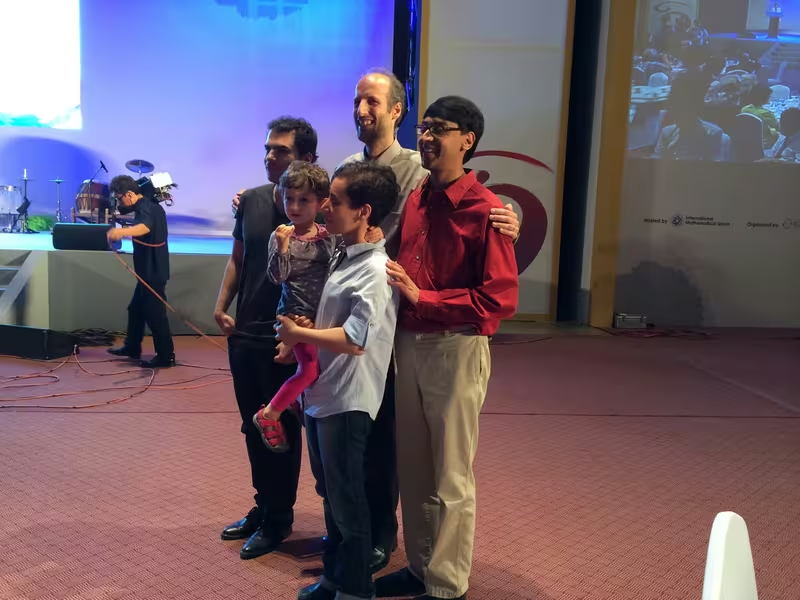
Manjul Bhargava - Fields Medalist and Number Theorist
In the vast and often abstract universe of pure mathematics, some minds see not just equations, but poetry. They hear not just logic, but music. They perceive in the infinite tapestry of numbers a deep, underlying harmony that connects the modern world to the ancient. Manjul Bhargava is one such mind. A mathematician of breathtaking creativity and profound insight, he stands as a monumental figure in modern science. In 2014, he was awarded the Fields Medal, often described as the Nobel Prize of mathematics, becoming the first person of Indian origin to receive this highest of honours. His story is not just one of intellectual triumph, but a beautiful confluence of ancient Indian wisdom and cutting-edge mathematical research, a testament to a heritage that has long celebrated the dance of numbers.
The Making of a Mathematician: Early Life and Influences
Manjul Bhargava was born on August 8, 1974, in Hamilton, Ontario, Canada, to Indian immigrant parents, but spent his formative years growing up on Long Island, New York. His intellectual journey was nurtured in a home where curiosity was the currency and knowledge a cherished inheritance. His mother, Mira Bhargava, was herself a mathematician and a professor at Hofstra University, and she became his first and most influential teacher. She recognized his precocious talent not through formal lessons, but by observing his innate curiosity. A now-famous family anecdote recounts how a young Manjul, fascinated by a crate of oranges at a grocery store, began experimenting with different ways to stack them. He intuitively discovered the most efficient arrangement—the face-centered cubic packing—a problem that has intrigued mathematicians for centuries. His mother nurtured this spirit, encouraging him to see mathematics not as a rigid set of rules, but as a playground for exploration and discovery.
While his immediate environment in America shaped his modern education, his connection to India provided a deeper, more ancient wellspring of inspiration. His grandfather, Purushottam Lal Bhargava, was a renowned scholar in Jaipur, Rajasthan, and the head of the Sanskrit department at the University of Rajasthan. During frequent family trips to India, Manjul was immersed in a world of Sanskrit poetry, ancient texts, and classical Indian thought. His grandfather would share with him the works of ancient Indian mathematicians like Brahmagupta, Āryabhaṭa, and Piṅgala. He learned that these scholars from centuries past were not just computing, but were composing—finding intricate patterns and structures, or sangeet (music), in the world of numbers. He was particularly captivated by the work of Brahmagupta from the 7th century, whose sophisticated composition law for binary quadratic forms would later become a central theme in his own research.
This dual heritage—the rigorous mathematical training of the West and the poetic, philosophical approach of the East—became the hallmark of his genius. He excelled in his formal education, graduating as valedictorian from Plainedge High School in 1992. He went on to Harvard University, where his brilliance was immediately apparent. For his undergraduate thesis, he proved a series of stunning results that astonished the faculty, and he was awarded the prestigious Morgan Prize in 1996 for his work. He then moved to Princeton University for his doctorate, where he studied under the guidance of Sir Andrew Wiles, the celebrated mathematician who had famously proven Fermat's Last Theorem. It was at Princeton that Bhargava would complete the doctoral thesis that would send shockwaves through the world of number theory and set the stage for his future triumphs.
Composing Numbers: A Symphony of Breakthroughs
Manjul Bhargava’s work is characterized by its elegance, its power, and its ability to solve problems that have remained intractable for centuries. He often achieves this by translating highly abstract algebraic problems into more intuitive, tangible questions in the geometry of numbers, a technique he has masterfully developed.
Higher Composition Laws: The cornerstone of his early career was his Ph.D. thesis, published in 2004. In it, he addressed a problem first explored by the legendary German mathematician Carl Friedrich Gauss in 1801. Gauss had discovered a remarkable “composition law” for binary quadratic forms—a way to combine two of these algebraic objects to produce a third. For 200 years, mathematicians had tried and failed to find similar laws for higher-degree polynomials. It was widely believed that Gauss’s law was a unique, isolated miracle of mathematics. Bhargava, thinking in a completely novel way, proved everyone wrong. He discovered not one, but thirteen new composition laws, generalizing Gauss’s work in a stunning display of creative insight. He achieved this by re-imagining the problem geometrically, using tools as simple as a Rubik's Cube and a sliced-up box to visualize the underlying structures. This work was hailed as a monumental breakthrough, solving a two-century-old mystery and opening up entirely new avenues of research.
The Average Rank of Elliptic Curves: One of the most significant open questions in mathematics is the Birch and Swinnerton-Dyer conjecture, a Millennium Prize Problem with a million-dollar reward. It deals with elliptic curves, which are central to modern cryptography and number theory. A key aspect of this conjecture involves understanding the “rank” of these curves. Along with his student Arul Shankar, Bhargava made a historic breakthrough by proving that the average rank of elliptic curves is less than 1. This was a colossal step towards resolving the conjecture and demonstrated the power of the new geometric methods he had developed. This work, published in 2015, is considered one of the most important results in number theory in the 21st century.
Bhargava's Factorials: Even a concept as fundamental as the factorial (the product of all integers up to a given number, e.g., 5! = 5×4×3×2×1) was not beyond his reimagining. He developed a generalized factorial function that works for any subset of integers, a creation that has found surprising applications in number theory and combinatorics.
For this extraordinary body of work, the accolades poured in. He received the SASTRA Ramanujan Prize in 2005, the Fermat Prize in 2011, and the Infosys Prize in 2012. The culmination came in 2014 at the International Congress of Mathematicians in Seoul, South Korea, where he was awarded the Fields Medal. The citation celebrated his development of “powerful new methods in the geometry of numbers” and their application to “count rings and to bound the average rank of elliptic curves.” In 2015, the Government of India further honoured him with the Padma Bhushan, its third-highest civilian award.
The Sangeet of Mathematics: Legacy and Influence
Manjul Bhargava's legacy transcends his specific mathematical theorems. He has fundamentally reshaped our understanding of number theory, but perhaps more importantly, he has built a bridge between disparate worlds: ancient and modern, East and West, art and science.
He is a powerful advocate for the rich mathematical heritage of India, often speaking about how the metrical structures of Sanskrit poetry informed his understanding of abstract patterns. He sees a direct line from the discoveries of Brahmagupta to his own work on composition laws, framing his achievement not as a solitary act of genius, but as a continuation of a conversation that has been ongoing for over a millennium. For India, his Fields Medal was a moment of immense national pride. He became an instant icon, a symbol of the nation's enduring intellectual prowess and a powerful inspiration for millions of students to pursue the sciences with passion and creativity.
Bhargava’s life also exemplifies the harmonious relationship between art and mathematics. He is an accomplished tabla player, having studied for years under the legendary virtuoso Ustad Zakir Hussain. He finds the same pursuit of rhythm, pattern, and underlying structure in both his music and his mathematics. For him, the tabla’s intricate rhythmic cycles (taals) are a physical manifestation of the same mathematical beauty he uncovers in number theory. This holistic view—that mathematics is not a cold, sterile discipline but a creative, artistic, and deeply human endeavour—is perhaps his most profound contribution to the culture of science.
Today, Manjul Bhargava continues to push the boundaries of knowledge as the R. Brandon Fradd Professor of Mathematics at Princeton University. He is also actively involved in shaping mathematics education in India, advocating for a curriculum that emphasizes discovery and joy over rote memorization. He reminds us that the quest for knowledge is universal and timeless, and that the answers to tomorrow's most complex problems may well be inspired by the wisdom of the ancient past. In the grand itihaas of human thought, Manjul Bhargava is both a brilliant new voice and a keeper of an ancient, harmonious flame.