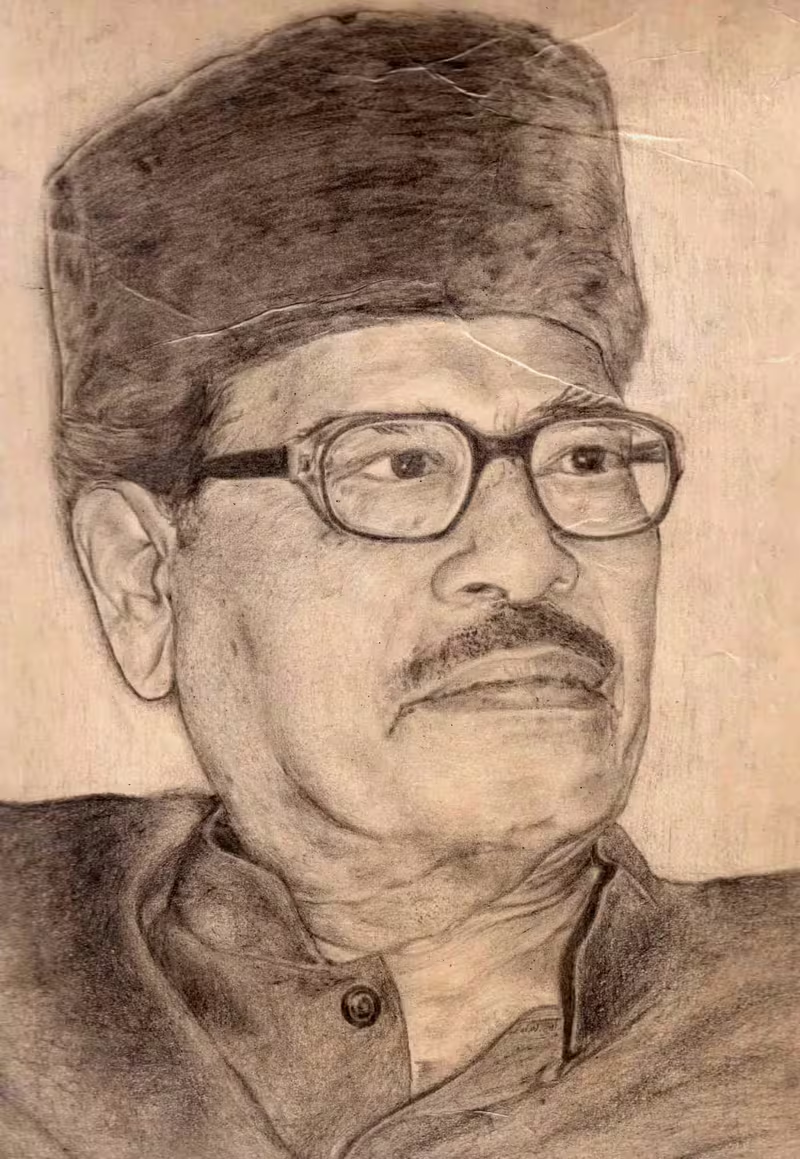
The Voice of a Generation: Manna Dey's Enduring Legacy
In the grand pantheon of Indian playback singers, where voices like Mohammed Rafi, Kishore Kumar, and Mukesh defined the quintessential sound of the cinematic hero, there existed a fourth pillar, a maestro whose voice was a genre unto itself: Prabodh Chandra Dey, known to the world as Manna Dey. He was the artist's artist, the musician's singer, a classically trained titan who infused popular film music with a depth, complexity, and soul that remains unmatched. From the wistful philosophy of 'Zindagi Kaisi Hai Paheli' to the intricate classical masterpiece of 'Poocho Na Kaise Maine Rain Bitai', Manna Dey’s voice was a finely-honed instrument that could traverse the entire spectrum of human emotion, solidifying his place as one of the most versatile and respected vocalists of India’s golden age of cinema.
Early Life & Musical Awakening in Calcutta
Prabodh Chandra Dey was born on May 1, 1919, in Calcutta (now Kolkata), the vibrant cultural capital of British India. Music was deeply embedded in the fabric of his household. His father, Purna Chandra Dey, and mother, Mahamaya Dey, nurtured a creative environment, but the most profound musical influence in young Prabodh's life was his paternal uncle, the legendary blind singer and composer Krishna Chandra Dey, fondly known as K.C. Dey.
K.C. Dey was a musical institution in his own right, a revered figure in the Bengali music scene. It was under his formidable tutelage that Manna Dey took his first, formative steps into the world of music. Initially, the young boy was more interested in the boisterous energy of wrestling and boxing, a passion he pursued with vigour at his school, the Scottish Church Collegiate School. However, the pull of his uncle's music was irresistible. He would sit for hours, listening intently as K.C. Dey composed and practiced, slowly absorbing the nuances of rhythm, melody, and expression. He became his uncle's dedicated shishya (disciple), accompanying him and meticulously learning the demanding art of Indian classical music.
His formal education continued at Scottish Church College and later Vidyasagar College, but his true university was the school of K.C. Dey. Beyond his uncle's guidance, he also sought training from other masters like Ustad Dabir Khan. This rigorous classical grounding distinguished him from many of his contemporaries and would become the bedrock of his illustrious career. It provided him with a technical mastery that allowed him to tackle the most complex compositions with an ease that belied their difficulty.
From Calcutta to Bombay: The Ascent of a Maestro
In 1942, Manna Dey’s journey took a decisive turn when he accompanied his uncle to Bombay (now Mumbai), the bustling centre of the Hindi film industry. His initial role was that of an assistant, first to K.C. Dey and later to another musical giant, Sachin Dev Burman (S.D. Burman). This apprenticeship was invaluable, offering him a behind-the-scenes look at the mechanics of film music composition and recording.
His playback debut came the same year in the film Tamanna. He sang the duet "Jago Aayee Usha" with the actress-singer Suraiya, a composition by his uncle. While it was a start, the path to stardom was not immediate. The Hindi film industry of the 1940s and 50s was a competitive landscape, and Manna Dey had to painstakingly carve a niche for himself.
His classical prowess became his calling card. Music directors, recognizing his unique ability, began entrusting him with songs that other singers found too challenging. It was S.D. Burman who gave him one of his earliest significant hits, "Upar Gagan Vishal" for the film Mashal (1950). The song's serene, spiritual quality, rendered with flawless control, captured the audience's attention and announced the arrival of a special voice.
The Voice of Raj Kapoor and a New Era
The mid-1950s saw Manna Dey become the playback voice for the legendary actor-director Raj Kapoor in films composed by the iconic duo Shankar-Jaikishan. While Mukesh was Kapoor's primary voice for melancholic solos, Manna Dey was chosen for romantic duets and complex, upbeat numbers. This collaboration produced some of the most timeless melodies in Indian cinema. Songs like "Pyaar Hua Ikraar Hua" (Shree 420, 1955), "Yeh Raat Bheegi Bheegi" (Chori Chori, 1956), and "Aaja Sanam Madhur Chandni Mein Hum" (Chori Chori, 1956), all duets with Lata Mangeshkar, became anthems of romance for a generation.
A Master of All Moods
To label Manna Dey as merely a classical-based singer would be to misunderstand his genius. His versatility was his greatest strength. He could effortlessly modulate his voice to fit any character, mood, or genre.
The Qawwali King: His rendition of "Na To Karvan Ki Talash Hai" in Barsaat Ki Raat (1960) is considered one of the greatest qawwalis ever recorded in film history. His powerful, soaring vocals anchored the ensemble piece, making it a cultural touchstone.
The Comedic Genius: He showcased a playful, spirited side in songs like "Aao Twist Karen" (Bhoot Bungla, 1965). His crowning achievement in this genre was the legendary musical duel "Ek Chatur Naar Karke Sringar" from Padosan (1968). Pitted against Kishore Kumar (singing for Sunil Dutt), Manna Dey (singing for Mehmood) delivered a tour de force of classical virtuosity and comedic timing, creating a moment of pure cinematic magic.
The Romantic and the Philosophical: He could be the voice of mature romance in Balraj Sahni's "Ae Meri Zohra Jabeen" (Waqt, 1965), a song that continues to be a favourite at weddings. At the same time, he could delve into deep introspection. The hauntingly beautiful "Zindagi Kaisi Hai Paheli" from Anand (1971) captured the film's poignant philosophy on life and death. Similarly, his voice lent a profound weight to the patriotic and philosophical lyrics of "Kasme Waade Pyar Wafa" for the character actor Pran in Upkar (1967).
The Classical Virtuoso: When a composition demanded pure, unadulterated classicism, Manna Dey was the undisputed choice. His rendition of S.D. Burman's composition "Poocho Na Kaise Maine Rain Bitai," based on Raga Ahir Bhairav, for the film Meri Surat Teri Ankhen (1963) remains a benchmark for classical singing in films.
Beyond Hindi cinema, Manna Dey was a cultural icon in Bengal. He recorded thousands of songs in Bengali, creating a distinct legacy of Adhunik Gaan (modern songs). Compositions like "Coffee Houser Shei Adda Ta" became an anthem of nostalgia and camaraderie for generations of Bengalis, a song that transcends music to become a cultural artifact. His command over multiple languages saw him record songs in Marathi, Gujarati, Assamese, Malayalam, and Kannada, making him a truly pan-Indian artist.
Legacy & Enduring Influence
Manna Dey passed away on October 24, 2013, in Bangalore, but his voice remains immortal. His legacy is not just in the thousands of songs he recorded but in the standard of excellence he set. He was a cornerstone of the Golden Age of Indian music, a singer who elevated the craft and demonstrated that technical mastery and popular appeal could go hand in hand.
His historical significance lies in his unique ability to bridge the gap between two worlds: the rigorous discipline of Indian classical music and the accessible, melodic universe of film music. He expanded the emotional palette of the Hindi film song, often lending his voice not to the dashing hero, but to the wise elder, the common man, or the character actor, giving them unforgettable musical identities.
His immense contribution was recognised with India's highest honours. He received the National Film Award for Best Male Playback Singer twice, the Padma Shri in 1971, the Padma Bhushan in 2005, and finally, the Dadasaheb Phalke Award in 2007, the highest honour in Indian cinema.
Manna Dey is remembered today as the "singer's singer," a vocalist deeply admired by his peers and successors for his flawless technique, incredible range, and profound musicality. His songs are not mere relics of a bygone era; they are masterclasses in vocal expression that continue to inspire and move listeners. Whether it is the playful banter of a comedy song, the devotion of a bhajan, or the complex tapestry of a classical raga, the voice of Manna Dey endures—a timeless testament to a life devoted to the relentless pursuit of musical perfection.