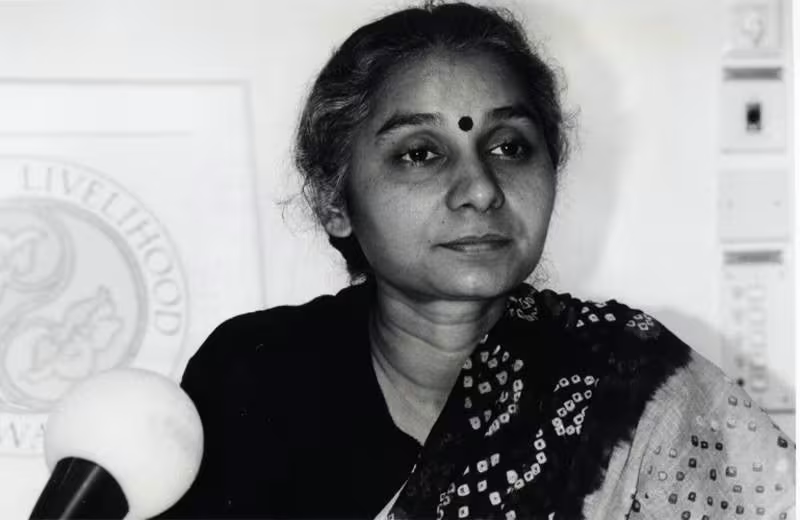
Medha Patkar - A Voice for the Voiceless
In the vast, complex tapestry of modern Indian history, few figures embody the spirit of relentless, non-violent resistance as powerfully as Medha Patkar. For decades, her name has been synonymous with the Narmada Bachao Andolan (NBA), one of the most significant and sustained grassroots environmental and social justice movements in the world. Patkar is more than just an activist; she is a conscience-keeper, a formidable intellectual, and a tireless advocate who has dedicated her life to questioning the dominant narrative of 'development' and giving voice to the millions silenced in its name. Her journey from a young social work scholar to the face of popular movements across India is a testament to the power of conviction against the might of the state and global finance.
The Making of an Activist: Early Life and Education
Medha Patkar was born on December 1, 1954, in Mumbai, into a family deeply steeped in the ethos of social service and political engagement. Her father, Vasant Khanolkar, was an active trade unionist and a freedom fighter in India's independence struggle. Her mother, Indumati Khanolkar, was a gazetted officer in the Posts and Telegraphs department who also worked with 'Swadhar,' an organization providing support to women facing difficult circumstances. Growing up in this environment, Patkar was exposed to ideals of social justice, equality, and public service from a very young age. The dinner table conversations and the values her parents lived by laid a powerful foundation for her future path.
Her academic journey further sharpened her social consciousness. She pursued a Master of Arts in Social Work from the prestigious Tata Institute of Social Sciences (TISS), Mumbai. TISS was a crucible of critical thinking, exposing her to the deep-seated structural inequalities plaguing Indian society. It was here that she honed her understanding of policy, governance, and the often-devastating impact of state-led projects on marginalized communities.
Following her Master's, Patkar began work with voluntary organizations in the slums of Mumbai and rural Gujarat. She was also pursuing a Ph.D., focusing on the impact of development on traditional societies. However, a pivotal moment arrived in the mid-1980s. As part of her research, she began visiting the Narmada valley, a region slated for one of the most ambitious and controversial development projects in Indian history: a cascade of over 30 large dams, 135 medium dams, and 3,000 minor dams along the Narmada River. What she witnessed there—the scale of impending displacement, the lack of information provided to the affected communities, and the sheer human and ecological cost—compelled her to make a life-altering decision. In 1985, she left her Ph.D. program midway, choosing to immerse herself completely in the struggle of the people of the Narmada valley.
The River's Roar: Narmada Bachao Andolan
The Narmada Valley Development Project, particularly its centerpiece, the Sardar Sarovar Project (SSP) in Gujarat, was championed as a lifeline that would provide water and electricity to millions. However, its hidden cost was staggering. The project was set to submerge hundreds of villages and vast tracts of forest and agricultural land, displacing an estimated quarter of a million people, predominantly from Adivasi (tribal) and Dalit communities who had lived on and cultivated that land for generations.
Initially, Patkar's work involved studying the project's official documents and comparing them with the reality on the ground. She discovered massive discrepancies, particularly concerning the government's resettlement and rehabilitation (R&R) plans, which were woefully inadequate or, in many cases, non-existent. Armed with this information, she began organizing the local communities, traveling from village to village, explaining the true implications of the dam, and building a network of resistance.
In 1989, these disparate local groups formally coalesced under a single banner: the Narmada Bachao Andolan (Save the Narmada Movement). Medha Patkar emerged as its most prominent and articulate leader. The NBA’s philosophy was rooted in Gandhian principles of non-violent civil disobedience (satyagraha). Their methods were a powerful combination of grassroots mobilization, legal action, and symbolic protest.
Patkar led long marches (Sangharsh Yatras), organized sit-ins, and, most famously, undertook numerous fasts that brought the issue to national and international attention. Her 22-day fast in 1991, which brought her close to death, was a turning point that forced the central government to take notice. The NBA’s core argument was not simply a rejection of development, but a demand for a more just, equitable, and sustainable model. They asked fundamental questions: Who benefits from this development? And who pays the price? Why should the poorest and most vulnerable communities be forced to sacrifice their homes, lands, and culture for the prosperity of others?
One of the NBA's most significant victories came in 1993. After immense pressure from the movement and its global supporters, the World Bank, a major funder of the Sardar Sarovar Project, was forced to conduct an independent review. The resulting Morse Commission report was a scathing indictment of the project, validating nearly all of the NBA's claims regarding environmental and social violations. Humiliated by the findings, the World Bank withdrew its funding from the project, a landmark achievement for a grassroots movement taking on a global financial institution.
Despite this victory, the Indian government pushed forward. The NBA's fight moved to the Supreme Court of India in a long and arduous legal battle. The court's judgments were often complex and did not always favor the movement. In a controversial 2000 ruling, it allowed construction to resume, albeit with strict conditions on rehabilitation. For Patkar and the NBA, the struggle did not end; it merely shifted focus to ensuring that the rights of every displaced family were upheld, a fight that continues to this day.
Beyond the Valley: A National Vision for Justice
While the Narmada struggle remained her life's central work, Medha Patkar understood that the issues at play were not unique to one river valley. The policies of globalization and liberalization adopted by India in the 1990s were creating similar conflicts over land, water, and resources across the country. To unite these disparate struggles, Patkar co-founded the National Alliance of People's Movements (NAPM) in 1996.
The NAPM serves as an umbrella organization for a wide array of social movements—from farmers and fishworkers to anti-mining activists and women's groups. It provides a national platform to advocate for an alternative development paradigm, one that prioritizes social equity, environmental sustainability, and community control over resources. Through the NAPM, Patkar's influence expanded, and she became a key figure in numerous other campaigns:
- Singur Land Agitation: She stood in solidarity with farmers in West Bengal protesting the forced acquisition of their land for the Tata Nano car factory.
- Mumbai Slum Dwellers: Through the Ghar Bachao Ghar Banao Andolan (Save Homes, Build Homes Movement), she has fought for the housing rights of the urban poor facing eviction.
- Lavasa Project: She led the opposition against the controversial luxury hill city project near Pune, highlighting its massive environmental violations.
- Anti-Nuclear Protests: She has supported local communities protesting the establishment of nuclear power plants, such as the one in Kovvada, Andhra Pradesh.
In 2014, in an attempt to influence policy from within the legislative system, Patkar contested the Lok Sabha elections from the Mumbai North East constituency as a candidate for the Aam Aadmi Party (AAP). Though she did not win, her campaign was a significant effort to bring the politics of people's movements into the electoral mainstream. She later resigned from the party, returning her full focus to grassroots activism.
Legacy and Influence: Redefining Development
Medha Patkar's legacy is profound and multi-layered. She and the Narmada Bachao Andolan fundamentally altered the discourse on development in India. Before the NBA, large dams were seen as unquestionable 'temples of modern India,' a phrase coined by Jawaharlal Nehru. Patkar and her fellow activists forced the nation to confront the dark side of this model—the immense human suffering and ecological destruction it often entailed. They successfully embedded the principles of social justice, human rights, and environmental impact assessment into the national conversation about progress.
Her unwavering commitment has earned her both immense admiration and harsh criticism. To her supporters, she is a hero, a fearless champion of the marginalized who speaks truth to power. To her detractors, often aligned with state and corporate interests, she is an obstructionist, an 'anti-development' figure who hinders India's economic growth. This very polarization, however, is a measure of her impact.
Patkar has received numerous international accolades for her work, including the Right Livelihood Award (1991), often called the 'Alternative Nobel Prize,' and the Goldman Environmental Prize (1992). These awards brought global legitimacy to her cause and amplified the voices of the communities she represents.
Today, Medha Patkar remains an active and indomitable force in Indian public life. Her legacy is not just in the battles won or lost, but in the critical questions she has compelled a nation to ask. She has inspired a generation of activists and demonstrated that with courage, perseverance, and a deep commitment to non-violence, ordinary citizens can challenge the most powerful institutions and fight for a more just and sustainable world. Her life's work is a powerful reminder that the true measure of a nation's development lies not in the height of its dams, but in the dignity and well-being of its most vulnerable people.