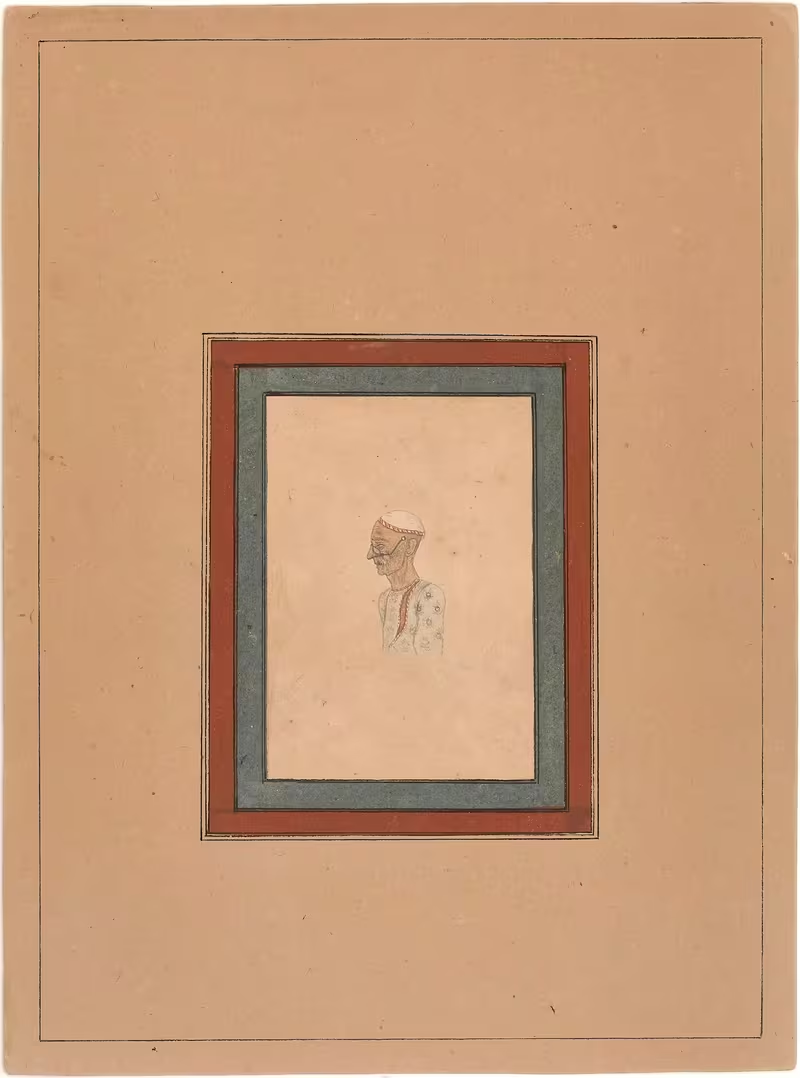
The Soul of a Crumbling Empire: Mir Taqi Mir, Khuda-e-Sukhan
In the tumultuous landscape of 18th-century Hindustan, as the magnificent Mughal Empire fractured under internal decay and external invasions, a voice arose that would come to define not just an era, but the very soul of Urdu poetry. This was the voice of Mir Muhammad Taqi, known to posterity as Mir Taqi Mir (1723-1810). Hailed with the ultimate honorific, Khuda-e-Sukhan (God of Poetry), Mir was more than a poet; he was a chronicler of heartache, a witness to ruin, and the principal architect of the Urdu ghazal. His verses, steeped in a profound and eloquent melancholy, captured the twin sorrows of a broken heart and a collapsing world, solidifying his place as one of the most revered figures in the Indian literary canon.
Early Life: The Making of a Poet in Agra and Delhi
Mir was born in 1723 in Akbarabad (modern-day Agra), a city that still basked in the fading glory of its Mughal zenith. His early life was shaped by his father, Mir Abdullah, a man of deep religious conviction with strong Sufi inclinations. While not a man of great worldly wealth, his father's influence was profound, instilling in the young Mir a foundation in Persian, the language of the court and high literature, and a contemplative, introspective worldview. This spiritual and intellectual inheritance would become the bedrock of his poetic sensibility.
However, tragedy struck early and repeatedly. His father passed away when Mir was just a boy, leaving him in the care of his uncle, Siraj-ud-Din Ali Khan Arzu, a prominent poet in his own right. This period of turmoil was formative. Orphaned and facing financial hardship, the young Mir left Agra for the imperial capital, Shahjahanabad (Delhi), in search of patronage and a future.
He arrived in a Delhi that was a paradox of cultural brilliance and political terror. It was the epicenter of Urdu's literary evolution, home to bustling kuchas (lanes) and grand havelis where mushairas (poetic gatherings) were the lifeblood of the city's elite. Yet, this was also a city living on a knife's edge. The authority of the Mughal emperor was rapidly eroding, and the capital was repeatedly subjected to devastating raids, most notably by the Persian invader Nader Shah in 1739 and the Afghan king Ahmad Shah Abdali multiple times thereafter. It was in this crucible of creativity and chaos that Mir’s poetic genius was forged. The city’s splendor and its suffering became the canvas for his own personal experiences of love, loss, and disillusionment.
Career: The Voice of an Age
In Delhi, Mir quickly began to make his name in the competitive world of poetry. His style was a departure from the ornate, Persian-heavy poetry that was often in vogue. Mir chose a language that was closer to the spoken idiom of the city's educated class—a language that was direct, emotionally resonant, and deceptively simple. This style, known as Sahl-e-mumtana, is one where the simplicity of the verse belies its profound depth and technical perfection. It appears easy to imitate, but is nearly impossible to master.
His primary form was the ghazal, a lyrical form of rhyming couplets expressing the pains of loss, the beauty of the beloved, and the ecstasy of love. Mir elevated it to an art form of unparalleled emotional intensity. His ghazals spoke of unrequited love, the transient nature of life, and a deep-seated sorrow (gham) that was both intensely personal and universally relatable. For Mir, his personal grief (gham-e-jaanan, the sorrow of the beloved) became indistinguishable from the collective grief of his time (gham-e-dauran, the sorrow of the age).
His literary output was immense and foundational. His major contributions include:
The Six Diwans: Mir's magnum opus is his Kulliyat (collected works), which comprises six diwans (volumes of poetry). This colossal collection contains over 13,000 couplets, primarily ghazals, but also other forms like masnavis (narrative poems) and qasidas (odes). These volumes represent the heart of his legacy, a vast ocean of poetic thought that set the standard for generations to come.
Zikr-e-Mir (The Memoir of Mir): Written in Persian, this autobiography is a precious, if stylized, window into his life and mind. It chronicles his personal hardships, his professional rivalries, and his immense pride in his own poetic craft. It offers a firsthand account of the social and political turmoil that defined his world.
Nukat-us-Shura (Points about the Poets): Also in Persian, this work is a tazkira, or a biographical dictionary, of the Urdu poets of his day. It stands as the first major critical work on Urdu poetry, establishing Mir not only as a master practitioner but also as a discerning critic and historian of his craft.
His time in Delhi was marked by a constant search for stable patronage. He was associated with several nobles of the Mughal court, but as their fortunes waned, so did his. The city he loved was plundered and depopulated time and again. The once-great capital was reduced to a shadow of its former self, a reality Mir lamented in his poetry. One of his most famous couplets reflects this pain:
Dilli ke na thay kooche, auraaq-e-musawwar thay
Jo shakl nazar aayi, tasveer nazar aayi
(The lanes of Delhi were not mere streets, but a painter's album pages;
Every face I saw was a masterpiece, a perfect portrait.)
The Exile to Lucknow
By the late 1770s, Delhi had become unlivable. The well of patronage had run dry, and the city was a landscape of ruins and ghosts. Like many other artists and scholars of his generation, Mir made the difficult decision to leave. In 1782, he accepted an invitation from Nawab Asaf-ud-Daula, the ruler of Awadh, and migrated to Lucknow.
Lucknow was the new center of culture and power in North India. Its court was wealthy, extravagant, and a haven for poets, musicians, and artists. But for Mir, a man who carried the soul of old Delhi within him, Lucknow was an alien land. He felt like a relic from a more dignified, somber era, out of place amidst the perceived frivolity and different cultural etiquette of the Lucknow court.
A famous and poignant anecdote, recounted by Mir himself, captures this sense of displacement. Upon his arrival at a mushaira in Lucknow, his old-fashioned attire—a style typical of Delhi—drew smirks and whispers from the elegantly dressed local poets. When asked where he hailed from, Mir responded with a series of heart-rending couplets, including:
Kya bood-o-baash poochho ho poorab ke saakino?
Hum ko ghareeb jaan ke hans hans pukaar ke
Dilli jo ek sheher tha aalam mein intekhaab,
Rehte thay muntakhab hi jahan rozgaar ke
Usko falak ne loot ke veeran kar diya,
Hum rehne waale hain usi ujde dayaar ke
(What is my abode you ask, O residents of the East?
You mock me, thinking me a destitute wanderer.
Delhi, which was a city select in all the world,
Where only the chosen of the age resided.
The heavens have looted and laid it to waste,
And I am an inhabitant of that very ruined land.)
He lived the rest of his long life in Lucknow, respected and provided for, but forever an exile mourning a lost world. He passed away in 1810 and was buried there, far from the city that was his true muse.
Legacy: The Undisputed Master
Mir Taqi Mir’s legacy is monumental. He is not merely a great poet; he is considered the fountainhead from which much of the subsequent tradition of Urdu poetry flows. His influence is so profound that it is impossible to study the ghazal without encountering his shadow.
His historical significance lies in his role as the definitive voice of his age. His poetry is the most powerful elegy ever written for 18th-century Delhi and the Mughal civilization it represented. He universalized his personal pain, making it a metaphor for the decay and disintegration he witnessed all around him.
His impact on literature was immediate and enduring. Every major Urdu poet who followed him has, in some way, contended with his towering presence. The 19th-century master, Mirza Ghalib, who himself reached the pinnacle of Urdu poetry, paid Mir the ultimate tribute in one of his own couplets:
Rekhta ke tumhi ustaad nahin ho Ghalib,
Kehte hain agle zamaane mein koi Mir bhi tha
(You are not the only master of Rekhta, O Ghalib;
They say that in a bygone era, there was a certain Mir.)
Today, Mir Taqi Mir is remembered as the Khuda-e-Sukhan, a title that acknowledges his supreme and almost divine command over the poetic word. His couplets are woven into the fabric of South Asian culture, quoted by scholars and laypersons alike to express the deepest sentiments of love, melancholy, and philosophical resignation. His work remains a testament to the power of art to find timeless beauty even in the midst of profound ruin.