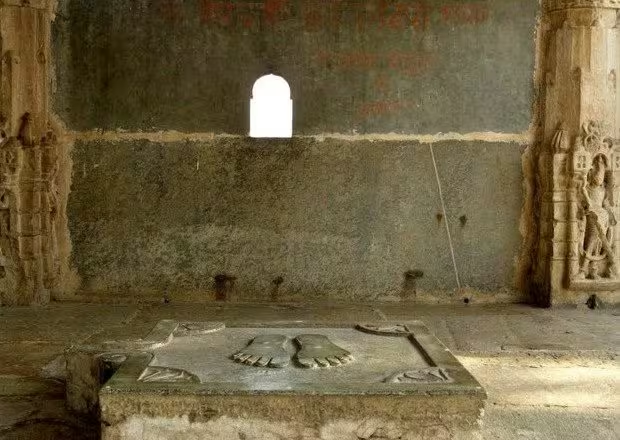
Mirabai - Bhakti Poet and Krishna Devotee
In the tapestry of medieval India, woven with the threads of Rajput valour, political intrigue, and rigid social codes, the story of Sant Meerabai (c. 1498–c. 1547) is a vibrant, unbroken strand of pure devotion. A princess who renounced worldly comforts for spiritual ecstasy, a widow who refused the shackles of tradition, and a poet whose songs of love for Lord Krishna dissolved the boundaries between the human and the divine, Meerabai remains one of the most revered figures of the Bhakti movement. Her life was a testament to a faith so profound it could challenge a kingdom, and her poetry continues to be a living, breathing part of India’s spiritual and cultural heritage.
Early Life & Background
Meerabai was born around 1498 CE into the Rathore clan of Rajputs in Merta, a small but formidable kingdom in the Marwar region of Rajasthan. She was the daughter of Ratan Singh and the granddaughter of Rao Duda, the ruler who had established Merta as a sovereign state. Her upbringing was steeped in the Vaishnava tradition, a devotional sect of Hinduism focused on the worship of Vishnu and his avatars, particularly Krishna. This environment provided the fertile ground in which her singular, lifelong devotion would take root.
Tradition holds that the seeds of this devotion were sown in her early childhood. A popular legend, central to her life story, recounts how a travelling holy man visited her family's palace. He carried with him a beautiful idol of Krishna, which captivated the young Meera. She insisted on keeping the idol, and from that day forward, it became her constant companion. She saw the idol not as a mere image, but as the living presence of her beloved lord, to whom she declared herself eternally married.
Her formal education, typical for a Rajput princess of the time, would have included instruction in music, literature, and statecraft. Her later poetic compositions, marked by their lyrical sophistication and emotional depth, are clear evidence of a sharp intellect and a masterful command of language.
In 1516, in a strategic alliance typical of the era, Meerabai was married to Bhoj Raj, the crown prince of Mewar and the eldest son of the powerful and respected Rana Sanga. The move from the Vaishnava-centric court of Merta to the court of Chittorgarh, the capital of Mewar, marked a significant shift. The Sisodia dynasty of Mewar were primarily devotees of Shakti, the divine feminine, and worshipped Goddess Durga. While Meerabai dutifully performed her royal functions, her personal life remained an unwavering circle of devotion to her Girdhar Gopal (Krishna, the lifter of the Govardhan Hill).
Her life took a dramatic turn when her husband, Bhoj Raj, died from battle wounds between 1518 and 1521. As a young, high-born Rajput widow, she was expected to adhere to a life of severe austerity and seclusion. The most extreme expectation for a Rajput queen was the rite of sati, self-immolation on her husband's funeral pyre. Meerabai refused. For her, who had long considered herself married to the immortal Krishna, a mortal husband's death did not make her a widow. This act of defiance was the first of many that would place her in direct conflict with the patriarchal norms of her time and the royal family of Mewar.
Career & Major Contributions
Meerabai's widowhood marks the beginning of her public journey as a saint and poet. Freed from her marital duties but still bound by the strictures of the royal court, her Krishna bhakti intensified, becoming more open and expressive. She spent her days composing songs, singing them with uninhibited joy, and dancing before the Krishna idol in her personal temple. She began to seek the company (satsang) of wandering saints and holy men who passed through Chittorgarh, disregarding the rigid rules of caste and gender that forbade a royal woman from mixing with commoners and ascetics.
This behaviour was a source of great scandal for her in-laws. After the death of Rana Sanga, the throne of Mewar passed to rulers who viewed her public displays of devotion as an embarrassment to the family's honour. Her own poetry and later hagiographies, which form the primary sources for her life, are filled with references to the persecution she faced. Her brother-in-law, Vikramaditya, who ruled Mewar from 1531 to 1536, is often depicted as her chief tormentor.
Two famous legends from this period illustrate her unshakeable faith. In one, the Rana sent her a cup of poison, which she was ordered to drink. Offering it first to her beloved Krishna, she drank it without hesitation, and by divine grace, it turned to harmless nectar. In another, a basket supposedly containing a venomous snake was sent to her as an offering for her deity. When Meera opened it, she found not a serpent but a beautiful garland of flowers (shaligram). While these stories may not be literal historical events, they serve as powerful metaphors for her spiritual resilience and the belief that her devotion was a shield against all worldly harm.
Unable to deter her and unwilling to tolerate her defiance any longer, the royal family's hostility reached a point where Meerabai chose to leave the palace of Chittorgarh forever. She abandoned her royal status and embarked on the life of a wandering mendicant, a path unheard of for a Rajput queen.
The Bhajans: A Torrent of Devotion
Meerabai's most significant and enduring contribution is her vast body of devotional songs, known as bhajans or pads. Composed in a mix of Braj Bhasha and Rajasthani, the vernacular languages of the people, her poetry was a radical departure from the formal, Sanskrit-dominated religious texts of the elite. This made her message of love for God accessible to everyone, regardless of their social standing or education.
Her poems are intensely personal, expressing the full spectrum of emotions in a soul's yearning for the divine. This form of devotion is known as madhurya bhava, which conceives of the relationship between the devotee and God as that of a lover and the beloved. She addresses Krishna with stunning intimacy—as a friend, a master, a confidant, and above all, her eternal husband.
Her verses speak of the torment of separation (viraha) and the ecstasy of union. A famous couplet encapsulates her singular focus:
Mere to Girdhar Gopal, doosro na koi (For me, there is only Girdhar Gopal, no other)
This simple line was a radical declaration of spiritual independence, rejecting all other worldly allegiances—to family, clan, and societal expectation—in favour of an absolute, all-consuming divine love.
While hundreds of bhajans are attributed to Meerabai today, scholars believe that a core group of about two hundred poems can be traced back to her with more certainty. The rest have been added over centuries by anonymous devotees, a testament to how deeply her style and spirit permeated the oral traditions of North India.
Pilgrimage and Final Years
After leaving Mewar, Meerabai embarked on a pilgrimage, travelling to the sacred sites associated with Krishna's life. Her journey first took her back to her childhood home of Merta, but she eventually made her way to Vrindavan, the pastoral town in modern-day Uttar Pradesh where Krishna is believed to have spent his youth. In Vrindavan, she immersed herself in the culture of bhakti that thrived there.
A well-known anecdote from this period involves her encounter with Jiva Goswami, a prominent saint and philosopher of the Gaudiya Vaishnava school. As an ascetic who had taken a vow of celibacy, he initially refused to meet Meerabai because she was a woman. Her reported response was sharp and illuminating: "I had thought that the only true man (purusha) in Vrindavan was Lord Krishna. Are there other men here besides him?" Her reply, which asserted that all souls are feminine in relation to the supreme Lord, humbled the scholar, who recognized her advanced spiritual state and granted her an audience.
From Vrindavan, tradition states that she travelled to Dwarka in modern-day Gujarat, the city where Krishna is said to have established his kingdom and spent his later years. It was here, in the temple of Dwarkadhish, that she spent the remainder of her life.
The end of her life, around 1547, is as steeped in legend as its beginning. One account suggests that a delegation from Mewar, facing immense hardship, was sent by the then-ruler Rana Udai Singh II to persuade her to return. When she refused, the Brahmins accompanying the delegation began a fast unto death, compelling her to make a decision. Seeking guidance, Meerabai entered the inner sanctum of the Dwarkadhish temple to be with her lord. According to the hagiographic tradition, when the temple doors were opened the next morning, she was gone. Her sari was found wrapped around the idol of Krishna, signifying that she had miraculously merged into the very being of her beloved.
Legacy & Influence
Meerabai's legacy is monumental and multifaceted. She was not a philosopher who wrote complex theological treatises, nor a monarch who built an empire. Her power lay in the authenticity of her devotion and the courage of her convictions.
Historical and Social Significance
As a pivotal figure of the Bhakti movement, Meerabai championed a path to the divine that was direct, personal, and emotional, bypassing the need for priestly intermediaries and elaborate rituals. Her life became a powerful symbol of spiritual agency, particularly for women. In a deeply patriarchal society, she carved out an independent identity based solely on her spiritual quest. By abandoning the palace, rejecting widow's austerity, and mixing freely with people from all castes, she subverted every social and religious norm that was meant to confine her. For centuries, she has been an inspiration for those who seek freedom from oppressive social structures.
Impact on Culture
Meerabai's most tangible legacy is her music. Her bhajans are not historical artifacts; they are a living, vibrant tradition. They are sung in homes, temples, and on the grandest concert stages across India and the world. From classical renditions by maestros like M.S. Subbulakshmi to folk versions sung in the villages of Rajasthan, her words continue to move the hearts of millions. Her poetry is a foundational element of Hindi and Rajasthani literature, studied for both its spiritual depth and its literary beauty.
Enduring Memory
Today, Sant Meerabai is venerated not just as a poet, but as a saint whose life was her greatest poem. She is remembered through countless films, books, and television serials that narrate her story of unwavering faith. The iconic image of Meera, with her simple saffron robes and her ektara (a one-stringed instrument), symbolizes a love for God so pure and powerful that it transcends time, convention, and even life itself. She remains a beacon, illuminating a path where the only true kingdom is the heart, and the only true ruler is love.