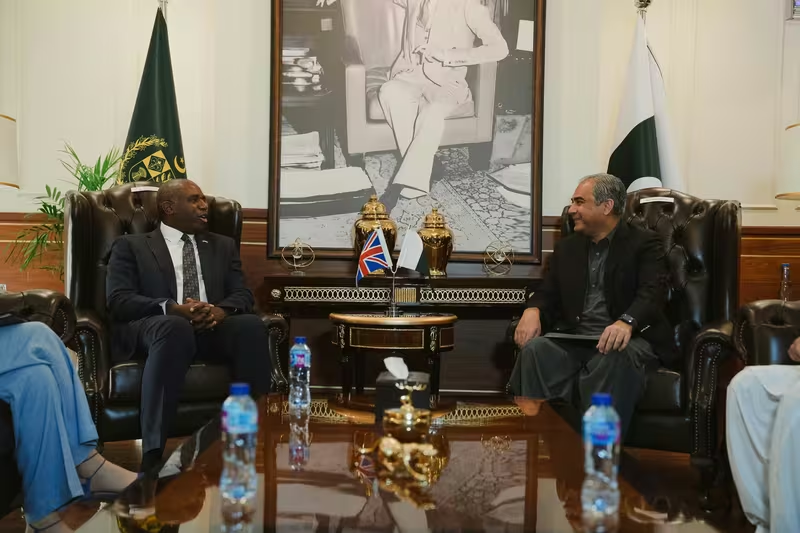
Mohsin Naqvi: The Media Baron at the Helm of Power
In the intricate tapestry of modern South Asian politics, few figures have charted as swift and consequential a rise as Syed Mohsin Raza Naqvi. A name once primarily synonymous with the burgeoning media landscape of Pakistan, Naqvi has, in a remarkably short span, transitioned from the newsroom to the highest echelons of provincial and sporting governance. As the founder of a major media conglomerate, the caretaker Chief Minister of Pakistan's most populous province during a period of intense political turmoil, and the Chairman of the Pakistan Cricket Board (PCB), his career embodies the potent and often controversial nexus of media, business, and state power in the 21st century.
Early Life & Formative Years
Syed Mohsin Raza Naqvi was born on 28 October 1978, in the historic city of Lahore, the cultural and political heart of Punjab. Raised in a Syed family, his early life was rooted in the milieu of a city that has long been a crucible for Pakistani politics and culture. He received his initial education at the prestigious Crescent Model School, a Lahore institution known for its rigorous academics.
For his higher education, Naqvi enrolled in the esteemed Government College University (GCU), Lahore, an alma mater to poets, prime ministers, and intellectuals. It was here, amidst the Gothic architecture and vibrant intellectual environment, that the foundations of his future ambitions were likely laid. Seeking to broaden his horizons, Naqvi later traveled to the United States for further studies. He attended Miami University in Ohio, where he pursued his interest in journalism. This American sojourn proved to be a pivotal, formative experience. It not only provided him with a Western education but also gave him his first professional foray into the world of international media. Naqvi secured a position at the global news giant CNN, working as a producer. This role offered him an invaluable, firsthand perspective on the standards, operations, and influence of a major international news network, an experience that would profoundly shape his own entrepreneurial ventures back in Pakistan.
Career & Major Contributions
Naqvi's career can be viewed as a tale of two distinct but interconnected acts: his rise as a media magnate and his sudden, high-profile entry into the political and administrative arena.
The Architect of a Media Empire
Upon returning to Pakistan, Naqvi astutely identified a gap in the country's rapidly liberalizing media scene. While national news channels were flourishing after the electronic media boom of the early 2000s, local, city-specific news coverage was largely underserved. With a clear vision and an understanding of grassroots media consumption, Naqvi launched his first major venture in 2008: City 42.
The channel was a groundbreaking concept for Pakistan. It was dedicated entirely to the news, events, and issues of a single metropolis—Lahore. From traffic updates and local crime to cultural festivals and municipal politics, City 42 gave Lahoris a platform that spoke directly to their daily lives. The model was an immediate success, resonating with viewers and advertisers alike.
This success became the blueprint for a much larger ambition. Naqvi began to build a formidable media empire under the umbrella of the City News Network. He replicated the hyper-local model in other urban centers, launching City 41 for the industrial hub of Faisalabad. He understood the power of regional identity and language, establishing Rohi TV to cater to the vast Saraiki-speaking belt of Southern Punjab. His vision extended beyond Pakistan's borders with the launch of UK 44 (later renamed Neo News), a channel aimed at the large and influential Pakistani diaspora in the United Kingdom.
To complete his media ecosystem, he launched a national Urdu-language news channel, 24 News HD, to compete with the established giants in the national space, and a daily newspaper, Daily City 42. Through strategic expansion and a keen sense of market dynamics, Mohsin Naqvi transformed himself from a young journalist into one of Pakistan's most influential media owners, wielding the power to shape narratives and influence public opinion on a massive scale.
The Pivot to Politics and Governance
In January 2023, Mohsin Naqvi's career took a dramatic and unexpected turn. Following the dissolution of the Punjab Assembly by the then-ruling Pakistan Tehreek-e-Insaf (PTI) party, the province was plunged into a political crisis. The outgoing government and the opposition failed to agree on a consensus candidate for the neutral post of caretaker Chief Minister, whose constitutional mandate is to oversee free and fair elections.
In this politically charged environment, the decision fell to the Election Commission of Pakistan (ECP). On 22 January 2023, the ECP appointed Mohsin Naqvi as the caretaker Chief Minister of Punjab. The appointment was instantly contentious. The PTI vehemently opposed his selection, accusing him of being close to their political rivals in the Pakistan Democratic Movement (PDM) alliance. PTI leaders, including Fawad Chaudhry, publicly decried the decision, arguing that a figure with such deep ties to the media and known political leanings could not be considered neutral. They viewed his appointment as a move by the establishment to install a friendly administration in the country's most crucial province ahead of general elections.
Naqvi's tenure as caretaker Chief Minister was one of the most challenging and controversial in Pakistan's history. His government was in power during the tumultuous events of 9 May 2023, when protests erupted across the country following the arrest of PTI chairman Imran Khan, leading to attacks on state and military installations. The subsequent crackdown on the PTI by Naqvi's administration was severe and widespread, involving the arrests of thousands of party workers and leaders. This period cemented his reputation among his critics as an instrument of the state's power against a political party.
Furthermore, his tenure extended far beyond the constitutionally mandated 90-day period, as the general elections were delayed until February 2024. This extension drew further criticism and fueled debates about the legitimacy and neutrality of the caretaker setup under his leadership.
At the Helm of Pakistan Cricket
While still serving as the caretaker Chief Minister, Naqvi's public profile expanded even further. In February 2024, just before the general elections, he was nominated by the caretaker Prime Minister for the coveted position of Chairman of the Pakistan Cricket Board (PCB). He was subsequently elected unopposed for a three-year term, becoming the 37th Chairman of the PCB.
His appointment continued the long-standing tradition in Pakistan of the board being led by figures with strong political connections rather than a background in cricket administration. Taking charge of an institution that is a source of national passion and pride, Naqvi's dual role as both the head of a provincial government and the country's cricket chief was unprecedented and highlighted his unique position within Pakistan's power structure. He immediately signaled his intent to overhaul the board's functioning, focusing on improving domestic cricket structures and enhancing the infrastructure of stadiums across the country.
Legacy & Influence
Though his public life in governance is relatively recent, Syed Mohsin Raza Naqvi has already carved out a significant and complex legacy. He is a quintessential figure of modern Pakistan, representing the convergence of media influence, entrepreneurial success, and political authority.
His historical significance lies in his embodiment of the 'media mogul-turned-administrator' archetype. In a country where the media, often referred to as the fourth pillar of the state, plays a powerful role in shaping political discourse, Naqvi's career demonstrates a direct pathway from media ownership to executive power. His controversial appointment as caretaker Chief Minister has become a case study in the ongoing debate about the neutrality of electoral oversight bodies in Pakistan and the role of non-political figures in governance during times of crisis.
His lasting impact on the media landscape is undeniable. The City News Network's hyper-local model has fundamentally changed television news consumption in urban Punjab, forcing national players to pay more attention to local issues. As a media owner, he remains a powerful voice in the national conversation.
In the political sphere, his tenure as Chief Minister will be remembered for its role during one of the most polarized and fraught periods in Pakistan's recent history. The actions taken by his government against the PTI have had a profound and lasting impact on the country's political dynamics.
Today, Mohsin Naqvi is a deeply polarizing figure. To his supporters and allies, he is a dynamic and capable administrator, a self-made success story who answered the call of duty during a national crisis and is now tasked with reforming the nation's most beloved sport. To his detractors and political opponents, he is a symbol of an overreaching establishment, a figure whose appointments were engineered to serve specific political interests, thereby undermining democratic principles and neutrality.
As he continues to navigate the high-stakes worlds of Pakistani cricket and media, the full story of Mohsin Naqvi's influence is still being written. But his journey from a news producer to one of the most powerful men in Pakistan is already a compelling chapter in the contemporary history of the subcontinent—a testament to the fluid, and often turbulent, interplay of ambition, media, and power.