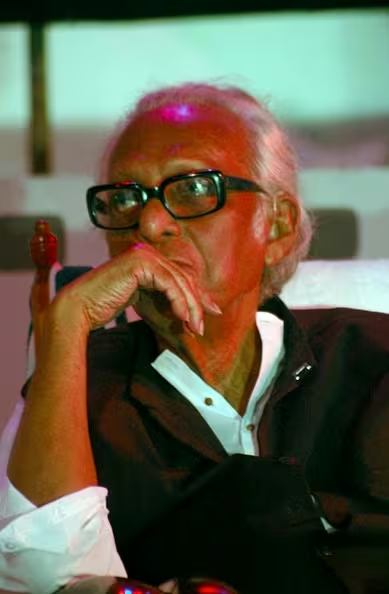
The Uncompromising Chronicler of a Nation's Conscience
In the hallowed trinity of Bengali cinema, alongside the lyrical classicism of Satyajit Ray and the tumultuous expressionism of Ritwik Ghatak, stood Mrinal Sen—the maverick, the polemicist, the unsparing urban chronicler. From the 1950s to the early 2000s, Sen wielded his camera not merely as an artist's brush but as a surgeon's scalpel, dissecting the anxieties, hypocrisies, and simmering rage of a post-independence India grappling with its own identity. A fiercely independent intellectual and a lifelong Marxist, his films were restless, provocative, and formally audacious, forever challenging the viewer to not just watch, but to confront. Mrinal Sen was more than a filmmaker; he was the conscience of his time, etched onto celluloid.
Early Life & The Making of a Dissident
Mrinal Sen was born on May 14, 1923, in the town of Faridpur, now in Bangladesh. His father, Durgacharan Sen, was a nationalist lawyer, and the young Mrinal grew up in a household where progressive ideas and political discourse were commonplace. This environment instilled in him an early awareness of the social and political currents shaping the subcontinent.
In 1940, seeking higher education, Sen moved to Calcutta (now Kolkata), a city that would become both his muse and his battleground. He enrolled to study physics at the prestigious Scottish Church College and later at the University of Calcutta. However, the city's intellectual ferment proved more captivating than his formal studies. Calcutta in the 1940s was a crucible of political upheaval, famine, and burgeoning revolutionary thought. It was here that Sen was drawn into the orbit of the Communist Party of India and became deeply involved with its cultural wing, the Indian People's Theatre Association (IPTA).
While he never directed for the stage, his association with IPTA was formative. It exposed him to a new kind of art—one that was socially committed, politically engaged, and aimed at the masses. It was also during this period that Sen, a voracious reader, stumbled upon Rudolf Arnheim's book Film as Art. This text was a revelation, opening his eyes to the theoretical and aesthetic possibilities of cinema. He devoured literature on film theory, absorbing the ideas of masters like Sergei Eisenstein and Vsevolod Pudovkin, building an intellectual foundation that would distinguish his work for decades to come.
His early career was far from glamorous. After a brief stint as a journalist, he took a job as a medical representative, a role that required him to travel extensively through the villages of Uttar Pradesh. This experience provided him with a raw, firsthand look at the poverty and social stratification of rural India, observations that would later inform the deep-seated empathy and anger in his films. By the early 1950s, his passion for cinema had solidified, and after a short period as an audio technician in a Calcutta film studio, he was ready to tell his own stories.
A Career Forged in Rebellion and Experiment
Mrinal Sen’s cinematic journey was one of constant evolution and relentless experimentation. He directed his first feature, Raat Bhore (The Dawn), in 1955, a film he would later disown as a novice's misstep. His first taste of recognition came with Neel Akasher Neechey (Under the Blue Sky) in 1959, a poignant story of an immigrant Chinese hawker in 1930s Calcutta. The film's humanism resonated with audiences, though its political undertones led to a brief two-month ban by the Indian government—an early sign of Sen's willingness to provoke authority.
His international breakthrough arrived with Baishey Sravan (The Wedding Day) in 1960. A stark and tragic tale of a couple whose lives are shattered by the Bengal Famine of 1943, the film's bleak realism earned it acclaim at the Venice and London film festivals, announcing Sen as a powerful new voice in world cinema.
The Dawn of a New Cinema: Bhuvan Shome
The year 1969 marked a watershed moment not just for Sen, but for all of Indian cinema. With a modest loan from the state-sponsored Film Finance Corporation (FFC), he made Bhuvan Shome. The film, shot in Hindi, tells the story of a rigid, authoritarian railway bureaucrat who, on a bird-hunting trip to rural Gujarat, has his worldview gently but irrevocably altered by a spirited young village woman.
Bhuvan Shome was revolutionary. It broke free from every convention of mainstream Indian filmmaking. Sen employed a freewheeling, French New Wave-inspired style, using jump cuts, freeze frames, animation, and a wry voice-over narration. Its commercial success was unexpected and electrifying. It is widely regarded as the film that kickstarted India’s “New Wave” or “Parallel Cinema” movement, proving that artistically ambitious, low-budget films could find an audience and inspiring a generation of independent filmmakers.
The Calcutta Trilogy: A City on Fire
As the 1970s dawned, Calcutta was a city in turmoil, wracked by economic stagnation, political violence, and the radical Naxalite movement. Sen, feeling the pulse of his city, responded with a trilogy of films that remain his most politically ferocious and formally daring works.
Interview (1971): Shot in a gritty, newsreel style, the film follows a young man's desperate attempts to secure a suit for a job interview, a quest that becomes a searing indictment of the persistence of colonial mindsets in independent India. The film famously breaks the fourth wall, directly addressing the audience and implicating them in the narrative.
Calcutta 71 (1972): This was Sen's masterpiece of political rage. It weaves together multiple stories of poverty and exploitation, spanning decades but all culminating in the volatile present of 1971. Its fragmented structure and direct, confrontational tone captured the anger and desperation of a generation.
Padatik (The Guerrilla Fighter, 1973): The final film in the trilogy marked a shift towards introspection. It focuses on a young Naxalite revolutionary in hiding, who begins to question the dogmatic and authoritarian tendencies within his own party. It was a work of immense courage, demonstrating Sen's commitment to critical inquiry, even when it meant interrogating the very ideologies he was associated with.
The Middle-Class Labyrinth
After the political intensity of the Calcutta Trilogy, Sen turned his sharp gaze inwards, towards the cloistered world of the Bengali middle class (bhadralok). In a series of subtle, psychologically astute films, he explored the moral anxieties and quiet cruelties that lay beneath their veneer of respectability.
- Ek Din Pratidin (And Quiet Rolls the Day, 1979): A masterful chamber piece, the film documents the agony of a family as they wait through the night for their eldest daughter, the sole breadwinner, to return home. It is a devastating critique of patriarchal hypocrisy and the suffocating pressures placed upon women.
- Kharij (The Case is Closed, 1982): A young, liberal middle-class couple’s world is upended when their underage house-servant is found dead from carbon monoxide poisoning. The film is a quiet, chilling examination of guilt, class prejudice, and the subtle ways in which the privileged absolve themselves of responsibility. It won the prestigious Jury Prize at the 1983 Cannes Film Festival.
- Khandhar (The Ruins, 1984): A hauntingly beautiful film starring Shabana Azmi and Naseeruddin Shah, Khandhar uses the metaphor of ancient ruins to explore themes of loneliness, memory, and emotional decay. It is one of Sen's most poetic and poignant works.
Throughout his career, Sen continued to experiment, making films in Bengali, Hindi, Oriya, and Telugu. Works like Akaler Sandhane (In Search of Famine, 1980), a complex film-within-a-film, further cemented his reputation as an innovator of cinematic form and narrative.
Legacy of a Restless Visionary
Mrinal Sen passed away on December 30, 2018, at the age of 95, leaving behind a body of work that is as relevant and challenging today as it was when it was first created. His legacy is immense and multifaceted.
He was, first and foremost, India's preeminent political filmmaker. He refused to let cinema be a mere escape, insisting on its power as a tool for social analysis and political dissent. His films are invaluable documents of the turbulent socio-political history of modern India, particularly of the city of Calcutta.
Sen was also a formal innovator who constantly pushed the boundaries of cinematic language. He showed that serious, political filmmaking did not have to be stylistically dull. His use of non-linear narratives, documentary techniques, and self-reflexive storytelling inspired countless independent filmmakers across India to find their own, unique voices.
For his monumental contributions to cinema, he was honored with countless awards, including the Dadasaheb Phalke Award in 2005, the highest honor in Indian cinema. But Mrinal Sen's true significance lies beyond accolades. He is remembered as the eternal dissident, the intellectual provocateur who remained, until the very end, what his memoir was titled: Always Being Born. He was a filmmaker who never grew comfortable, never stopped questioning, and never allowed his audience to do so either. His films do not offer easy answers; instead, they leave you with urgent, unsettling questions—the mark of a true and timeless artist.