Muhammad Iqbal: The Poet-Philosopher of a Nation
In the grand tapestry of modern Indian history, few figures are as complex, influential, and intellectually towering as Sir Muhammad Iqbal. Known affectionately as Allama Iqbal (The Scholar Iqbal), he was a man of profound contradictions and soaring vision—a poet whose early verses celebrated a united India, and a philosopher whose later political thought carved the intellectual foundations for its division. His life (1877-1938) was a relentless quest for meaning, an attempt to reconcile the spiritual heritage of Islam with the turbulent currents of Western modernity. As a poet, he breathed new life into Urdu and Persian literature; as a thinker, he awakened a generation of Muslims to a new vision of selfhood and destiny, earning him the title of the 'Spiritual Father of Pakistan'.
Early Life & The Forging of a Scholar
Muhammad Iqbal was born on November 9, 1877, in the bustling city of Sialkot, Punjab, in British India. His family hailed from a lineage of Kashmiri Brahmins (of the Sapru clan) who had converted to Islam centuries earlier. His father, Sheikh Noor Muhammad, was a tailor by profession, a man without formal education but possessing a deep, intuitive spirituality that left an indelible mark on his son. His mother, Imam Bibi, was a compassionate and pious woman. This humble, devout household became the crucible for Iqbal’s early intellectual and spiritual development.
Young Iqbal’s prodigious talent was evident early on. He received his initial education in a traditional maktab before enrolling in the Scotch Mission College in Sialkot. Here, he came under the mentorship of a figure who would change the course of his life: Syed Mir Hassan, a brilliant scholar of Oriental languages. Hassan recognized the divine spark in his student and nurtured it, immersing Iqbal in the rich traditions of Islamic literature, Arabic, and Persian, while also encouraging a broad, modern education.
In 1895, Iqbal moved to Lahore to attend the prestigious Government College, a vibrant center of intellectual activity. He studied philosophy, English literature, and Arabic, graduating with a Master of Arts degree in philosophy in 1899. In Lahore, he found another crucial mentor in Sir Thomas Arnold, a distinguished scholar of Islam and modern philosophy. Arnold guided Iqbal’s philosophical inquiries, introducing him to the currents of Western thought and encouraging him to pursue higher studies in Europe. This period in Lahore was also when Iqbal first gained recognition as a poet, his lyrical and patriotic verses becoming a sensation at local literary gatherings (mushairas).
The European Sojourn: A Philosophical Transformation
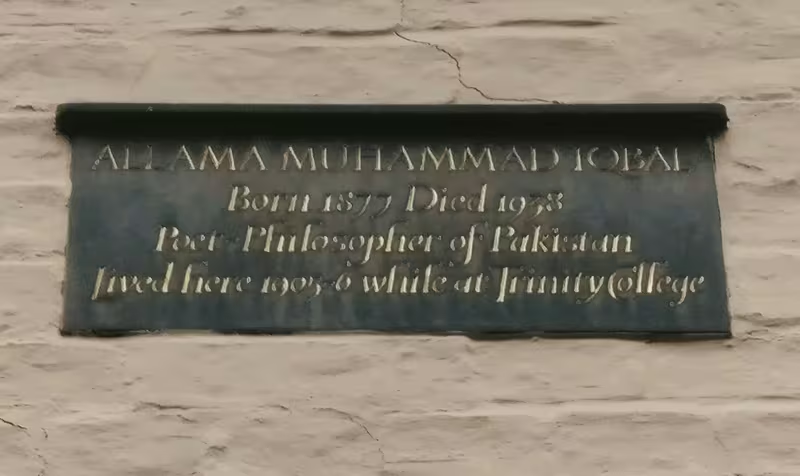
In 1905, on the advice of Sir Thomas Arnold, Iqbal embarked on a journey to Europe that would fundamentally reshape his worldview. He enrolled at Trinity College, Cambridge, where he earned a Bachelor of Arts degree in 1906. He simultaneously studied law at Lincoln’s Inn and was called to the bar in 1908. His insatiable intellectual curiosity then took him to Germany, where he earned a PhD in philosophy from Ludwig Maximilian University, Munich. His doctoral thesis, The Development of Metaphysics in Persia, was a groundbreaking study of Islamic and Persian philosophical traditions.
His three years in Europe were a period of intense intellectual ferment. Iqbal delved deeply into the works of Western philosophers like Nietzsche, Bergson, and Goethe, absorbing their ideas on will, intuition, and the dynamic nature of reality. However, he also grew profoundly disillusioned with European civilization. He saw its unbridled materialism, its competitive nationalism, and its colonial ambitions as spiritually hollow and ultimately destructive. This critical perspective triggered a monumental shift in his own thought. The poet who had once written Tarana-e-Hindi (“Saare Jahan Se Achha”), a stirring anthem to a composite Indian nationhood, now began to look towards a pan-Islamic identity as the solution to the Muslim world's decline.
Career & Major Contributions: The Poet of the Self
Upon his return to India in 1908, Iqbal began a legal practice and briefly taught philosophy and English literature. But his true calling was poetry and philosophy, which he saw as instruments for social and spiritual awakening. His work from this period onward can be seen as a grand project to reconstruct Muslim identity for the modern age.
The Philosophy of Khudi (The Self)
Iqbal’s most significant philosophical contribution is the concept of Khudi, or the Self. He introduced this powerful idea in his first major poetic work, Asrar-i-Khudi (The Secrets of the Self, 1915). Written in Persian to reach a wider Muslim audience across the world, the poem was a clarion call against the passive fatalism that he believed had plagued Muslim societies. Drawing inspiration from Islamic mysticism and Western vitalism, Iqbal argued that the purpose of life was the strengthening of the Self. Khudi was not ego or arrogance, but a dynamic, creative force within each individual. Through constant struggle, self-knowledge, and righteous action, one could elevate their Khudi and become a more perfect individual, a co-creator with God.
He followed this with Rumuz-i-Bekhudi (The Secrets of Selflessness, 1917), which presented the other side of the coin. Once the individual Self is fortified, it must subordinate itself to the service of the community, the Islamic Ummah. The ideal community, for Iqbal, was one that allowed for the fullest expression of individual potential while being bound by a shared spiritual purpose. These two works formed the bedrock of his entire philosophical system.
Literary Masterpieces
Iqbal was a master of both Persian and Urdu, using each for distinct purposes. His Persian works, like the sublime Javid Nama (The Book of Eternity, 1932)—an epic spiritual journey through the cosmos modeled on Dante's Divine Comedy with the poet Rumi as his guide—were dense with philosophical thought. His Urdu poetry, however, brought his message to the masses with unparalleled lyrical power and emotional force.
Collections like Bang-i-Dara (The Call of the Marching Bell, 1924) chart his poetic evolution from nationalist to pan-Islamist. Bal-i-Jibril (Gabriel’s Wing, 1935) and Zarb-i-Kalim (The Rod of Moses, 1936) represent the zenith of his Urdu poetry. In these works, he raged against colonialism, capitalism, and soulless secularism, urging Muslims to rediscover the dynamic, revolutionary spirit of early Islam.
The Political Visionary: The Allahabad Address
While primarily a poet and philosopher, Iqbal’s ideas inevitably drew him into the political arena. He was elected to the Punjab Legislative Council in 1927. His most historic political contribution came on December 29, 1930. Presiding over the annual session of the All-India Muslim League in Allahabad, Iqbal delivered a monumental speech that would alter the destiny of the subcontinent.
In what is now known as the Allahabad Address, he articulated a clear vision for the political future of Indian Muslims. Observing the intractable communal tensions and the fear of Hindu majoritarianism, Iqbal argued for self-determination. He declared: “I would like to see the Punjab, North-West Frontier Province, Sind and Baluchistan amalgamated into a single state. Self-government within the British Empire, or without the British Empire, the formation of a consolidated North-West Indian Muslim state appears to me to be the final destiny of the Muslims, at least of North-West India.”
This was the first time the idea of a separate Muslim state was proposed from a major political platform. While his vision at the time was of an autonomous state within a larger Indian federation, it provided the intellectual and philosophical justification for the Pakistan Movement. He spent his later years corresponding with Muhammad Ali Jinnah, convincing him to return from England and lead the Muslim League, and persistently arguing that a separate homeland was the only way to safeguard the cultural and political identity of Muslims in India.
Legacy & Influence: A Contested Inheritance
Sir Muhammad Iqbal passed away on April 21, 1938, in Lahore, nine years before the creation of the country he had envisioned. His tomb, an elegant red sandstone structure located in the Hazuri Bagh lawn between the Badshahi Mosque and the Lahore Fort, is a site of national reverence.
Iqbal's legacy is as vast as it is complex. In Pakistan, he is revered as the national poet and the nation’s ideological founder. His birthday is a public holiday, and his philosophy of Khudi is woven into the national identity, a perpetual call for self-reliance and spiritual strength. He is the Mufakkir-e-Pakistan (The Thinker of Pakistan), the visionary who dreamed a nation into existence.
In India, his legacy is more ambivalent. While his later political ideology is viewed critically, his literary genius remains undisputed. His early poem, Tarana-e-Hindi (“Saare Jahan Se Achha, Hindustan Hamara”), is sung with patriotic fervor across the country, a poignant reminder of a time when his vision encompassed a single, pluralistic India. He is remembered as one of the greatest Urdu poets of all time, a revolutionary who infused the language with a new philosophical dynamism.
Globally, Iqbal is recognized as one of the most important Islamic thinkers of the 20th century. His magnum opus in prose, The Reconstruction of Religious Thought in Islam (1930), remains a seminal work for those seeking to harmonize Islamic traditions with modern philosophical and scientific inquiry. He was a bridge between East and West, a fierce critic of both, who sought to forge a new path forward—one that was modern yet authentic, progressive yet spiritually grounded.
Sir Muhammad Iqbal was more than a poet or a politician. He was a civilizational thinker, grappling with the most profound questions of his time: identity, faith, and the destiny of a people caught between a dying colonial order and an uncertain future. His words, whether calling for a united India or a separate Pakistan, were born from a deep love for his people and a burning desire to see them liberated from intellectual and political subjugation. His work remains a powerful, challenging, and enduring testament to the power of ideas to shape history.