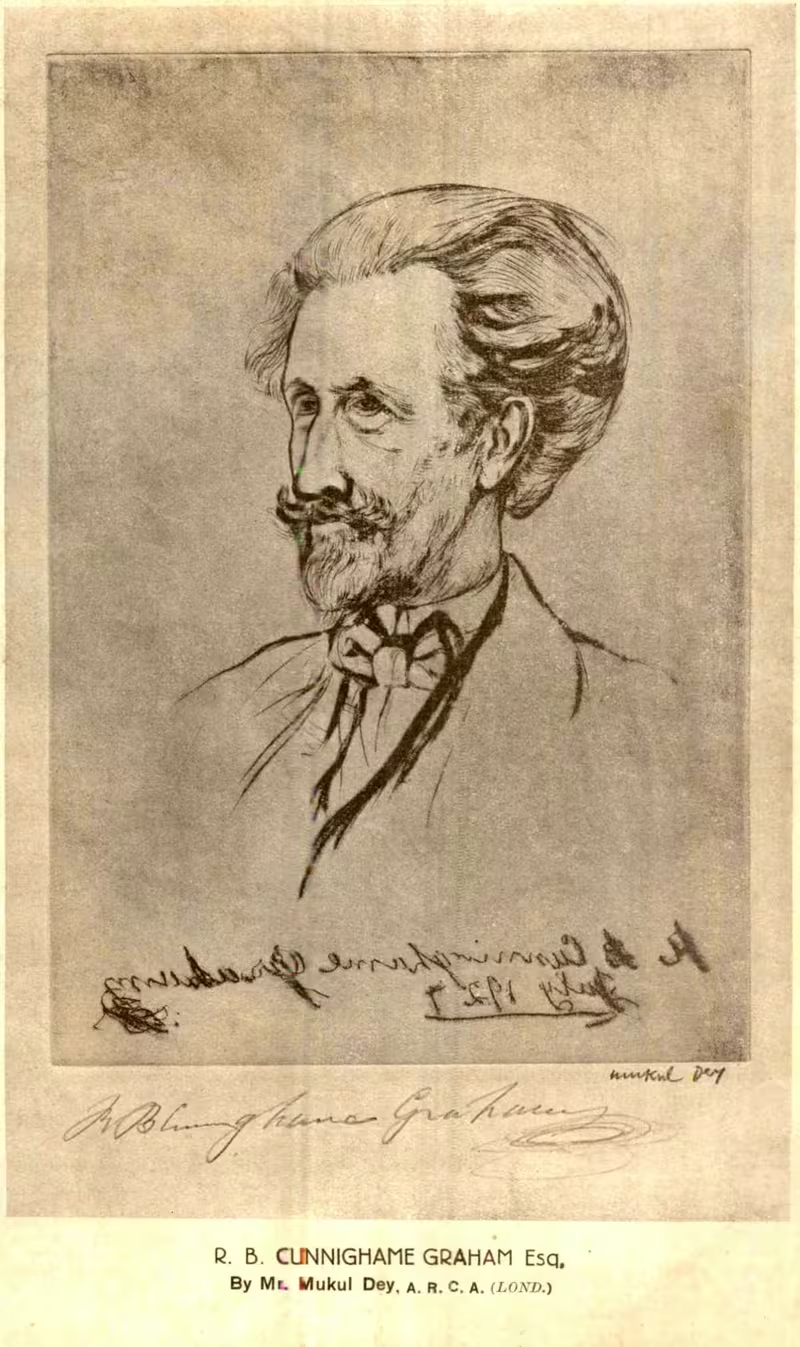
Mukul Chandra Dey - Pioneer of Drypoint Etching in India
In the grand theatre of Indian modern art, where broad canvases and vibrant pigments often take centre stage, the story of Mukul Chandra Dey is one of quiet precision, intimate observation, and the sharp, indelible line. With a steel needle in hand and a copper plate before him, Dey carved out a unique space for himself and a new medium for his nation. He was a bridge between the poetic idealism of Santiniketan and the rigorous technical studios of London, a chronicler of a nation's awakening, and the artist who taught India the evocative power of drypoint etching.
The Making of an Artist: Santiniketan and the Bengal School
Mukul Chandra Dey was born on July 23, 1895, in Sridharkhola, Bengal Presidency, in what is now Bangladesh. His formative years were spent not in a conventional school, but in the revolutionary educational environment of Santiniketan. In 1905, he became one of the earliest students to join Rabindranath Tagore's ashram-school, a place where education was interwoven with nature, art, and philosophy.
This immersion in the cultural renaissance of Bengal shaped him profoundly. He came under the direct tutelage of the great masters of the Bengal School of Art: Abanindranath Tagore, the movement's visionary leader, and Nandalal Bose, its most distinguished practitioner. From them, Dey learned the delicate 'wash' technique, creating ethereal, dreamlike paintings steeped in Indian mythology and literary themes. His early works bore the unmistakable stamp of the Bengal School—graceful lines, muted colours, and a deep-seated nationalism that sought to reclaim an indigenous artistic identity.
A pivotal moment arrived in 1916 when he was chosen to accompany Rabindranath Tagore on a tour of Japan and the United States. This journey was more than a trip; it was an expansion of his artistic universe. In Japan, he observed the masterful ink paintings of Yokoyama Taikan and other masters, absorbing the principles of line and form. But it was in America where the seeds of his future legacy were sown.
A Passage to the West: Mastering a New Medium
In Chicago, Dey encountered the world of printmaking. He began studying etching under the guidance of James Blanding Sloan and Bertha Jaques, a prominent figure in the American etching revival. The process captivated him. Unlike painting, which allowed for correction and layering, etching demanded confidence and precision. The direct, incisive act of scratching a design onto a metal plate was a revelation. He held his first solo exhibition in Chicago, a testament to his rapid mastery of the new form.
His quest for technical excellence led him to London in 1920. He enrolled at both the prestigious Slade School of Fine Art and the Royal College of Art. The most significant phase of his training, however, came under the mentorship of the celebrated Scottish etcher, Sir Muirhead Bone. Bone was a master of drypoint, a technique where the artist draws directly onto the copper plate with a sharp needle, or 'burin'. This process creates a furrow, raising a delicate ridge of metal on either side called the 'burr'. When inked, this burr holds extra pigment, producing a uniquely soft, rich, and velvety line that is the hallmark of a great drypoint print.
Under Bone's guidance, Dey honed his craft to perfection. He learned to control the pressure of his needle, to create texture and shadow, and to capture the very essence of his subject with a few, decisive strokes. His talent was quickly recognized, and in 1922, he was elected an Associate of the Royal Society of Painters, Etchers and Engravers. He was exhibiting his work alongside the finest printmakers in Britain, an Indian artist mastering a quintessentially Western medium.
The Etcher's Needle in an Indian Hand: A New Vision
When Mukul Dey returned to India in 1928, he brought with him not just a new skill, but a new artistic language. At the time, printmaking was largely considered a commercial or reproductive craft in India, not a medium for fine art. Dey was determined to change that. He became the foremost pioneer and evangelist for drypoint etching in the country.
His subjects were a powerful blend of his international exposure and his deep Indian roots. He became, in essence, the portraitist of an era. With his portable copper plates, he travelled the length and breadth of the country, gaining access to the most iconic figures of the age. He captured Mahatma Gandhi in a moment of quiet contemplation, the weight of a nation on his shoulders visible in the lines on his face. He etched Rabindranath Tagore, his mentor, portraying the poet's flowing beard and profound, wise eyes with an intimacy that a photograph could never achieve. His needle documented the intellectual fire of Jawaharlal Nehru, the scientific brilliance of C.V. Raman, and the regal grace of Sarojini Naidu. He even sketched Albert Einstein from life during his travels.
These portraits were not mere likenesses; they were character studies. The drypoint technique allowed for a subtlety and psychological depth that was perfectly suited to capturing the personality of his sitters. Each print was an encounter, a dialogue between artist and subject, frozen in time by the scratch of steel on copper.
Beyond the pantheon of famous personalities, Dey turned his gaze to the soul of everyday India. He documented the mystical Baul singers of Bengal, their ecstatic dance captured in fluid lines. He etched the bustling river life on the Padma, the ancient ghats of Benares teeming with pilgrims and sadhus, and the vibrant street scenes of Calcutta. His work became a visual archive of a nation poised between tradition and modernity, created with a technique that was itself a synthesis of East and West.
A Visionary Administrator: The Government School of Art, Calcutta
In 1928, the same year he returned to India for good, Mukul Dey was appointed the Principal of the Government School of Art, Calcutta (now the Government College of Art & Craft). At just 33, he became the first Indian to hold this prestigious post, breaking a century-long tradition of British leadership. It was a landmark moment for Indian art education.
Dey proved to be as innovative an administrator as he was an artist. He immediately set about reforming the curriculum, which had been rigidly based on Western academic traditions. He introduced courses on Indian art history and aesthetics, encouraging students to study the frescoes of Ajanta and the miniatures of the Mughal courts alongside European masters. He championed the Bengal School, ensuring its legacy was taught and preserved.
One of his most significant contributions was the establishment of a dedicated department for women artists, creating institutional space for female students to pursue art professionally. He also founded a journal, Our Magazine, to showcase the work of his students and foster a creative community. During his tenure, which lasted until 1943, he nurtured a generation of artists, instilling in them a pride in their own heritage while equipping them with modern skills. He transformed the institution from a colonial outpost of art into a truly Indian centre for creative learning.
Legacy and Influence: The Enduring Mark
Mukul Chandra Dey passed away on March 1, 1989, leaving behind a legacy as sharp and enduring as the lines of his etchings. His most profound contribution was the elevation of printmaking from a craft to a major art form in India. He demonstrated that the stark, monochromatic world of the print could be as expressive, emotional, and powerful as any painting.
He was also an avid archivist and collector. Throughout his life, he painstakingly collected and preserved a vast range of Indian art, from the folk traditions of Kalighat painting and Bankura terracotta horses to the works of his Bengal School contemporaries. This collection became an invaluable resource for future generations of artists and scholars.
After his retirement, he and his wife, Bina Dey, established one of Calcutta’s first private art galleries, Chitralekha, in their own home, further promoting the cause of modern Indian art. Today, his works are held in the permanent collections of major museums around the world, including the National Gallery of Modern Art in New Delhi, the Victoria and Albert Museum in London, and the British Museum.
Mukul Chandra Dey’s life was a testament to the power of synthesis. He was a product of Tagore’s pan-Asian humanism, a disciple of the Bengal School’s nationalist art, and a master of a European technique. He looked both inward to the soul of his country and outward to the artistic currents of the world. In the quiet, focused work of his studio, with the simple tools of needle and plate, he etched not just the faces of great men and women, but the very character of a new India.