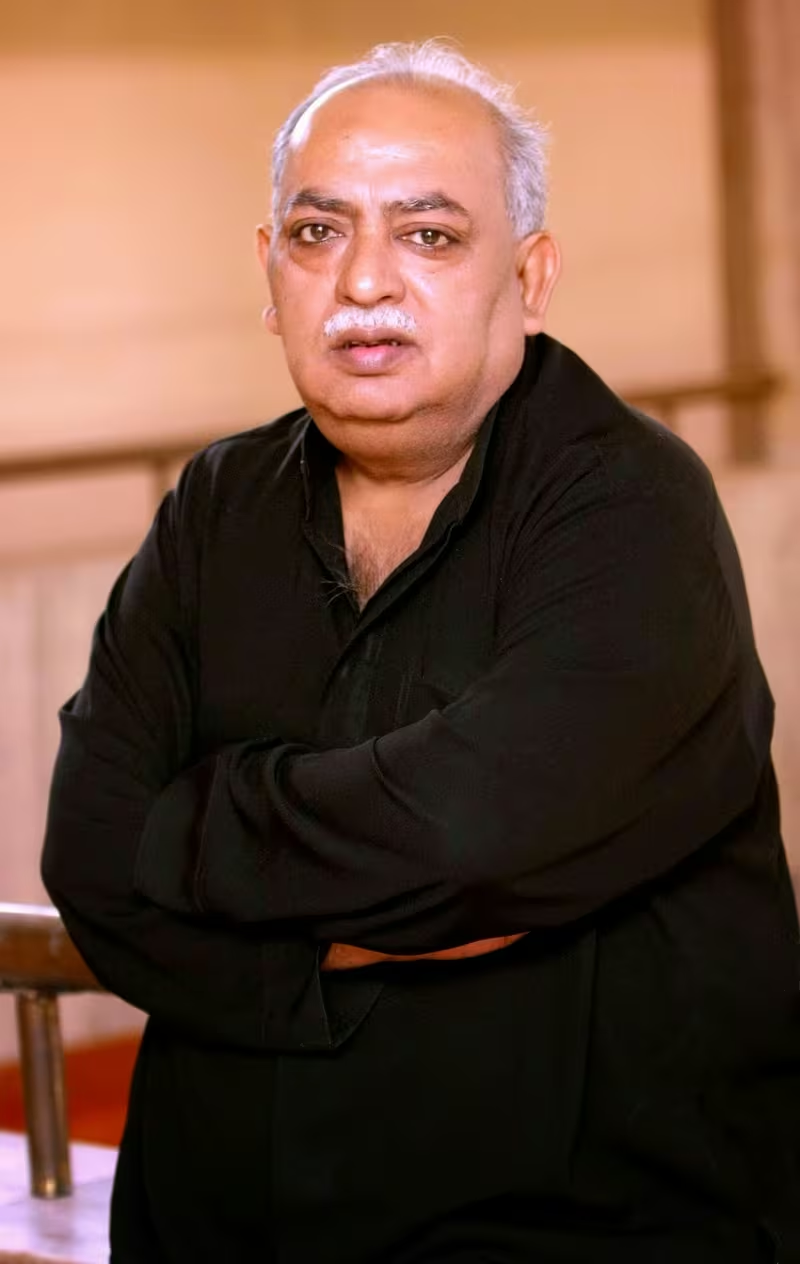
Munawwar Rana: The Poet Who Crowned 'Mother' in the Kingdom of the Ghazal
In the grand, ornate chambers of Urdu poetry, traditionally perfumed with the scent of roses, wine, and the bittersweet longing for a mystical beloved, one voice rose to speak of a love more primal, more universal. This was the voice of Munawwar Rana, a poet who took the intricate form of the ghazal and filled it not with the abstract sighs of a lover, but with the tangible, unwavering devotion for a mother. Munawwar Rana (1952-2024) was more than a poet; he was a phenomenon, a wordsmith who dismantled the ivory tower of high Urdu and built a home for it in the heart of the common man. His passing in January 2024 marked the end of an era for the countless admirers who saw their own unspoken emotions reflected in his simple, yet profound, verses.
Early Life: A Confluence of Cultures
Syed Munawwar Ali, who would later become famous as Munawwar Rana, was born on 26 November 1952, in the town of Raebareli, Uttar Pradesh. While his roots lay deep in the Awadhi heartland, a region steeped in a rich literary and cultural history, his destiny was to be shaped elsewhere. Following the Partition of India, his family, including his father Syed Anwar Rana, relocated to the bustling, cosmopolitan city of Kolkata. This move was formative. Young Munawwar grew up not in the familiar lanes of UP, but amidst the vibrant, diverse cultural tapestry of Bengal.
He spent most of his formative years in Kolkata, where his family ran a transport business. The city’s intellectual energy, its blend of tradition and modernity, and its unique linguistic environment left an indelible mark on him. While he was initially involved in the family business, his heart was never truly in the logistics of transport; it was captive to the rhythm of words and the cadence of poetry. This juxtaposition of a commercial background and a poetic soul would later inform his work, grounding his verses in the realities of everyday life rather than abstract philosophical flights.
The Poet's Calling: A New Voice for an Old Art
Munawwar Rana’s entry into the world of poetry was not as a practitioner of its most classical, Persianized form. Instead, he emerged as a voice of the people. He recognized that for Urdu poetry to survive and thrive, it needed to speak a language that resonated beyond elite literary circles. He consciously chose to employ a simple, accessible Hindustani—a blend of Hindi and Urdu peppered with Awadhi and other regional dialects—that could be understood and felt by a rickshaw puller in Lucknow as easily as a professor in Delhi.
His primary instrument was the ghazal, a poetic form known for its strict rhyming scheme (qaafiyaa-radiif) and its thematic focus, which had for centuries revolved around ishq (love), husn (beauty), and sharaab (wine). Rana revolutionized this. He took the vessel of the ghazal and poured into it the most sacred relationship he knew: that of a mother and child. This was his masterstroke. He made 'Maa' (Mother) the central protagonist of his poetic universe.
His couplets on this theme became legendary, recited in mushairas, shared on social media, and inscribed in the hearts of millions:
Kisi ko ghar mila hisse mein ya koi dukaan aayi,
Main ghar mein sab se chhota tha mere hisse mein maan aayi.
(Someone received a house in their share, someone a shop,
I was the youngest in the family; my share was my mother.)
This single couplet encapsulates his genius. It is emotionally devastating, narratively brilliant, and utterly relatable. He painted vivid, heart-wrenching portraits of motherhood, capturing its sacrifice, its unconditional love, and its irreplaceable presence:
Ae andhere dekh le munh tera kaala ho gaya,
Maa ne aankhein khol di ghar mein ujaala ho gaya.
(O darkness, behold, your face has been blackened,
Mother opened her eyes, and the house was filled with light.)
The Mushaira Superstar
Munawwar Rana was not just a poet for the page; he was a titan of the stage. In the vibrant world of the mushaira (poetic symposium), he was a reigning star. His recitation style was unique and deeply emotional. He did not merely recite his verses; he lived them. Often, he would be moved to tears while reciting his couplets about his mother, and this raw, unfiltered emotion created a powerful, almost spiritual connection with his audience. He could hold thousands of people in rapt attention, their silence broken only by thunderous applause and cries of "Waah! Waah!". He made the mushaira a space not just for intellectual appreciation but for collective emotional catharsis.
His popularity transcended borders, and he became a beloved figure in mushairas across the globe, from the Middle East to North America, carrying the warmth of his Hindustani verses to the Indian diaspora.
Major Works and Controversies
Throughout his prolific career, Rana penned numerous collections of poetry. One of his most significant works is 'Shahdaba', a collection for which he was awarded the prestigious Sahitya Akademi Award in 2014, one of India's highest literary honors. This award was official recognition of his immense contribution to Urdu literature.
Another seminal work was 'Muhajirnama' (The Chronicle of a Migrant). In this poignant collection, he explored the pain of displacement and the feeling of being an outsider in one's own land. Drawing from the experiences of Partition and the subsequent migrations, he gave voice to the silent sorrow of millions who had been uprooted from their ancestral homes.
However, Rana's later years were also marked by a turn towards vocal political commentary. In October 2015, in a dramatic and widely publicized move, he returned his Sahitya Akademi Award. He did so during a live television debate, protesting what he and many other writers and artists perceived as a rising tide of intolerance in India. This act of protest cemented his position as a public intellectual who was unafraid to use his platform to voice dissent.
He remained an outspoken critic of government policies, frequently commenting on issues such as the Citizenship Amendment Act (CAA) and other matters affecting India's minority communities. While his political stances earned him both admiration and criticism, they underscored his evolution from a purely literary figure to a voice of social and political conscience.
Legacy: A Poet of the People
Munawwar Rana's legacy is multi-faceted and profound.
First and foremost, he will be remembered as the poet who democratized the Urdu ghazal. He rescued it from the confines of scholarly appreciation and delivered it to the masses, proving that profound emotion could be expressed in the simplest of words.
Second, his canonization of the 'Maa' as a central poetic subject is a singular achievement. He carved out a new, deeply resonant theme within a centuries-old tradition, ensuring his unique place in the annals of literary history. Through his work, the figure of the mother received a literary reverence previously reserved for the romantic beloved.
Third, he acted as a linguistic and cultural bridge. By writing in both the Urdu and Devanagari scripts and using a vocabulary accessible to speakers of both Hindi and Urdu, he reinforced the shared heritage of the Hindustani language and brought diverse communities together through the shared experience of his poetry.
Finally, his life stands as a testament to the poet as a public figure. He was not a recluse but an active participant in the nation's discourse, embodying the idea that art cannot remain silent in the face of social and political turmoil.
Munawwar Rana passed away on 14 January 2024, in Lucknow, a city he had made his home in his later years. He left behind a void in the world of Urdu poetry, but also a treasure trove of verses that continue to bring solace, inspire love, and moisten the eyes of readers. He was the people's poet, the son who never stopped writing for his mother, and in doing so, he became the voice for every child who ever found their entire world in their mother's embrace.