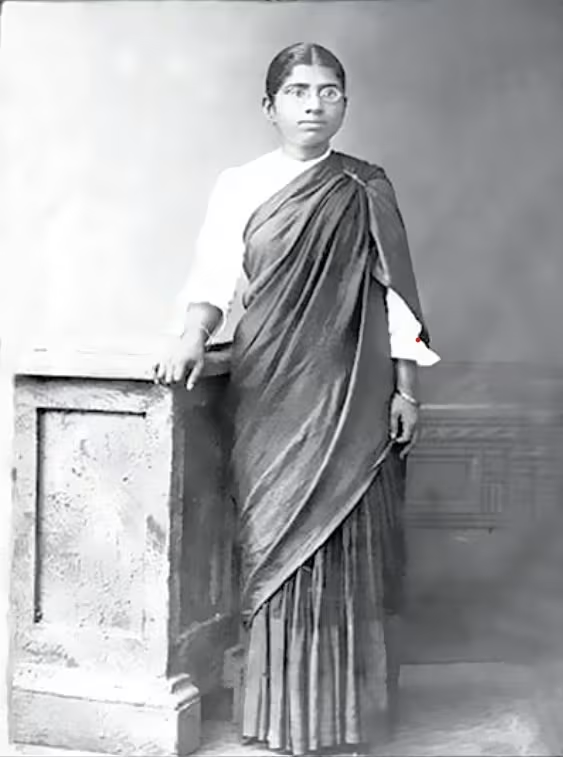
A Rebel with a Cause: The Indomitable Spirit of Muthulakshmi Reddy
In the grand tapestry of modern Indian history, some threads shine with a singular, defiant brilliance. Dr. Muthulakshmi Reddy (1886 - 1968) was one such thread. She was a woman of staggering firsts: a pioneering surgeon, the first woman to be admitted to a men’s college in India, the country's first female legislator, and the first female Deputy President of a legislative council. Yet, to define her by these firsts alone is to miss the fierce compassion and unyielding resolve that powered her life. She was not just a trailblazer; she was a path-maker, a healer of social ills, and a builder of institutions that stand today as monuments to her extraordinary vision.
Early Life & A Fight for Education
Muthulakshmi was born on July 30, 1886, in the princely state of Pudukkottai in present-day Tamil Nadu. Her very existence was an act of social rebellion. Her father, S. Narayanaswami Iyer, was the erudite Principal of the Maharaja's College, a Brahmin scholar. Her mother, Chandrammal, belonged to the Isai Vellalar community, a community traditionally associated with the Devadasi system. This mixed-caste union was unconventional and subjected the family to social scrutiny, but it endowed Muthulakshmi with a unique and empathetic perspective on the rigid hierarchies of caste and gender that governed Indian society.
Her father, a progressive thinker, educated her at home, nurturing a sharp and inquisitive mind. However, when she sought formal schooling, she was met with a wall of prejudice. The headmasters of local schools refused her admission, and the parents of other students threatened to withdraw their children if a girl from a “dancing girl’s family” was allowed to study alongside them. It was only through her father's persistent efforts and the enlightened intervention of the Maharaja of Pudukkottai, Martanda Bhairava Tondaiman, that she was finally admitted to the Maharaja's High School.
She excelled, completing her matriculation with distinction. Her ambition then soared higher: she wished to attend college. This was an almost unthinkable aspiration for a woman in early 20th-century South India. The Maharaja’s College in Pudukkottai was exclusively for men. Once again, society erupted in protest. But with the unwavering support of her father and the forward-thinking Maharaja, who awarded her a scholarship, the rules were bent. Muthulakshmi Reddy became the first woman student to be admitted to the college, a quiet but seismic victory against patriarchy.
Breaking Barriers in Medicine
A personal tragedy soon set the course for her professional life. The death of a close cousin from rectal cancer, an illness shrouded in ignorance and shame, deeply affected her. She resolved to become a doctor, to bring science and compassion to the suffering of women. She applied to the prestigious Madras Medical College in 1907.
The faculty was hesitant, but her exceptional academic record was undeniable. She was admitted, becoming one of the first women to study medicine in the institution. She graduated in 1912 with an array of gold medals and prizes, topping her class. She was appointed as the first woman House Surgeon at the Government Maternity Hospital in Madras, where her skill and empathy quickly earned her a formidable reputation.
Her quest for knowledge took her to England for postgraduate studies in gynecology and obstetrics. But it was the memory of her sister, who later died of cancer, that cemented her lifelong mission. She witnessed firsthand the devastating lack of awareness, facilities, and treatment for cancer in India. A seed was planted, one that would blossom decades later into one of her greatest legacies.
The Legislator’s Gavel: A Crusade for Justice
In 1926, Muthulakshmi Reddy’s life took another revolutionary turn. She was nominated to the Madras Legislative Council, becoming the first woman legislator in British India. This was not a role she sought, but one she embraced with the full force of her convictions. Her entry into the male-dominated halls of power was a landmark moment. A year later, in a testament to the respect she commanded, she was unanimously elected as the Deputy President of the Council, another unprecedented achievement for a woman anywhere in the world.
From this powerful platform, Dr. Reddy waged her most significant and arduous battle: the abolition of the Devadasi system. Having witnessed its corrosive effects through her own family's history, she understood it not as a sacred tradition, but as a system of sexual exploitation masquerading as religious devotion. Young girls were “dedicated” to temples, denied the right to marriage and education, and often forced into prostitution.
She introduced a bill to outlaw this practice, sparking a furious and protracted debate. Conservative stalwarts, including the nationalist leader S. Satyamurti, vehemently opposed her, arguing that she was attacking an ancient Hindu custom. They accused her of being a Westernized radical, ignorant of her own culture. Dr. Reddy stood her ground, armed with facts, logic, and a moral clarity that was unshakeable.
In her powerful speeches on the council floor, she dismantled their arguments. “Let us not in the name of art or religion degrade our women,” she thundered. She presented evidence of the suffering, the disease, and the social ostracism faced by these women. Her campaign was relentless, spanning years of advocacy, public awareness drives, and political maneuvering. Though she resigned from the council in 1930 to protest the arrest of Mahatma Gandhi, she continued her crusade. Her tireless efforts culminated in the passage of the Madras Devadasi (Prevention of Dedication) Act in 1947, a monumental victory for human rights.
Her legislative work did not end there. She was instrumental in raising the minimum age of marriage for girls, establishing special facilities for women and children in hospitals, and creating residential schools for girls. She was a fierce advocate for women’s suffrage, education, and property rights, laying the legislative groundwork for a more equitable society.
Builder of Sanctuaries: Avvai Home and the Adyar Cancer Institute
Dr. Reddy knew that legislation alone was not enough. The women and children she fought for needed refuge, support, and opportunity. In 1931, she founded the Avvai Home in Madras. It began as a small shelter for four girls rescued from the Devadasi system, but it grew into a large complex providing education, vocational training, and a safe haven for hundreds of destitute women and orphans. It was a living embodiment of her belief in rehabilitation and empowerment.
Her other monumental achievement was born from personal grief and professional vision. Haunted by the deaths of her sister and cousin, and appalled by the state of cancer care in India, she resolved to build a world-class cancer hospital. In the 1950s, cancer was a terrifying and untreatable disease for most Indians. There were no specialized facilities.
She began with almost nothing, starting a small cancer relief ward at the Women's Indian Association. With the tenacity that defined her, she lobbied the government, organized fundraisers, and inspired philanthropists. In 1954, the Adyar Cancer Institute opened its doors with just 12 beds, a single radiotherapy unit, and two doctors, including herself. Her vision was clear: no patient should be turned away for lack of funds. It was to be a place of hope, healing, and research.
Today, the Adyar Cancer Institute is a global powerhouse in oncology, a 500-bed hospital and research center renowned for its cutting-edge treatment, ethical practices, and unwavering commitment to providing free or subsidized care to the poor. It stands as Dr. Reddy’s greatest gift to the nation—a testament to her belief that healthcare is a fundamental right, not a privilege.
Legacy of an Icon
Muthulakshmi Reddy’s life was a masterclass in courage. She shattered every ceiling she encountered—in education, medicine, and politics. In 1956, a grateful nation honored her with the Padma Bhushan, one of India's highest civilian awards. She passed away on July 22, 1968, leaving behind a legacy that continues to touch millions of lives.
She is remembered not just as a woman of many firsts, but as a profound social architect. She fought not only for women's rights but for their dignity. She did not just identify problems; she built the institutions to solve them. In Tamil Nadu, her birthday is celebrated as 'Hospital Day' in recognition of her immense contribution to public health.
Dr. Muthulakshmi Reddy’s story is a powerful reminder that history is not merely shaped by grand political movements, but by the relentless conviction of individuals who dare to challenge the status quo. She was a doctor who healed a society, a legislator who gave voice to the voiceless, and a visionary who built sanctuaries of hope that will endure for generations.