Narasimhavarman I: The Great Wrestler Who Carved a Legacy in Stone
In the grand tapestry of Indian history, few rulers embody the dual spirit of a fierce warrior and a visionary builder as completely as Narasimhavarman I. Ascending to the throne of the Pallava dynasty around 630 CE, he inherited a kingdom smarting from humiliation. Yet, in a reign that spanned nearly four decades, he would not only avenge his father's defeat but also etch his name into the very granite cliffs of the Coromandel Coast, leaving behind a legacy of unparalleled military glory and artistic genius. Known by his virudas (titles) Mamalla (The Great Wrestler) and Vatapikonda (The Conqueror of Vatapi), his story is one of retribution, power, and the creation of timeless beauty.
Early Life & The Shadow of Defeat
Narasimhavarman was born into the heart of Pallava power, the son of the erudite and artistically inclined King Mahendravarman I. His father was a pioneer, the first to excavate stone temples from live rock in the Tamil country, a patron of music, and the author of the Sanskrit farce Mattavilasa Prahasana. But Mahendravarman's reign was also marked by a grave threat from the north. The ambitious Chalukyan emperor, Pulakeshin II, having consolidated his power in the Deccan and famously halted the advance of Emperor Harsha of Kannauj, turned his sights southward.
In a devastating campaign, Pulakeshin II swept through Pallava territory, reaching the very gates of their magnificent capital, Kanchipuram. While Mahendravarman I successfully defended the capital in a hard-fought battle, the Chalukyan invasion was a deep wound to Pallava pride. The young Narasimhavarman grew up in the shadow of this conflict, witnessing firsthand the peril his kingdom faced. This formative experience instilled in him a steely resolve to restore the honor of his dynasty. His education was undoubtedly comprehensive, encompassing the arts and sciences that his father cherished, but it was the art of war that would define the first half of his reign.
The Avenger of Kanchi: The Road to Vatapi
When Narasimhavarman I ascended the throne around 630 CE, his primary objective was clear: to crush the power of Pulakeshin II and the Western Chalukyas. He was not his father; where Mahendravarman had been a defender, Narasimhavarman was an aggressor. He spent the initial years of his reign meticulously reorganizing the Pallava army, building a formidable force capable of taking the fight to the enemy's heartland.
He found an able and fiercely loyal commander in his general, Paranjothi. The stage was set for one of the most significant military campaigns in South Indian history. Narasimhavarman's strategy was not merely to reclaim lost territory but to strike a decisive blow that would neutralize the Chalukyan threat for a generation.
The Pallava counter-offensive began in earnest. In 642 CE, the two great armies clashed at the Battle of Manimangalam, a town near Kanchipuram. It was the first major test of Narasimhavarman's new army, and they proved their mettle with a resounding victory. This was followed by further triumphs at Pariyala and Suramara, systematically pushing the Chalukyan forces out of Pallava lands and back across their own frontier. With each victory, the Pallava army, led by their king, gained momentum, their march turning from a war of liberation into a relentless invasion.
Vatapikonda: The Sack of the Chalukyan Capital
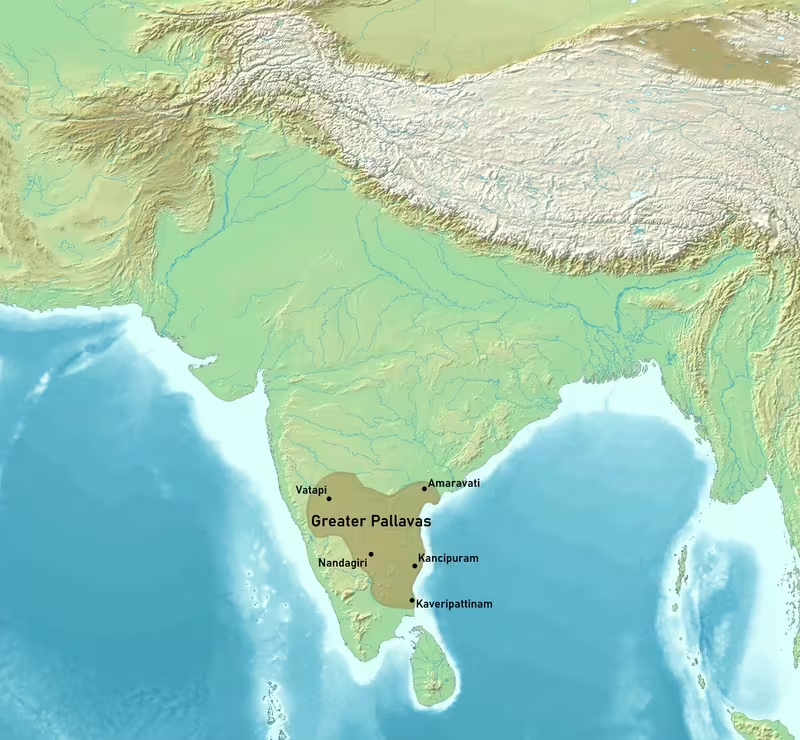
The campaign reached its dramatic climax in 642 CE at the Chalukyan capital, Vatapi (modern-day Badami in Karnataka). Perched amidst rugged sandstone cliffs and protected by formidable fortifications, Vatapi was considered impregnable. But Narasimhavarman's army, fired by a desire for vengeance, laid siege to the city.
The battle for Vatapi was fierce and bloody. The Pallava forces, under the command of Paranjothi, stormed the capital. In the ensuing conflict, the great Chalukyan emperor Pulakeshin II was defeated and likely killed. The victory was absolute. The city was sacked, and the Pallavas returned to Kanchipuram laden with immense booty, a symbolic reversal of the humiliation they had suffered years earlier.
Among the spoils of war was a now-iconic image of Ganesha, the Vatapi Ganapati. General Paranjothi brought this idol back and enshrined it in his hometown of Tiruchenkattankudi in the Chola country, where it remains an object of veneration to this day. To commemorate this monumental achievement, Narasimhavarman I assumed the title Vatapikonda. This victory was not just a military triumph; it was a profound statement of Pallava supremacy that would echo for centuries. The Chalukyan kingdom was thrown into disarray, and it would take them over a decade to recover, a period during which the Pallavas were the undisputed masters of Southern India.
Mamalla: The Great Builder of Mamallapuram
With his greatest enemy vanquished and his kingdom secure, Narasimhavarman I, the warrior, gave way to Narasimhavarman I, the visionary. He channeled the same ambition and resources that had won him the war into an artistic project of breathtaking scale. He turned his attention to the ancient port city on the coast, which would come to be known as Mamallapuram—the city of Mamalla.
Here, on the granite-strewn shores of the Bay of Bengal, Narasimhavarman initiated a sculptural and architectural revolution. He took his father's concept of rock-cut temples and expanded it into a magnificent open-air gallery. His artisans did not build with stone; they sculpted the living rock itself, transforming monolithic outcrops into architectural marvels.
The Pancha Rathas (Five Chariots): Perhaps the most famous of his commissions, these five monolithic structures are not temples in the conventional sense but architectural models, each carved from a single piece of granite. Named after the Pandava brothers and their wife Draupadi, they represent different styles of temple architecture—from the hut-like Draupadi Ratha to the multi-storied, apsidal Nakula Sahadeva Ratha and the grand Dharmaraja Ratha. They stand as a testament to the Pallava sculptors' skill and their king's desire to experiment with form.
Arjuna's Penance: This colossal open-air bas-relief, also known as the Descent of the Ganges, is one of the largest in the world and a masterpiece of narrative art. Carved onto the face of two massive boulders, it depicts a universe of figures—gods, demigods, ascetics, humans, and life-sized elephants—all moving towards a central cleft. The scene is a vibrant, dynamic portrayal of the epic story of the River Ganga's descent to Earth, a cosmic event brought to life in stone with incredible detail and emotional depth.
Cave Temples (Mandapas): Narasimhavarman continued the tradition of excavating cave temples, but his were more elaborate and refined than his father's. The Varaha Mandapa and the Mahishasuramardini Mandapa contain some of the finest examples of Pallava sculpture, depicting powerful mythological scenes with a grace and fluidity that seem to defy their stone medium.
Mamallapuram was more than just a royal project; it was the physical manifestation of a golden age, a place where religious devotion, artistic innovation, and imperial power converged. Today, it is a UNESCO World Heritage Site, a lasting monument to Mamalla's creative vision.
Patronage, Diplomacy, and Naval Power
Narasimhavarman's reign was not solely defined by war and architecture. Kanchipuram flourished as a cosmopolitan center of learning. Around 640 CE, the famous Chinese Buddhist monk and traveler, Xuanzang (Hiuen Tsang), visited the Pallava capital. His detailed accounts paint a picture of a prosperous and intellectually vibrant city. He noted the presence of over one hundred Buddhist monasteries with more than ten thousand monks, alongside numerous Deva (Hindu) temples. This suggests a climate of religious tolerance and active scholarly pursuit under Narasimhavarman's rule.
His influence also extended across the seas. The Pallavas maintained a powerful navy, which Narasimhavarman used to project power and engage in foreign diplomacy. The Sri Lankan chronicle, the Mahavamsa, records in detail how he provided military assistance to the Sinhalese prince Manavarma. He dispatched a large naval expedition twice to help Manavarma wrest the throne from his rival. The second attempt was successful, placing a friendly ruler on the throne in Lanka and demonstrating the formidable reach of Pallava naval power.
Legacy and Influence
Narasimhavarman I passed away in 668 CE, leaving behind a kingdom that was far more powerful, prosperous, and culturally rich than the one he had inherited. His legacy is profound and multifaceted.
As a military leader, he established Pallava dominance in Southern India for over a generation. The conquest of Vatapi became a legendary feat, a benchmark of military success for future southern dynasties.
As an architectural patron, his name is synonymous with Mamallapuram. The monuments he commissioned laid the foundational grammar for the Dravidian style of temple architecture, which would later be elaborated upon by the Cholas, Pandyas, and Vijayanagara emperors. He demonstrated that stone could be shaped with the fluidity of a painter's brush, creating a new language of art and devotion.
As a ruler, he presided over a period of immense cultural and intellectual activity, turning Kanchipuram into one of India's great capital cities. His reign marks the zenith of Pallava power and influence.
Narasimhavarman I remains one of the most compelling figures of ancient India. He was the complete king: a brilliant strategist who avenged his kingdom's honor on the battlefield, and a sublime artist who used his power to create a world of divine beauty in stone. He was Mamalla, the Great Wrestler, who wrestled not only with his enemies but also with the very rock of the earth, and from it, created an immortal legacy.