Narasimhavarman II - The Royal Sage and Master Builder of the Pallavas
In the grand tapestry of South Indian history, some rulers are remembered for their swords, others for their statecraft. But a few, a rare and revered few, are immortalized by their chisels. Narasimhavarman II, the Pallava monarch known to history by his proud biruda (title) Rajasimha—the “Lion among Kings”—was one such sovereign. Ascending the throne in an era defined by the clang of steel, he chose to wield the builder's mallet and the poet's pen, transforming his kingdom into a canvas for divine art. His reign, largely free from the major conflicts that defined his predecessors, was not an era of conquest but of creation, a period when stone was coaxed into prayer and architecture became the ultimate expression of faith and power.
From the wind-swept shores of Mamallapuram to the sacred heart of his capital, Kanchipuram, Rajasimha’s legacy is carved in sandstone. He was the visionary behind some of the most breathtaking and foundational temples of the Dravidian style, including the iconic Shore Temple and his magnum opus, the Kailasanatha Temple. A devout devotee of Shiva, a patron of scholars, and a diplomat whose reach extended to Imperial China, Narasimhavarman II was more than a king; he was the architect of a cultural renaissance.
Early Life & A Heritage of Conflict
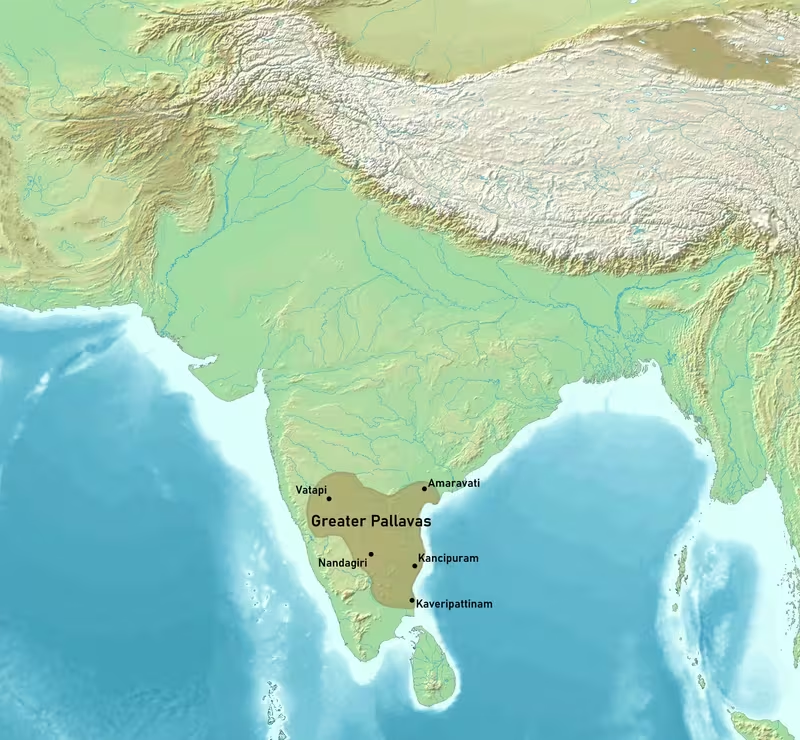
Narasimhavarman II came to power around 695 CE, inheriting a kingdom forged in the fires of a century-long struggle. His lineage was a roll call of Pallava titans. He was the son of Paramesvaravarman I and the great-grandson of the legendary Narasimhavarman I, the conqueror who had sacked the Chalukyan capital of Vatapi (Badami) and earned the title Vatapikonda. The Pallava-Chalukya rivalry was the defining political reality of the Deccan, a relentless contest for supremacy that had seen fortunes ebb and flow dramatically.
His father, Paramesvaravarman I, had endured a particularly brutal phase of this conflict. The Chalukyan king Vikramaditya I had pushed deep into Pallava territory, even temporarily occupying the capital, Kanchi. Though Paramesvaravarman I eventually rallied his forces and drove the Chalukyas back, the experience left an indelible mark on the kingdom. The Pallava court that Rajasimha grew up in was one of military readiness and resilience, acutely aware of the fragility of peace.
This background makes Rajasimha’s subsequent reign all the more remarkable. While his education would have undoubtedly included training in warfare and statecraft, he was also immersed in the rich cultural and intellectual milieu of the Pallava court. Kanchipuram was a flourishing center of learning, a hub for Sanskrit scholarship and religious philosophy. It was here that the seeds of his deep devotion to Shaivism and his passion for the Agamas (sacred scriptures) were sown, earning him titles like Shankara Bhakta (Devotee of Shankara) and Agamapriya (Lover of the Agamas).
When he ascended the throne, he inherited a kingdom that was weary of war but militarily secure. This unique position allowed him to pivot from a policy of aggression to one of consolidation, peace, and cultural expression. He chose to build temples, not just as acts of piety, but as powerful statements of Pallava sovereignty, stability, and cultural superiority.
A Reign of Peace and Architectural Splendor
The reign of Narasimhavarman II is notable for its conspicuous lack of major wars. The old Chalukyan foe was occupied with internal matters and the rising threat of the Rashtrakutas, granting the Pallava kingdom a period of sustained peace. This stability fostered immense prosperity, fueled by a flourishing maritime trade network that operated from the port city of Mamallapuram.
Rajasimha leveraged this peace to engage with the world not through armies, but through envoys. Historical records from China’s Tang Dynasty note the arrival of a Pallava embassy in 720 CE. The Chinese emperor Xuanzong received envoys from a king they recorded as Che-li-Na-lo-seng-k'ia-pao-to-pa-mo, a transliteration of Sri Narasimha Potavarman. This diplomatic mission sought Chinese support against the rising powers of the Arabs and Tibetans, demonstrating Rajasimha's astute understanding of geopolitics and his kingdom's significant role in the Indian Ocean world.
However, his greatest contributions were not in diplomacy, but in devotion-fueled architecture. He became the primary patron of a revolutionary shift in temple construction: the move from excavating monolithic, rock-cut shrines to building monumental, free-standing structural temples from dressed stone blocks. This was a quantum leap in engineering and artistry, and it would define the trajectory of South Indian temple architecture for the next thousand years.
The Kailasanatha Temple: A Vision in Sandstone
In the heart of Kanchipuram, Rajasimha commissioned his masterpiece: the Kailasanatha Temple, originally named Rajasimhesvaram (“The Lord of Rajasimha”). This temple is a symphony in sandstone and one of the earliest and most magnificent structural temples in the South. It is the quintessential example of the “Rajasimha style.”
The temple complex is a microcosm of the Hindu cosmos. A massive rectangular courtyard encloses the main shrine, lined with 58 smaller sub-shrines, each a miniature world of divine imagery. The main sanctum is crowned by a four-storey pyramidal vimana (tower), which became a prototype for the grand gopurams of later Dravidian temples. Its walls, both inside and out, are a gallery of Pallava sculpture at its most dynamic and graceful. Here, Shiva is depicted in his myriad forms: as the cosmic dancer Nataraja, the serene ascetic Dakshinamurti, and the vanquisher of demons. The recurring Somaskanda panel—depicting Shiva, Parvati, and the infant Skanda—is a signature Pallava motif found in prominence here.
The foundation inscriptions of the temple are a treasure trove for historians. In elegant Sanskrit verses, they proclaim the king’s glory and list his numerous titles—over 250 of them—that celebrate his valor, piety, and artistic sensibilities. The Kailasanatha Temple was not merely a place of worship; it was a testament to his power, a celebration of his faith, and a blueprint for a new architectural age.
The Shore Temple: A Sentinel by the Sea
If the Kailasanatha Temple represents the grandeur of the Pallava capital, the Shore Temple at Mamallapuram embodies its soul. A UNESCO World Heritage site, this elegant structure stands as a lonely sentinel against the ceaseless waves of the Bay of Bengal. Built from granite, it has weathered thirteen centuries of salt spray and cyclones, its form softened and sculpted by the elements.
The temple complex is unique in its layout. It features two primary shrines, both crowned with slender, soaring vimanas. The larger shrine faces east, its doors opened to catch the first rays of the morning sun over the ocean, and houses a Shivalinga. The smaller shrine faces west, protecting its inner sanctum from the sea. Unusually, nestled between them is a shrine dedicated to a reclining Vishnu, symbolizing a harmonious synthesis of the Shaivite and Vaishnavite traditions.
For ancient mariners navigating the Coromandel Coast, the gilded finials of the Shore Temple would have served as a brilliant landmark, a beacon of a prosperous and devout kingdom. It stands as a sublime fusion of the sacred and the secular, a monument that is in constant dialogue with its dramatic natural setting.
Beyond these two great monuments, Rajasimha's patronage extended to other temples like the Talagirisvara temple in Panamalai, famed for its surviving fragments of Pallava-era frescoes, and the Vaikuntha Perumal Temple in Kanchi, which was likely initiated by him and completed by his successor.
Legacy & Enduring Influence
Narasimhavarman II passed away around 728 CE, leaving behind a kingdom transformed. His legacy is not one of conquered territories but of a cultural and artistic paradigm shift that would echo for centuries.
An Architectural Revolution: Rajasimha's greatest legacy is his role as the pioneer of the large-scale Dravidian structural temple. The architectural vocabulary he established—the pyramidal vimana, the walled enclosure with subsidiary shrines, the extensive sculptural programs—became the foundational model for the great temple-cities built by the later Chola, Pandya, and Vijayanagara empires. The Brihadeeswarar Temple at Thanjavur, a Chola marvel built three centuries later, owes a clear architectural debt to the Kailasanatha Temple at Kanchi.
A Cultural Golden Age: His peaceful reign allowed for a flourishing of arts and letters. The great Sanskrit scholar Dandin, author of the prose romance Dashakumaracharita (“The Tale of the Ten Princes”), is widely believed to have graced his court. This patronage cemented the Pallava reputation as protectors of Sanskrit learning and high culture.
A Model of Kingship: Rajasimha presented a new ideal of the monarch: the king as the chief devotee (bhakta), whose primary duty was to protect dharma and beautify the earth with temples in honor of the divine. This model of pious kingship had a profound influence on later South Indian rulers.
Today, Narasimhavarman II is remembered not by the battles he won, but by the beauty he created. The Shore Temple, silhouetted against a rising sun, remains one of the most enduring images of India. The Kailasanatha Temple continues to inspire awe with its intricate carvings and spiritual ambience. These monuments are not cold relics of a bygone era; they are living testaments to the vision of a king who chose to be a builder, a poet, and a sage—a true Lion among Kings.