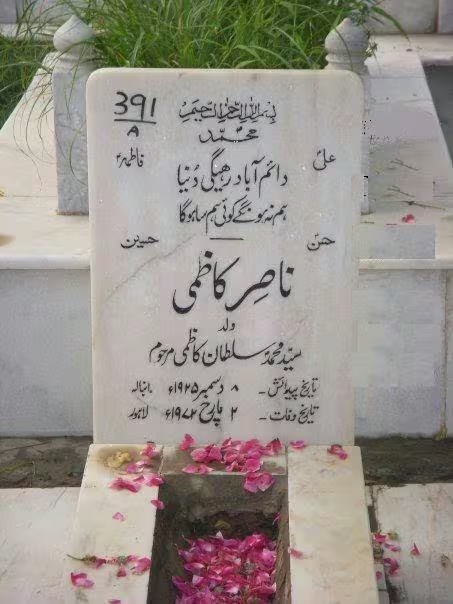
Nasir Kazmi: The Poet of Melancholy and Memory
In the vast, star-studded sky of Urdu poetry, some luminaries burn with a fierce, dazzling light, while others glow with a soft, persistent luminescence that touches the soul. Syed Nasir Raza Kazmi, known to the world simply as Nasir Kazmi, belonged to the latter. He was a poet not of grand pronouncements but of whispered sorrows, a chronicler of the quiet ache of separation and the haunting beauty of memory. His verses, crafted with a deceptive simplicity, became the definitive voice for a generation cleaved by the Partition of 1947, capturing the universal pain of displacement and the enduring longing for a lost home. More than just a writer, Nasir Kazmi was an architect of atmosphere, building worlds out of rain-soaked evenings, deserted streets, and the ever-present echo of nostalgia.
Early Life & The Lost World of Ambala
Syed Nasir Raza Kazmi was born on December 8, 1925, in Ambala, a bustling cantonment town in the Punjab of British India. He was born into a Syed family with a respectable scholarly and military background; his father, Syed Muhammad Sultan Kazmi, served as a Subedar-Major in the British Indian Army. This environment, a blend of discipline and intellectual curiosity, shaped his early years.
His childhood was spent in the serene, verdant landscapes of Ambala and Shimla, where his father was posted. These formative years were steeped in the sights and sounds of a pre-Partition India, a world of shared culture and undivided landscapes. This idyllic past would later become the inexhaustible wellspring of his poetic nostalgia. He received his early education in Ambala and later attended Islamia College in Lahore, a city that would eventually become his home, albeit a home shadowed by the memory of the one he had lost.
From a young age, Kazmi was drawn to the classical masters of Urdu poetry. While others were enchanted by the philosophical complexities of Ghalib or the revolutionary fire of Iqbal, Nasir found a kindred spirit in the 18th-century poet Mir Taqi Mir. He was captivated by Mir's ability to articulate profound grief (dard) in a language that was direct, unadorned, and piercingly honest. This artistic kinship would become the guiding star of his own poetic journey. He chose not to imitate Mir, but to channel his spirit, to speak of contemporary sorrows with the same timeless, understated grace. This deep admiration eventually earned him the informal title of Mir-e-sani—the second Mir—from critics and connoisseurs of Urdu literature.
The single most defining event of his life, and the crucible in which his poetic voice was forged, was the Partition of India in 1947. At the age of 22, Kazmi, like millions of others, was forced to leave his ancestral home. He migrated from Ambala to the newly formed nation of Pakistan, settling in Lahore. This was not merely a change of address; it was a profound and violent schism in his soul. The journey across the new border was a journey away from his childhood, his memories, and the very soil that had nurtured him. The trauma of this hijrat (migration) became the central, recurring motif of his work. Ambala was no longer just a town; it transformed into a powerful symbol of a lost paradise, an irretrievable past that he would forever chase in the haunting corridors of his poetry.
Career & The Architecture of a New Ghazal
Life in Lahore was a struggle for the young poet. The city was teeming with displaced souls, each carrying their own burden of loss. Kazmi navigated this new reality by immersing himself in the literary world. He took on various editorial roles for literary journals such as Auraq-e-Nau, Humayun, and Khayal, which kept him at the heart of the subcontinent's evolving literary discourse. Later, he found a more stable position as a staff editor at Radio Pakistan, a role he held for many years. This work provided him with a livelihood but, more importantly, allowed him the space to hone his unique poetic craft.
In 1952, he published his first collection of poetry, Barg-e-Nai (The Reed's Leaf). The title itself was a poignant metaphor, alluding to the reed that must be cut from its bed to become a flute, its music a lament for its separation. The book was a revelation. It announced the arrival of a voice that was starkly different from its contemporaries. In an era where poetry often leaned towards political rhetoric or ornate romanticism, Kazmi offered introspection, melancholy, and a deep, personal sense of alienation.
His poetic style is best described by the term sahl-e-mumtana—a style of deceptive simplicity. He meticulously stripped his language of complex Persianised vocabulary, opting instead for simple, everyday words. Yet, within this simplicity lay layers of meaning and profound emotional depth. His genius was in using common imagery—a lonely tree, a quiet lane, the first rain, a flickering lamp—to evoke complex states of being. His ghazals, often composed in chhoti behr (short meter), possessed a conversational, almost musical quality, making them feel like intimate confessions whispered to the reader.
Kazmi became a pioneer of the Nai Ghazal (New Ghazal) movement. While respecting the classical form of the ghazal, with its strict rules of rhyme and meter, he infused it with modern sensibilities. His poetry was not about the idealized, abstract beloved of classical tradition. It was about real, tangible loss. His landscape was not a mythical garden but the lonely, rain-lashed streets of a modern city. He wrote of the anxiety of urban life, the feeling of being a stranger in one's own home, and the silent grief that settles in the heart after a great upheaval.
His major works, many published posthumously, cemented his reputation:
- Barg-e-Nai (1952): His seminal first collection, which established his signature themes of nostalgia, separation, and melancholy.
- Deewan (1964): A collection that further explored his unique lyrical style.
- Pehli Baarish (The First Rain, 1975): Published after his death, this collection is considered one of his finest, filled with poems that are both tender and sorrowful, where rain serves as a metaphor for memory and longing.
- Nishat-e-Khwab (The Delight of Dreams, posthumous): A collection of ghazals that continued his exploration of dreams, memory, and the ephemeral nature of happiness.
Beyond poetry, his prose, collected in Khushk Chashme ke Kinare (By the Banks of a Dry Spring, 1982), revealed a sharp critical mind. In these essays, he reflected on literature, the craft of poetry, and the works of the classical masters who inspired him, offering invaluable insight into his own artistic philosophy.
One of his most quoted couplets perfectly encapsulates his worldview—the idea that memory is both a comfort and a wound:
Dil dhadakne ka sabab yaad aaya Woh teri yaad thi ab yaad aaya
(The reason for my heart's beating, I now recall It was your memory, I now recall)
Legacy & The Everlasting Echo
Nasir Kazmi's life was cut tragically short. He passed away from stomach cancer on March 2, 1972, in Lahore, at the age of just 46. His early death seemed to mirror the melancholy that pervaded his work, leaving behind a legacy that was as profound as it was poignant.
His historical significance lies in his role as the foremost poet of the Partition's psychological aftermath. He did not write of the riots or the politics; he wrote of the silence that followed. He documented the invisible scars left on the soul of a generation, the quiet, gnawing sense of loss that defined their existence. In doing so, he universalized a personal and collective trauma, creating a body of work that serves as an emotional archive of one of the most painful chapters in South Asian history.
Kazmi's influence on Urdu literature is immense. He rescued the ghazal from becoming a museum piece or a political tool, breathing new life into it by connecting it to the lived experience of the modern individual. Poets who followed him, like Parveen Shakir, were deeply influenced by his use of simple language and intimate, personal themes.
Perhaps his most enduring impact on Indian and Pakistani culture is through music. His ghazals, with their inherent musicality and emotional depth, were a perfect match for the voices of legendary singers. Icons like Mehdi Hassan, Farida Khanum, Ghulam Ali, and Iqbal Bano immortalized his words, carrying them from literary gatherings into the homes and hearts of millions. Ghazals such as "Dil mein ek lehar si uthi hai abhi," "Niyat-e-shauq bhar na jaaye kahin," and "Gaye dinon ka suraagh le kar kidhar se aaya kidhar gaya woh" have become timeless classics, integral to the cultural fabric of the subcontinent.
Today, Nasir Kazmi is remembered as the poet of dard and yaad—of pain and memory. He is the poet one turns to on a quiet, rainy night, when the heart is heavy with an unnamed sadness. His verses continue to resonate on social media, in literary discussions, and in the quiet moments of introspection, speaking to anyone who has ever felt the pang of loss or the bittersweet comfort of nostalgia. He taught the world that the deepest emotions need not be shouted; they can be conveyed in the gentle fall of a leaf, the scent of the first rain, or the simple, haunting memory of a lost home.