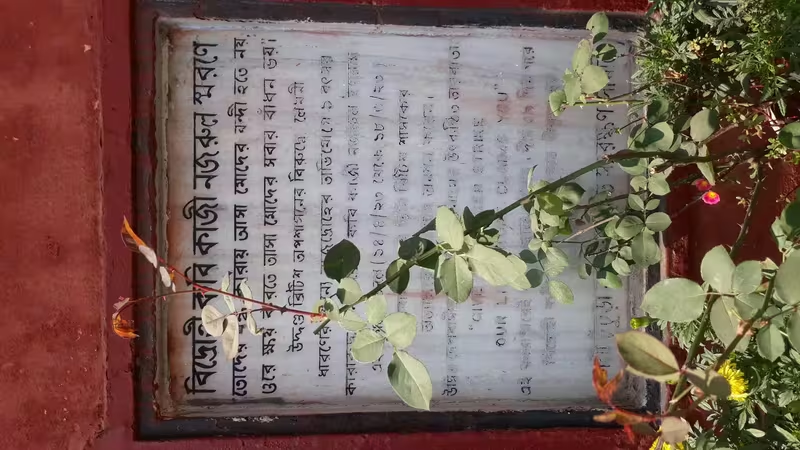
Kazi Nazrul Islam - The Rebel Poet of Bengal
In the tumultuous landscape of early 20th-century British India, when the air crackled with the fervor of revolution and the yearning for freedom, a voice erupted from the soil of Bengal—a voice as fierce as a storm and as tender as a lover's lament. This was the voice of Kazi Nazrul Islam (1899-1976), the Bidrohi Kobi, the Rebel Poet, whose pen was not merely a tool for art but a weapon against oppression. A poet, musician, revolutionary, and philosopher, Nazrul’s life was a testament to the indomitable spirit of humanism, a fiery crusade against injustice in all its forms—colonial, social, and religious.
Early Life & Tumultuous Beginnings
Kazi Nazrul Islam was born on May 25, 1899, in the village of Churulia, in the Paschim Bardhaman district of the Bengal Presidency. Born into a modest Kazi family, his father, Kazi Faqeer Ahmed, was the imam of the local mosque. From a young age, Nazrul was immersed in a world of both Islamic theology and the rich folk traditions of rural Bengal. His early life earned him the nickname 'Dukhu Mia' (Sorrowful One), a name that seemed to foreshadow a life marked by profound struggle and deep empathy for the suffering of others.
The death of his father in 1908, when Nazrul was just ten, thrust him into a world of responsibility. He took up his father's work as a muezzin (one who gives the call to prayer) to support his family. This period, however, also deepened his spiritual and literary education. His formal schooling was sporadic, a casualty of poverty. He wandered, driven by a restless spirit and an insatiable hunger for experience.
A pivotal chapter of his youth was his involvement with a traveling folk-theatrical group known as a leto dal. Here, the young 'Dukhu Mia' found a stage for his burgeoning talents. He acted, sang, and, most importantly, began composing songs and plays. Immersing himself in the great Hindu epics like the Mahabharata and the Puranas, he wrote folk plays such as Shakuni Badh (The Slaying of Shakuni). This early exposure to both Islamic and Hindu narratives laid the foundation for the remarkable syncretism that would become the hallmark of his life's work.
His journey was one of constant movement. He worked at a tea stall in Asansol and as a cook, experiences that brought him face-to-face with the grim realities of poverty and labor. A kind police officer, Kazi Rafizullah, recognized the spark of genius in the boy and took him to his village in Trishal (now in Bangladesh) to ensure his education continued. Nazrul eventually enrolled at the Searsole Raj High School, but the structured world of academia could not contain his rebellious spirit. In 1917, on the cusp of his matriculation exams, he made a decision that would change his life forever: he enlisted in the British Indian Army.
The Making of a Rebel: Army Life and Literary Awakening
Nazrul joined the 49th Bengal Regiment and was posted to the Karachi Cantonment. Though he never saw active combat in the First World War, the army barracks became his university. It was here that he devoured literature with a voracious appetite—from the works of Rabindranath Tagore and Sarat Chandra Chattopadhyay to the sublime poetry of the Persian masters Hafez and Rumi. He learned Persian from a regimental maulvi, and his own literary career began to take flight.
In 1919, his first prose piece, Baunduler Atmakahini (Autobiography of a Vagabond), was published. Soon after, his first poem, Mukti (Freedom), found its way into a Calcutta journal. When the regiment was disbanded in 1920, Nazrul returned not as an aimless youth but as a writer with a mission. He settled in Calcutta, the pulsating heart of Bengali culture and Indian nationalism.
It was here, in the politically charged atmosphere of the Non-Cooperation Movement, that Nazrul’s revolutionary voice found its true expression. In December 1921, he composed the poem that would define him for eternity: "Bidrohi" (The Rebel). Published in the Bijoli magazine in January 1922, the poem was a literary thunderbolt. It was a volcanic eruption of defiance against all forms of bondage:
"I am the unutterable grief, I am the trembling first touch of the virgin, I am the throbbing ten, I am the wild fire of the woods, I am the hellish rage of the sea... Weary of struggles, I, the great rebel, Shall rest in quiet only when I find The sky and the air free of the piteous groans of the oppressed. Only when the battlefields are cleared of jingling bloody sabres Shall I, weary of struggles, rest in quiet, I am the rebel eternal."
With its explosive rhythm, powerful imagery, and an all-encompassing “I” that identified with both creator and destroyer, “Bidrohi” electrified the Bengali literary world. It was a radical departure from the serene lyricism of the Tagorean school and instantly anointed Nazrul as the Bidrohi Kobi.
His activism was not confined to poetry. In August 1922, he launched his own bi-weekly magazine, Dhumketu (The Comet), which became an unapologetic platform for demanding complete independence from British rule. Its masthead was blessed by Rabindranath Tagore himself. In its pages, Nazrul published a politically charged poem, Anondomoyir Agomone (On the Arrival of the Goddess of Joy), which used religious imagery to condemn British tyranny. The response was swift. The colonial authorities raided his office, and on November 23, 1922, Nazrul was arrested on charges of sedition.
His trial became a public spectacle. Instead of a defense, Nazrul delivered a fiery statement, Rajbandir Jabanbandi (The Deposition of a Political Prisoner), a powerful indictment of colonial rule and a passionate defense of self-determination. Sentenced to one year of rigorous imprisonment, he continued his protest inside the Hooghly jail, embarking on a 40-day hunger strike against the deplorable conditions. The nation held its breath. A concerned Tagore sent him a telegram: “Give up hunger strike, our literature claims you.” Nazrul was finally released in December 1923, physically weakened but spiritually unbroken.
The Composer of the Soul and Champion of Unity
Emerging from prison, Nazrul’s creative energies flowed into a new channel: music. While he continued to write poetry, prose, and essays, he began a period of prolific musical composition that would give birth to a new genre: Nazrul Geeti (Music of Nazrul).
He composed an astonishing number of songs—estimated to be nearly 4,000—covering a vast emotional and spiritual spectrum. Nazrul was a musical innovator, a genius who shattered conventions. He masterfully blended the structures of Indian classical ragas with the soulfulness of Bengali folk forms like Bhatiali and Baul. He popularized the Ghazal in the Bengali language and fearlessly incorporated Arabic, Persian, and even Western musical influences into his work.
His songs were for every occasion and every soul. He wrote rousing patriotic songs like Chol Chol Chol (which became the marching song of the Bangladesh Armed Forces), tender romantic ballads, and powerful songs of social protest. At the same time, he composed some of the most profound devotional music the subcontinent has ever known. A devout Muslim, he wrote hundreds of Islamic songs (Hamd, Na'at), including the timeless Eid anthem O Mon Romzaner Oi Rozar Sheshe. Simultaneously, he composed an equally vast body of Shyama Sangeet (devotional songs to the Goddess Kali) and Hindu Bhajans, displaying a spiritual depth that transcended religious boundaries.
This syncretism was the core of his philosophy. At a time when communal tensions were being stoked by colonial policies, Nazrul was an unwavering champion of Hindu-Muslim unity. He famously wrote:
"Mora eki brinte duti kusum Hindu-Musalman Muslim tar noyonmoni, Hindu tahar praan" (We are two flowers on the same stalk, Hindu and Muslim. The Muslim is its eye, the Hindu its life.)
He used imagery from both traditions interchangeably, seeing them as part of a shared cultural heritage. He was also a fierce advocate for social justice, railing against casteism, economic exploitation, and religious orthodoxy. His poem Nari (Woman) was a powerful call for gender equality, celebrating women as equal partners in the journey of humanity. His personal life mirrored his beliefs; in 1924, he married a Hindu woman, Pramila Devi, in a union that defied the rigid social norms of the time.
Personal Tragedies and the Fading Light
Despite his towering fame, Nazrul’s life remained a relentless struggle against poverty and personal tragedy. The death of his beloved young son, Bulbul, from smallpox in 1930 left him shattered, a grief that he poured into his poetry collection Bulbul. In 1939, his wife Pramila was struck by a paralytic illness, adding an immense emotional and financial burden.
Then, in 1942, the cruellest blow of all fell. While participating in a live radio broadcast in Calcutta, the 43-year-old poet, at the zenith of his creative powers, suddenly faltered. He lost his ability to speak. The vibrant, rebellious voice that had roused a nation fell silent.
He was diagnosed with Pick's disease, a rare and incurable neurodegenerative disorder that slowly eroded his memory and cognitive functions. For the next 34 years, Kazi Nazrul Islam lived in a state of medical incapacitation, his mind trapped in a silent prison. The pen that had roared like a lion lay still. Efforts to treat him in India and Europe proved futile.
Legacy & Everlasting Influence
After the liberation of Bangladesh in 1971, the nation’s founding father, Sheikh Mujibur Rahman, brought Nazrul and his family from Calcutta to Dhaka in May 1972. He was granted Bangladeshi citizenship and, in 1974, was officially declared the National Poet of Bangladesh. It was a fitting honor for a man whose work had inspired the fight for linguistic and cultural freedom.
Kazi Nazrul Islam passed away on August 29, 1976, in Dhaka. He was buried with full state honors beside the Dhaka University mosque, a location he was said to have envisioned in one of his poems.
Today, Nazrul’s legacy is as powerful as ever. He is revered as a cultural icon in both Bangladesh and West Bengal. His music, Nazrul Geeti, stands alongside Rabindra Sangeet as one of the two great pillars of Bengali song. But his influence extends far beyond art. He remains a symbol of rebellion against all forms of tyranny, a timeless voice for the poor, the marginalized, and the oppressed. In an age still grappling with division and intolerance, Kazi Nazrul Islam's life and work are a blazing beacon of secularism, humanism, and the unquenchable fire of the free human spirit.