Neem Karoli Baba: The Saint of Unconditional Love
In the vast spiritual tapestry of 20th-century India, few figures radiate with the simple, profound warmth of Neem Karoli Baba. Known to his devotees as Maharaj-ji, he was not a philosopher who wrote complex treatises or a yogi who demonstrated esoteric powers. Instead, he was a living embodiment of Bhakti Yoga—the path of pure love and devotion. Wrapped in a simple plaid blanket, with a compassionate, often mischievous smile, he taught one fundamental truth: to love everyone, serve everyone, feed everyone, and remember God. His life, shrouded in the humility he so deeply cherished, became a beacon that drew seekers from the dusty villages of Uttar Pradesh to the bustling cities of the Western world, leaving an indelible mark on modern spirituality.
Early Life & The Wandering Sadhu
Neem Karoli Baba was born Lakshmi Narayan Sharma in the early 1900s in the village of Akbarpur in Uttar Pradesh, into a Brahmin family. In keeping with the customs of the time, he was married at the young age of 11. However, the call of the spiritual path was stronger than the pull of worldly life. Shortly after his marriage, he left his home to become a wandering sadhu, a renunciate traveling across the length and breadth of India. During these formative years, he was known by many names—Lakshman Das, Handi Wallah Baba, and Tikonia Walla Baba, among others—each name a marker of a place and a time in his journey of austerity and meditation.
Despite his commitment to a renunciate's life, he was eventually found by his father, who persuaded him to return to his family. For a period, Lakshmi Narayan Sharma lived the life of a householder, fulfilling his duties and fathering two sons and a daughter. Yet, this phase was a temporary anchor. The divine pull was relentless, and he once again left home, this time for good, fully immersing himself in his spiritual calling. He would later affirm that attachment to family and the responsibilities of a householder were far more challenging spiritual practices than the solitary life of an ascetic.
It was during his travels that the most famous incident of his life occurred, bestowing upon him the name by which the world would come to know him. While traveling by train, he was asked for a ticket by the conductor. As a sadhu with no possessions, he had none. Despite the protests of other passengers who recognized his saintly aura, the British conductor forced him off the train at the small village of Neem Karoli. Unperturbed, the sadhu sat down under a nearby tree and settled into meditation. What followed became local legend. The train, despite all efforts by the crew, refused to move. After several failed attempts to restart the engine, a passenger suggested to the conductor that they had wronged the holy man. The chastened officials went to the sadhu, apologized, and begged him to re-board the train. He agreed, but on two conditions: that the railway company promise to build a station for the villagers of Neem Karoli, and that they treat all sadhus with respect. The moment he stepped back onto the train, it started effortlessly. From that day forward, he was affectionately known as Neem Karoli Baba, the sage from Neem Karoli.
The Guru's Grace: Ashrams, Teachings, and Darshan
Maharaj-ji's "career" was not one of building an organization but of building communities of faith centered on selfless service. He never gave formal lectures or wrote books. His teachings were delivered in the simple, everyday moments—a shared meal, a quiet glance, a brief, often cryptic, remark. His primary ashrams at Kainchi Dham in the Kumaon Hills and in the holy city of Vrindavan became vibrant centers of this living wisdom.
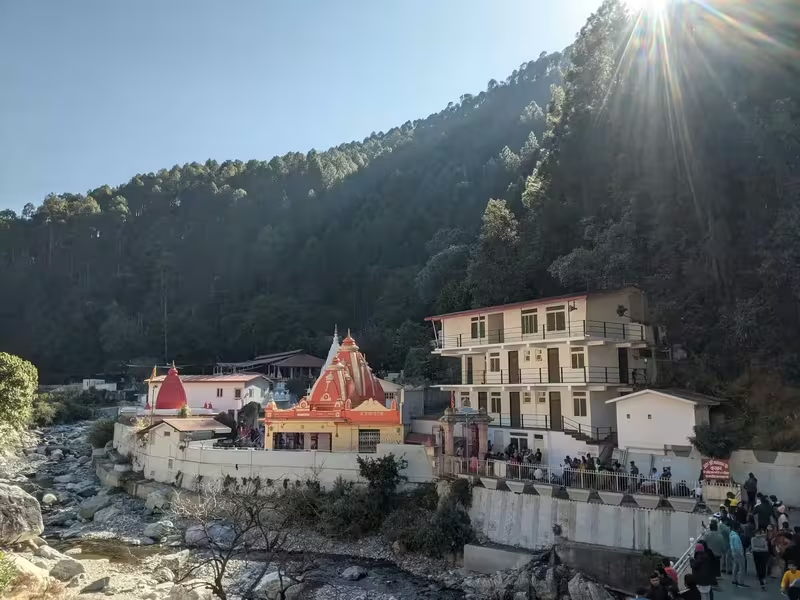
Kainchi Dham, established in 1964, is perhaps his most famous legacy. Nestled in a serene valley by a river, the ashram began with a small temple dedicated to Hanuman, the Hindu deity embodying strength, devotion, and selfless service, whom Maharaj-ji revered as his guru. Every year on June 15th, the anniversary of the ashram's inauguration, a massive bhandara (feast) is held, where tens of thousands of people are fed, a living testament to his simple instruction to "feed everyone."
His core philosophy was deceptively simple yet profoundly challenging:
- Bhakti Yoga: He emphasized that the easiest way to reach God in the current age (Kali Yuga) was through love and devotion. Chanting the name of God, especially "Ram," was a central practice he encouraged.
- Seva (Selfless Service): For Maharaj-ji, service was the highest form of devotion. He saw God in every person, especially the poor and the suffering. Acting with compassion and serving others without any expectation of reward was the most direct way to purify the heart.
- Sub Ek (All is One): He constantly reminded his devotees of the oneness of all beings and all religions. He saw no difference between a Hindu, a Muslim, a Christian, or a Jew, often saying, "All religions are the same. They all lead to the same goal."
To be in his presence, or to have his darshan, was an experience that devotees described as transformative. He was known for his lila, or divine play—unpredictable, often humorous, and always deeply meaningful actions that broke down the ego of the seeker. He might ignore a powerful official while spending hours with a simple villager, or throw an apple at someone as a form of blessing. He seemed to know the innermost thoughts and secrets of those who came to him, addressing their unspoken fears and desires with a simple word or gesture, leaving them in a state of awe and profound love.
Legacy & Influence: A Bridge Between East and West
While deeply revered in India, Neem Karoli Baba's influence expanded globally in the late 1960s and early 1970s, as a wave of Western spiritual seekers arrived in India. His legacy is inextricably linked with the American spiritual teacher Ram Dass. Born Richard Alpert, he was a prominent Harvard psychology professor working alongside Timothy Leary. Disillusioned with academia and psychedelic research, Alpert traveled to India in 1967, where he was guided to Maharaj-ji. In their first meeting, Maharaj-ji demonstrated an uncanny knowledge of Alpert's life, including the secret cause of his mother's death, a detail Alpert had never shared. This encounter shattered Alpert's rationalist worldview and initiated his transformation into Ram Dass. His 1971 book, Be Here Now, a counter-culture classic, introduced Neem Karoli Baba to millions in the West and became a gateway for many to Eastern spirituality.
Through Ram Dass, many other Westerners found their way to Maharaj-ji's feet. These included kirtan musicians Krishna Das and Jai Uttal, who would go on to popularize devotional chanting in the West, and epidemiologist Dr. Larry Brilliant. The story of Dr. Brilliant is a powerful example of Maharaj-ji's practical, world-changing guidance. He and his wife arrived at the ashram as young hippies, and Maharaj-ji told Brilliant that his destiny was to work for the United Nations to eradicate smallpox. Brilliant was skeptical, but heeded the guru's words. He joined the World Health Organization's smallpox program, which, in a historic achievement for humanity, successfully wiped the disease from the face of the Earth. Brilliant has consistently credited Maharaj-ji's foresight and blessing for this monumental success. Together, Ram Dass and Larry Brilliant later co-founded the Seva Foundation, an international health organization inspired by Maharaj-ji's teachings on selfless service.
The guru's influence also touched the pinnacles of technology and innovation. A young, searching Steve Jobs traveled to India in 1974, hoping to meet Neem Karoli Baba, only to find that he had passed away the previous year. Nevertheless, Jobs spent several months at the Kainchi Dham ashram, and the experience of simple living, spiritual inquiry, and intuitive wisdom profoundly shaped his worldview, which he later infused into the ethos of Apple. Decades later, when Facebook was facing a difficult period, Jobs advised its young founder, Mark Zuckerberg, to make the same pilgrimage. Zuckerberg visited Kainchi Dham in 2015, seeking clarity and a renewed sense of purpose, a testament to the enduring, cross-generational power of Maharaj-ji's spiritual legacy.
On September 11, 1973, in a hospital in Vrindavan, Neem Karoli Baba left his physical body. His mahasamadhi (a yogi's conscious departure) marked the end of an era, but his presence has only grown. His ashrams in Kainchi, Vrindavan, and Taos, New Mexico, remain vital centers for devotion. His teachings, unwritten but alive in the hearts of his devotees, continue to guide countless individuals. Neem Karoli Baba's life stands as a radiant reminder that the greatest spiritual truths are not found in complex doctrines but in the simple, powerful, and unconditional act of love.