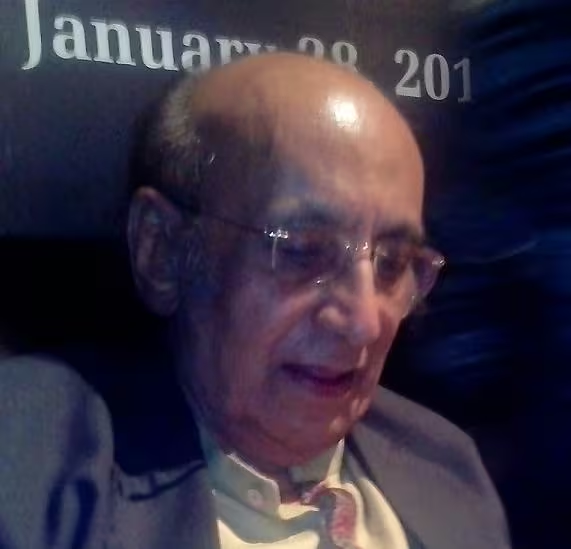
Nida Fazli: The People's Poet Who Wrote Life's Verses
In the vast universe of Urdu poetry, where ornate Persianised expressions often held sway, there emerged a voice that spoke a different language—the language of the soil, of the bustling street, of the quiet ache in a common person's heart. This was the voice of Muqtida Hasan Nida Fazli (1938-2016), a poet, lyricist, and writer who built a bridge of words (Lafzon Ka Pul) connecting the classical with the contemporary, the profound with the simple, and the mosque with the temple. His life was a testament to the power of art to transcend borders, both literal and metaphorical, leaving behind a legacy etched in the collective consciousness of India.
Early Life & The Shadow of Partition
Born Muqtida Hasan on 12 October 1938 in Delhi, the future poet was nurtured in an environment steeped in literature. His father was a poet himself, writing under the takhallus (pen name) Dua Dubaivi, and the young Muqtida grew up surrounded by the rhythm and rhyme of Urdu verse. The family later moved to Gwalior, a city with a rich, syncretic cultural tapestry. It was here that his worldview was shaped, not just by the ghazals of Mir and Ghalib, but equally by the devotional bhajans of Meera, the philosophical dohas of Kabir, and the lyrical verses of Surdas. This confluence of Hindu and Islamic traditions would become the bedrock of his secular and inclusive artistic vision.
His chosen name, Nida Fazli, was itself a story. 'Nida' translates to 'voice' or 'sound', while 'Fazli' was a tribute to Fazil, a region in Kashmir from where his ancestors were said to have hailed. He was embracing both a universal purpose and a personal history.
The most defining event of his formative years was the Partition of India in 1947. While his parents and siblings, caught in the communal upheaval, migrated to Pakistan, the young Nida Fazli chose to remain in India. This singular decision left an indelible mark on his soul. The profound loneliness, the pain of separation, and the search for identity in a fractured homeland became recurring motifs in his work. He was an emotional orphan of Partition, and his poetry often carried the weight of this personal tragedy, transforming it into a universal exploration of loss and belonging.
He pursued his education with a quiet determination, eventually earning a postgraduate degree in English Literature. This academic grounding gave him a wider lens, allowing him to infuse his vernacular sensibilities with a modern, global perspective, a quality that set him apart from many of his contemporaries.
The Making of a Poet: From Gwalior to Bombay
In the early 1960s, like countless dreamers before him, Nida Fazli moved to Bombay (now Mumbai) in search of work and a platform for his creative voice. The initial years were a struggle, but his unique style soon found a home in prominent literary magazines like Dharmayug and Sarika. His poetry was a breath of fresh air. It was conversational, direct, and stripped of the elaborate metaphors that often made classical Urdu poetry inaccessible to the masses.
His first collection of poetry, Lafzon Ka Pul (1969), firmly established him as a significant voice in modern Urdu literature. He followed this with several acclaimed collections, including Mor Naach, Aankh Aur Khwab Ke Darmiyan, and Safar Mein Dhoop Toh Hogi. His philosophy was simple: poetry should resonate with lived experience. He famously said, "A poet should be like a camera, not a painter." He aimed to capture life as it was, with all its imperfections and quiet dignities.
One of his most quoted couplets perfectly encapsulates this approach:
"Har aadmi mein hote hain das bees aadmi, Jis ko bhi dekhna ho kai baar dekhna."
(Every person contains ten or twenty people within, Whoever you wish to see, look at them several times.)
Beyond poetry, Fazli was also a gifted prose writer. His autobiographical works, Deewaron Ke Beech (Between the Walls) and Deewaron Ke Bahar (Outside the Walls), offer poignant insights into his life and the socio-cultural milieu of his times. He was a keen observer of human nature, and his prose, much like his poetry, was marked by its honesty and emotional depth.
A Lyricist for the Silver Screen
While Nida Fazli was a celebrated figure in literary circles, it was his work as a Bollywood lyricist that made him a household name across India. His entry into the film industry was serendipitous. Following the death of the legendary lyricist Jan Nisar Akhtar, director Kamal Amrohi was in search of a writer for his magnum opus, Razia Sultan (1983). Impressed by Fazli's poetic prowess, he was brought on board, and a new, illustrious chapter of his career began.
However, it was his song for the 1980 film Aap To Aise Na The that first catapulted him to fame. The ghazal, "Tu Is Tarah Se Meri Zindagi Mein Shamil Hai," became an instant classic, its gentle melody and heartfelt words capturing the essence of love and belonging.
His lyrical genius lay in his ability to infuse simple words with profound philosophical meaning. His songs were not mere romantic interludes; they were thoughtful reflections on life, love, and loss. Consider the timeless line from the film Ahista Ahista (1981):
"Kabhi kisi ko mukammal jahan nahi milta, Kahin zameen toh kahin aasman nahi milta."
(No one ever gets a complete world, Sometimes the earth is missing, sometimes the sky.)
This couplet transcended the film to become a popular adage, a comforting truth for anyone grappling with life's imperfections. His words had the rare quality of being both specific to a character's situation and universal to the human condition.
In 1994, he collaborated with the ghazal maestro Jagjit Singh for the album In Sight. The album was a landmark success, and one of its songs, "Hoshwalon Ko Khabar Kya," became an anthem of unrequited love. The song's popularity was so enduring that it was later used in the critically acclaimed film Sarfarosh (1999), introducing Fazli's poetry to a new generation.
He continued to write memorable songs for films like Sur (2002), with tracks like "Aa Bhi Ja, Aa Bhi Ja," proving his ability to adapt his style for contemporary cinema without compromising on lyrical quality. He brought the soul of a poet to the craft of a lyricist, elevating the film song to a form of literary art.
Legacy & Enduring Influence
Nida Fazli's greatest legacy is perhaps his role as a voice of reason, secularism, and harmony in an increasingly polarized world. His life and work were a celebration of India's composite culture. He saw no contradiction in drawing inspiration from a Sufi saint and a Hindu mystic. One of his most powerful poems illustrates this beautifully:
"Ghar se masjid hai bahut door, chalo yun kar lein, Kisi rote hue bachche ko hansaya jaaye."
(The mosque is too far from home, let's do this instead, Let's find a crying child and make him laugh.)
This simple, powerful idea—that humanity is the highest form of prayer—was the cornerstone of his being. He was an awaami shayar, a people's poet, whose work dismantled barriers and built bridges of empathy.
His immense contribution to literature and culture was recognized with numerous accolades. He received the Sahitya Akademi Award, one of India's highest literary honors, in 1998 for his poetry collection Khoya Hua Sa Kuch. In 2013, the Government of India conferred upon him the Padma Shri, a prestigious civilian award, cementing his status as a national treasure.
Nida Fazli passed away on 8 February 2016 in Mumbai, but his voice remains as resonant as ever. His couplets are shared widely on social media, his ghazals are sung in concert halls, and his film songs continue to soothe and inspire millions. He democratized Urdu poetry, freeing it from the confines of the elite and delivering it to the people it was always meant for.
He is remembered not just as a poet who wrote about life, but as one whose life was a poem—a poem of resilience, compassion, and an unshakeable faith in the shared humanity that binds us all. In a world often deafened by noise, Nida Fazli’s gentle, profound verses remain a guiding light, reminding us to listen to the quiet truths within ourselves and each other.