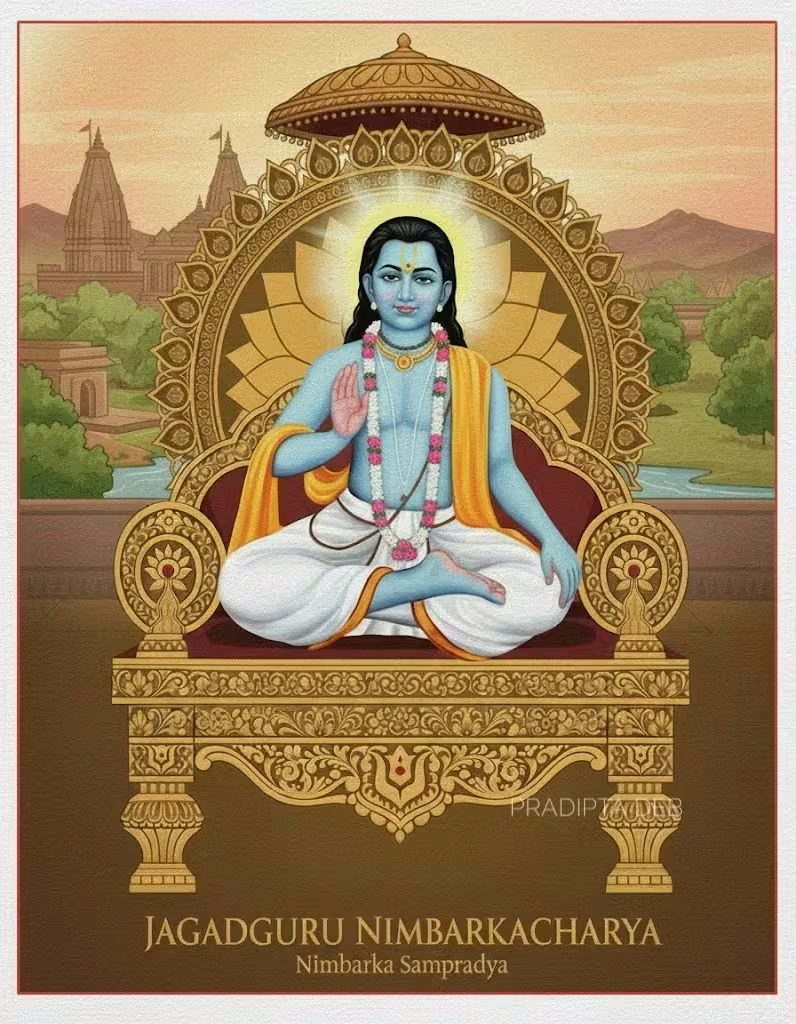
The Philosopher Beneath the Neem Tree: The Life and Legacy of Nimbarkacharya
In the grand, sprawling tapestry of Indian philosophy, where threads of thought weave complex patterns of existence, reality, and divinity, certain figures stand out not just for their intellectual brilliance but for the profound spiritual warmth they infused into the subcontinent's culture. One such towering personality was Nimbarkacharya, a medieval philosopher, theologian, and saint whose teachings offered a sublime and harmonious resolution to one of Vedanta's most persistent questions: is the soul one with God, or is it separate? His answer, a philosophy known as Dvaitadvaita (dualistic non-dualism), carved a unique path between absolute monism and stark dualism, providing a robust intellectual foundation for the devotional worship of Radha and Krishna.
The precise timeline of Nimbarkacharya's life is shrouded in the mists of history, a common challenge when studying ancient and medieval Indian figures. Traditional accounts within the Nimbarka Sampradaya (the lineage he founded) place him much earlier, sometimes linking him to the 3rd millennium BCE. However, based on textual analysis and the evolution of Vedantic thought, modern academic scholarship generally situates him in the 12th or 13th century CE. This places him in a vibrant and competitive philosophical era, as a near-contemporary of or successor to other great Vedantic commentators like Ramanujacharya and a predecessor to Madhvacharya and Vallabhacharya. Regardless of the exact century, his contribution remains a cornerstone of Vaishnava thought and the Bhakti movement.
Early Life & The Birth of a Name
According to traditional hagiographies, Nimbarkacharya was born with the name Niyamananda. His birthplace is often identified as Mungi Village, situated on the banks of the sacred Godavari River near Paithan in present-day Maharashtra. From a young age, he displayed a prodigious intellect and a deep inclination towards spirituality, immersing himself in the study of the foundational texts of Hindu philosophy: the Vedas, the Upanishads, the Puranas, and most importantly, the Brahma Sutras.
The story of how Niyamananda became Nimbarka is a cherished legend that beautifully illustrates the compassionate core of his being. One evening, a wandering Jain monk arrived at his ashram, exhausted and hungry. As a gracious host, Niyamananda offered him food, but the monk, adhering to his vow of not eating after sunset, politely declined. The sun had already dipped below the horizon, and his religious principles were absolute. Seeing the sage's plight, Niyamananda was moved. He went outside and, using his spiritual powers, projected a radiant effulgence from behind a nearby Neem (Nimba) tree, making it appear as though the sun (Arka) was still in the sky. The monk, believing it was still twilight, accepted the meal. For this act of showing the sun from behind a neem tree, Niyamananda came to be known as Nimbarkacharya—the teacher who is like the sun from a Neem tree.
This story, whether taken as literal history or as a symbolic allegory, encapsulates the essence of his philosophy: a blend of divine power and profound compassion, finding a way to uphold dharma while tending to the needs of the soul.
Career & Major Contributions: The Philosophy of Dvaitadvaita
Nimbarkacharya's most significant contribution was the systematization of the Dvaitadvaita (also known as Bhedabheda) school of Vedanta. It was a masterful attempt to reconcile scriptural passages that seemed to present conflicting views on the relationship between Brahman (the ultimate reality, God), the Jiva (the individual soul), and the Jagat (the material world).
The Core Concept: Simultaneous Difference and Non-Difference
At its heart, Dvaitadvaita posits that the relationship between the soul/world and God is one of simultaneous difference and non-difference. How can two things be both separate and one at the same time? Nimbarka used powerful analogies to explain this profound concept.
- The Wave and the Ocean: A wave is undeniably made of the same water as the ocean (non-different), yet it has its own distinct form, existence, and movement (different). It is both ocean and not-ocean simultaneously.
- The Sun and its Rays: The sun's rays emanate from the sun and are of the same essence (light and heat), yet they are not the sun itself. They are dependent on the sun for their existence but are experienced separately.
Applying this logic, Nimbarkacharya argued that the individual soul (Jiva) and the world (Jagat) are real and distinct creations of Brahman. They are not illusions, as proposed by Shankara's Advaita Vedanta. In this sense, they are different (Dvaita). However, they are not entirely separate or independent from Brahman. They are wholly dependent on God for their very existence and essence, just as a wave depends on the ocean. In this sense, they are non-different (Advaita).
This philosophy elegantly validated both the scriptural declarations of God's oneness and the lived experience of the individual as a distinct being who engages in devotion. It provided a framework where the soul could maintain its identity and lovingly worship a personal God, while still being fundamentally connected to that divine source.
The Three Realities (Tattva-Traya)
Nimbarkacharya categorized all of existence into three fundamental realities:
- Isvara (The Controller): The supreme, independent reality. This is Brahman, identified as Krishna, who is omniscient, omnipotent, and the ultimate cause of creation, sustenance, and dissolution.
- Cit (The Sentient): The conscious reality, comprising the infinite individual souls (Jivas). Souls are eternal, possess knowledge, and are agents of their own actions. Their true nature is bliss, but this is obscured by karma in the embodied state.
- Acit (The Non-Sentient): The unconscious, material reality. This includes not only the physical universe (prakriti) but also time (kala). It is real, not illusory, and serves as the medium for the soul's experiences.
The Worship of Radha-Krishna: Yugala Upasana
While his philosophical contributions were profound, Nimbarkacharya's impact on devotional practice was equally revolutionary. He was one of the earliest and most influential theologians to establish the worship of Radha alongside Krishna as the highest form of devotion. This is known as Yugala Upasana (worship of the divine couple).
In Nimbarka's theology, Radha is not merely a consort or a devotee; she is the eternal counterpart to Krishna, the embodiment of his Hladini Shakti (bliss-giving potency). She is the ultimate exemplar of selfless love and devotion (bhakti). He taught that Krishna, as the supreme Brahman, cannot be fully realized or approached without the grace of Radha. Together, Radha-Krishna represent the complete manifestation of divinity—the unity of power and grace, majesty and sweetness. This theological framework elevated Radha from a Puranic character to a central figure of worship, paving the way for the rich traditions of Braj Bhakti that would flourish in the centuries to come, profoundly influencing poets like Jayadeva and saints like Chaitanya Mahaprabhu.
Major Written Works
Nimbarkacharya's genius is evident in his written works, which are known for their clarity, brevity, and poetic elegance. His primary goal was not to write exhaustive critiques of other schools but to clearly articulate his own philosophy.
- Vedanta Parijata Saurabha (The Fragrance of the Celestial Flower of Vedanta): This is his magnum opus, a commentary on Badarayana's Brahma Sutras. Unlike the lengthy and complex commentaries of Shankara or Ramanuja, Nimbarka's work is concise and direct, explaining the sutras from his Dvaitadvaita perspective.
- Dashashloki (Ten Verses): This short, gem-like text is a masterpiece of philosophical compression. In just ten verses, Nimbarkacharya encapsulates his entire system, explaining the nature of the soul, the path of devotion (prapatti or surrender), the object of worship (Radha-Krishna), and the ultimate goal of liberation (moksha).
- Sri Krishna Stavaraja: A powerful hymn of praise dedicated to Krishna, showcasing the devotional heart of his philosophy.
These works became the foundational scriptures for the Nimbarka Sampradaya (also known as the Kumara Sampradaya), the spiritual lineage that carries his teachings forward. The tradition holds that this knowledge was passed down from the celestial sage Narada, who received it from the four Kumaras (the mind-born sons of Brahma), making it one of the four principal Vaishnava lineages.
Legacy & Lasting Influence
Nimbarkacharya's influence extends far beyond the confines of academic philosophy. His teachings have had a deep and enduring impact on the religious and cultural landscape of India.
Philosophical Legacy: By championing Bhedabheda, he provided a vital philosophical alternative that resonated with the devotional spirit of the Bhakti movement. His work created a space where both the immanence and transcendence of God could be celebrated, and where the individual soul's loving relationship with a personal God was given ultimate philosophical validation.
Cultural Impact: Nimbarkacharya's systematization of Radha-Krishna worship was a watershed moment. It fueled an explosion of art, music, poetry, and dance centered on the divine love of Radha and Krishna, particularly in the Braj region of North India (Mathura and Vrindavan). The Nimbarka Sampradaya established important centers in this region, contributing to its identity as the sacred heartland of Krishna devotion. Today, the main seat of the Sampradaya is located at Salemabad in Rajasthan, from where his teachings continue to inspire thousands of followers.
A Living Tradition: Nimbarkacharya is remembered not as a dry intellectual, but as a compassionate Jagadguru (world teacher) who harmonized reason with faith. He is revered as the acharya who gave Radha her rightful place at the center of theological discourse. The Nimbarka Sampradaya remains a vibrant and active spiritual tradition, carrying the fragrance of his Dvaitadvaita philosophy and the profound sweetness of Radha-Krishna devotion into the modern world. He remains a radiant sun in the firmament of Indian thought, forever associated with the sheltering grace of the Neem tree.