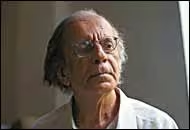
A Poet of the City: The Life and Legacy of Nissim Ezekiel
In the sprawling, chaotic, and endlessly vibrant landscape of post-Independence India, a new literary voice emerged, one that chose not to sing of ancient myths or pastoral idylls, but of the grit and grace of the modern Indian city. This was the voice of Nissim Ezekiel (1924-2004), a poet, playwright, critic, and editor who is widely regarded as the father of modern Indian English poetry. With meticulous craftsmanship, unflinching honesty, and a wry, observant eye, Ezekiel carved out a new path for Indian writing in English, grounding it firmly in the soil of lived, everyday experience. His work was a mirror held up to the urban Indian, reflecting their anxieties, aspirations, and the unique cadence of their English. To understand Nissim Ezekiel is to understand the birth of a modern literary consciousness in India.
Early Life & Background: An Outsider-Insider in Bombay
Nissim Ezekiel was born on December 16, 1924, in Bombay (now Mumbai), the city that would become the central character in his vast body of work. His family belonged to the Bene Israel community, a small but historic group of Marathi-speaking Jews in India. This identity placed him in a unique position—he was deeply Indian, yet part of a minority, giving him the perspective of both an insider and an outsider, a vantage point that would profoundly shape his poetry.
His upbringing was intellectually stimulating. His father, Moses Ezekiel, was a professor of botany and zoology at Wilson College, and his mother was the principal of her own school. The household was one of books, ideas, and rational inquiry. This environment instilled in him a love for language and a skeptical, scientific temperament that would later surface in his poems, which often interrogated faith, superstition, and spiritual claims with a gentle but persistent rationalism.
Ezekiel pursued his education in his home city, attending the Antonio De Souza High School and later Wilson College, where he earned a Master's degree in Literature in 1947, the very year of India’s independence. This was a time of immense national upheaval and hope, a backdrop against which Ezekiel’s own journey of self-discovery began. In 1948, seeking to broaden his horizons and immerse himself in the English literary tradition, he sailed to London.
His three and a half years in London were formative but also deeply disillusioning. He studied philosophy at Birkbeck College, but the city was not the literary haven he had imagined. He faced loneliness, poverty, and a sense of alienation. This experience, however, was crucial. It stripped him of his colonial reverence for England and solidified his identity as an Indian. The decision to return was a conscious and definitive choice to embrace his homeland. His journey back in 1952 is the stuff of literary legend: he worked his passage home as a deck-scrubber on a cargo ship, an experience that underscored his commitment to returning to the raw material of his own culture.
Career & Major Contributions: Building an Institution
Upon his return to Bombay, Ezekiel embarked on a career that would transform the landscape of Indian English literature. His contributions were not limited to his own poetry; he became an institution-builder, a mentor, and a powerful advocate for a modern, authentic Indian voice.
The Poet of Urban Realities
Ezekiel’s poetry was a radical departure from the romantic, often spiritual, and ornate verse of his predecessors like Sri Aurobindo and Sarojini Naidu. He traded mysticism for irony, grandiloquence for conversational precision, and the pastoral for the pavement. His first collection, A Time to Change, was published in London in 1952, followed by a steady stream of influential works including Sixty Poems (1953), The Unfinished Man (1960), The Exact Name (1965), and his Sahitya Akademi Award-winning collection, Latter-Day Psalms (1982).
His poems were populated with the sights, sounds, and smells of Bombay. He wrote of crowded local trains, peeling billboards, urban poverty, and the quiet desperation of the middle class. His most famous poems remain touchstones of Indian literature:
"Night of the Scorpion": A narrative masterpiece, this poem recounts a childhood memory of his mother being stung by a scorpion. It masterfully contrasts the villagers' superstitious, ritualistic responses with his father's scientific skepticism ("sceptic, rationalist"). Yet, the poem's emotional core lies in the mother's selfless love, who, after the ordeal, only says: "Thank God the scorpion picked on me / And spared my children." It is a profound exploration of love, faith, and modernity in a rural Indian context.
"Goodbye Party for Miss Pushpa T.S.": In this brilliant and humorous dramatic monologue, Ezekiel perfectly captures the idiosyncrasies of "Babu English," the formal yet often ungrammatical English spoken in India. With lines like "Whatever I or anybody is asking / She is always saying yes," and "Pushpa Miss is never saying no," he doesn't mock the speaker but presents a fond, satirical portrait of a distinct linguistic culture, thereby legitimizing it as a subject for serious poetry.
"The Professor": Another masterful monologue, this poem gives voice to a retired professor reflecting on his life. It captures the pathos, the gentle pride, and the linguistic flavor of an entire generation. The closing lines, where he gives his address and offers to provide more details of his life, are a poignant blend of loneliness and a desire to remain relevant.
"Enterprise": This allegorical poem charts a pilgrimage undertaken by a group of people that starts with high ideals but descends into discord and disillusionment. By the end, the weary travelers realize that the grand goal was less important than the journey itself, and that "Home is where we have to gather grace." It is a timeless meditation on the human condition.
The Editor and Mentor
Perhaps as significant as his own writing was Ezekiel’s role as a literary facilitator. He understood that a literary movement needed more than just poets; it needed platforms, critics, and a sense of community. From 1954 to 1959, he worked as an assistant editor for The Illustrated Weekly of India, a highly influential magazine. He also edited the literary journal Quest in the 1950s and, later, Poetry India. As an art critic for The Times of India and a long-serving professor of English at Mithibai College, he influenced generations of students and readers.
He was a generous and exacting mentor to a new generation of poets who would come to be known as the "Bombay School," including Dom Moraes, Adil Jussawalla, Gieve Patel, and Arvind Krishna Mehrotra. He created a space where these poets could share their work, receive rigorous feedback, and develop a modern poetic idiom that was precise, ironic, and rooted in Indian reality.
Legacy & Influence: A New Voice for a New Nation
Nissim Ezekiel’s historical significance cannot be overstated. He professionalized the craft of Indian English poetry, insisting on discipline, clarity, and precision. He demonstrated that English was not merely a colonial relic but a vibrant, adaptable Indian language, capable of expressing the most intimate and complex realities of Indian life.
His lasting impact can be summarized in several key areas:
The Establishment of Modernism: Ezekiel single-handedly steered Indian English poetry away from 19th-century Romanticism and into the 20th-century modernist tradition. His use of irony, self-reflection, and conversational language became the new standard.
Legitimizing the Indian Context: Before Ezekiel, there was a tendency for Indian poets to write about subjects (like daffodils and nightingales) that felt alien to their environment. Ezekiel made it not only acceptable but essential to write about the here and now: the heat, the dust, the crowds, the political and social fabric of India.
The Celebration of Indian English: Through poems like "Goodbye Party for Miss Pushpa T.S.," he showed that the unique ways in which Indians spoke English were not a source of shame but a rich resource for literary creativity. He gave it dignity and a place in the canon.
A Moral and Intellectual Compass: His poetry consistently grapples with fundamental questions of identity, morality, love, and faith. He never offered easy answers, but his work always reflected a deep-seated humanism and a commitment to intellectual honesty.
For his immense contributions, he was honored with the Sahitya Akademi Award in 1983 and the Padma Shri, one of India's highest civilian honors, in 1988.
In his later years, Nissim Ezekiel battled Alzheimer's disease, a cruel affliction for a man whose life was dedicated to the precision of thought and language. He passed away in Mumbai on January 9, 2004, leaving behind a monumental legacy. He is remembered not just as a poet, but as an architect of a literary tradition. He taught a nation of writers how to find poetry on their own streets and how to speak of their own lives with courage, clarity, and an unflinching eye for the truth.