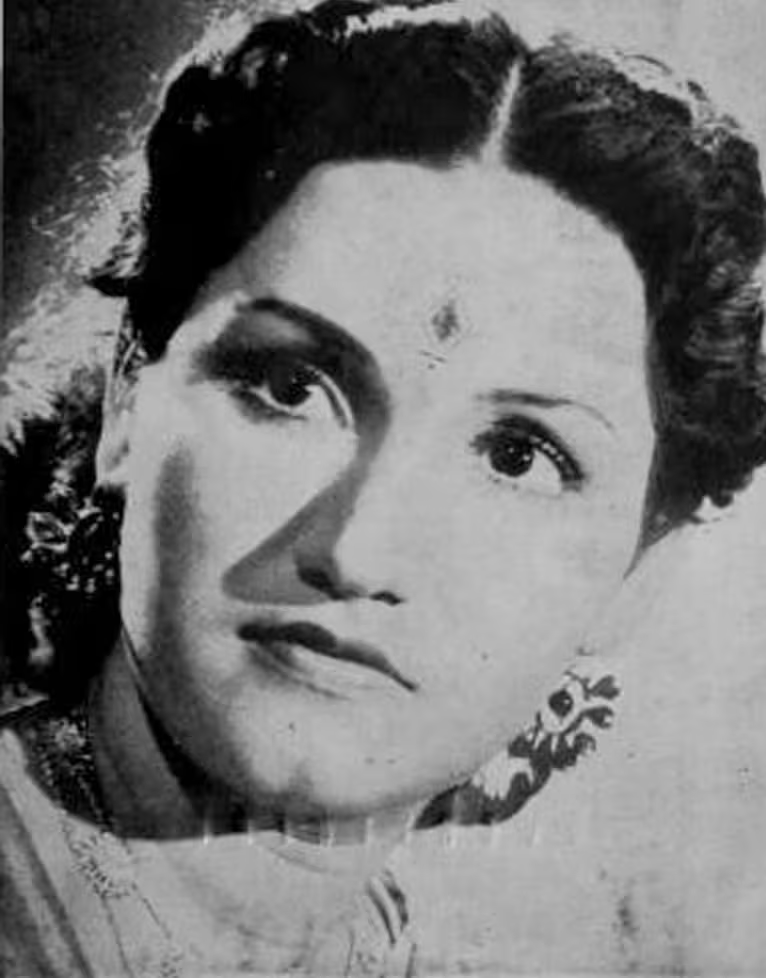
Noor Jehan - The Queen of Melody
In the grand tapestry of South Asian music and cinema, few threads shine as brightly or are woven as deeply as the voice of Noor Jehan. Known to millions by the honorific title Malika-e-Tarannum—the Queen of Melody—she was more than a singer; she was a cultural institution, a phenomenon whose career spanned the final, glittering decades of British India and the formative years of a new nation, Pakistan. Her voice, a sublime instrument of immense power and delicate emotion, became the soundtrack for an entire subcontinent, capturing its joys, sorrows, and enduring spirit.
Early Life & Background
Noor Jehan was born Allah Rakhi Wasai on September 21, 1926, in the historic city of Kasur, Punjab, in what was then British India. She was born into a family with deep roots in music; her parents, Madad Ali and Fateh Bibi, were professional musicians, and the air in her home was thick with melody and rhythm. From a very young age, Allah Rakhi displayed an extraordinary vocal talent, an ability to grasp complex musical notes with an ease that belied her years.
Recognizing her prodigious gift, her parents initiated her into the rigorous discipline of Hindustani classical music. She received training in the esteemed traditions of the Patiala Gharana, mastering the intricate arts of thumri and khayal. This classical foundation would become the bedrock of her versatile career, lending a profound depth and technical mastery to even her simplest film songs.
In the early 1930s, seeking a larger stage for their talented children, the family moved to Calcutta, the vibrant cultural and cinematic heart of India at the time. Here, the young Allah Rakhi, along with her sisters Eiden Bai and Haider Bandi, began performing on stage. It was during this period that she adopted the stage name that would become immortal: Noor Jehan, meaning 'Light of the World'. The name was an apt prophecy for a star whose brilliance was just beginning to emerge.
Career & Major Contributions
Noor Jehan's career can be viewed in two distinct, yet equally brilliant, acts: her meteoric rise as an actress-singer in the unified film industry of British India, and her unparalleled reign as the voice of Pakistan.
The Golden Age in British India
After a few roles as a child artist, Noor Jehan's transition to a leading lady came with the film Khandaan (1942). Directed by Shaukat Hussain Rizvi, whom she would later marry, the film was a resounding success. At just sixteen, Noor Jehan delivered a magnetic performance, but it was her singing that truly captivated the nation. The film's songs, sung in her powerful, rustic, and yet incredibly melodious voice, became chartbusters, and Noor Jehan was catapulted to stardom.
This success prompted a move to Bombay (now Mumbai), the epicenter of Hindi cinema. The mid-1940s were the zenith of her Indian career. She was the complete package: a beautiful actress with a commanding screen presence and a voice that needed no substitute. This was the era of the 'singing star', and Noor Jehan was its undisputed queen.
In Anmol Ghadi (1946), a musical masterpiece directed by Mehboob Khan with music by the legendary Naushad, she delivered some of the most iconic songs of her career. Her duets and solos, including "Awaaz De Kahan Hai" and "Jawan Hai Mohabbat," became timeless anthems of love and longing. The film was a blockbuster, cementing her position as the highest-paid and most sought-after female star of her time.
Her final major film in India was Jugnu (1947), opposite the then-rising star Dilip Kumar. It was the highest-grossing Indian film of that year, and its songs, particularly the melancholic "Yahan Badla Wafa Ka," showcased her incredible ability to convey pathos through her voice. At the peak of her fame, with a flourishing career in Bombay, history intervened.
A New Beginning in Pakistan
The Partition of India in 1947 was a cataclysmic event that redrew borders and reshaped millions of lives. Noor Jehan and her husband, Shaukat Hussain Rizvi, made the momentous decision to immigrate to the newly created nation of Pakistan. This meant leaving behind the industry she dominated, the adoring fans, and the established studios of Bombay to start anew.
In Pakistan, she became a foundational pillar of the fledgling film industry, affectionately known as 'Lollywood'. She and her husband established their own film studio, Shahnoor Studios, in Lahore, providing crucial infrastructure for a nascent industry. Not content with just acting and singing, she also stepped behind the camera, directing the film Chan Wey (1951), making her one of Pakistan's first female film directors.
Throughout the 1950s, she continued to act in successful films like Dupatta (1952), which featured the hauntingly beautiful melody "Chandni Raatein." However, by the early 1960s, she made another pivotal career decision: she retired from acting to focus exclusively on playback singing.
This marked the beginning of her second, and arguably more dominant, reign. For the next three decades, Noor Jehan's voice was synonymous with Pakistani cinema. She sang for virtually every leading actress, her voice adapting effortlessly to different characters and situations. She recorded an astonishing number of songs, estimated to be over 10,000, in languages including Urdu, Punjabi, and Sindhi. Her Punjabi film songs, with their folk energy and raw emotion, were particularly beloved.
Her status as a national icon was further cemented during the Indo-Pakistani War of 1965. She recorded a series of deeply moving and powerful patriotic songs, such as "Aye Watan Ke Sajeelay Jawanon" (O' Valiant Soldiers of the Nation), which were broadcast on Radio Pakistan. These songs became a source of immense inspiration and morale for the soldiers and the public, transforming her from a film icon into a revered national treasure.
Legacy & Influence
Noor Jehan's legacy is monumental and multifaceted. She is not merely remembered; she is revered as the Malika-e-Tarannum, a title formally bestowed upon her by the Government of Pakistan but first given to her by the hearts of her countless admirers.
A Voice That Crossed Borders
Her influence transcended the political boundaries that divided the subcontinent. In India, her pre-Partition songs remain cherished classics. The legendary Indian singer Lata Mangeshkar, who began her career when Noor Jehan was at her peak, often spoke of her profound admiration for the elder artist, acknowledging her as a formidable inspiration. Noor Jehan’s voice, with its unique blend of classical precision and heartfelt emotion, set a benchmark for playback singing that influenced generations of vocalists in both India and Pakistan. She remains a powerful symbol of a shared, indivisible cultural heritage.
A Trailblazer and a Feminist Icon
In a deeply patriarchal society, Noor Jehan was a figure of immense strength and independence. She was a self-made woman who reached the pinnacle of her profession through sheer talent and hard work. As a top-earning star in the 1940s, a studio owner, and one of her country's first female directors, she shattered numerous glass ceilings. She managed a demanding public career while navigating a complex personal life, doing so with a characteristic grace and resilience that made her an icon of female empowerment.
The Enduring Melody
Noor Jehan passed away on December 23, 2000, in Karachi, after a prolonged illness. Her death was mourned across South Asia, as people from all walks of life paid tribute to the voice that had accompanied them through decades of their lives.
Today, her songs continue to resonate. They are played at weddings, featured in films, reinterpreted by new artists, and cherished in quiet moments of reflection. Her voice is an indelible part of the region's collective memory. Noor Jehan was more than the 'Queen of Melody'; she was the voice of a people, a bridge between nations, and an artist whose light, like her name, will never fade.