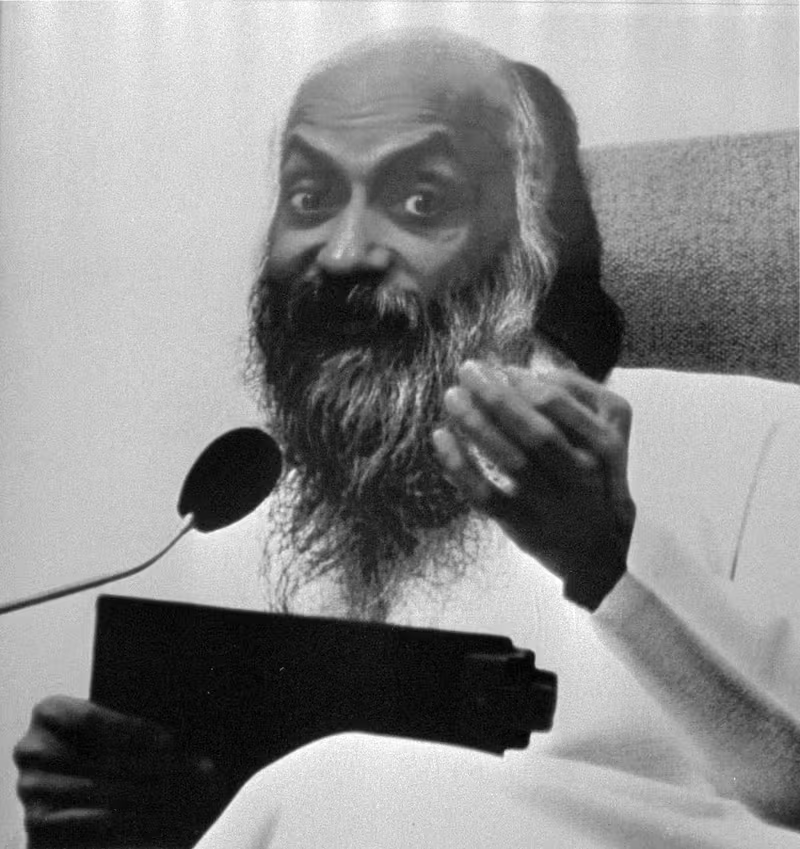
Osho - Indian Guru and Philosopher
Chandra Mohan Jain, who would later be known to the world as Bhagwan Shree Rajneesh and finally as Osho, was one of the 20th century's most enigmatic and polarizing spiritual figures. A brilliant philosophy professor turned mystic, he crafted a syncretic spiritual path that drew heavily from Eastern traditions like Zen, Taoism, and Tantra, while weaving in Western psychotherapy and a radical embrace of life in its totality—including wealth, sexuality, and rebellion. His journey took him from the dusty towns of central India to the global stage, where he built a formidable spiritual empire that both inspired millions and courted intense controversy. Osho's story is not merely that of a guru; it is a complex narrative of spiritual innovation, social experimentation, immense wealth, and a dark, dramatic clash with the Western world that culminated in one of the most significant bioterror attacks in American history.
Early Life & Background
Born Chandra Mohan Jain on December 11, 1931, in the small village of Kuchwada in the Central Provinces of British India (modern-day Madhya Pradesh), his early life was shaped by a unique set of circumstances. He was the eldest of eleven children in a Taranpanthi Jain family. For the first seven years of his life, he was raised not by his parents, but by his maternal grandparents, who granted him an extraordinary degree of freedom. This unconstrained upbringing, devoid of the rigid discipline and traditional education imposed on other children, fostered a fiercely independent, questioning, and rebellious spirit that would define his entire life.
From a young age, he was a voracious reader and a natural debater, relentlessly challenging the religious and social dogmas he encountered. He was skeptical of all established faiths, preferring direct, personal experience over received wisdom. This intellectual precocity was matched by a deep, introspective pull towards the spiritual. He experimented with various meditation techniques, pushing his mind and body to their limits in a personal quest for truth.
A pivotal moment, central to his entire life's narrative, occurred on March 21, 1953. At the age of twenty-one, while sitting under a Maulshree tree in the Bhanvartal Garden in Jabalpur, he claimed to have experienced a profound spiritual enlightenment. He described it not as an achievement, but as a state of letting go, a dissolution of the self into the cosmic whole. This experience became the bedrock of his future teachings.
Academically, he excelled. He earned his Bachelor of Arts in philosophy from D.N. Jain College in Jabalpur and later a Master of Arts in philosophy from the University of Saugar. His academic career culminated in a position as a professor of philosophy at Jabalpur University, where he taught until 1966. Yet, the confines of academia could not hold him. He was already a compelling and provocative public speaker, and he began traveling across India, giving lectures that systematically dismantled the sacred cows of Indian society: socialism, Mahatma Gandhi, and all forms of institutionalized religion.
Career & Major Contributions
In the 1960s, then known as Acharya Rajneesh, he transitioned from academic to full-time spiritual teacher. He held meditation camps, known as "dhyan shivirs," and delivered fiery discourses that attracted a growing number of followers, or "neo-sannyasins." His message was a radical departure from the asceticism traditionally associated with Indian spirituality. He advocated for a life-affirming path, one that embraced materialism, celebrated the body, and encouraged emotional catharsis as a prerequisite for silent meditation.
The Poona Ashram (1974-1981)
In 1974, with the help of his first disciples, he established the Shree Rajneesh Ashram in Koregaon Park, a wealthy suburb of Pune. This ashram quickly became an international magnet for spiritual seekers, particularly Westerners disillusioned with both traditional religion and the perceived emptiness of consumer culture. Here, Rajneesh, who now called himself Bhagwan Shree Rajneesh, synthesized his teachings into a powerful, experiential practice.
His most significant innovation was Dynamic Meditation. This active, cathartic technique was designed for the "modern man," whom he believed was too repressed and mentally cluttered for passive sitting meditation. The hour-long practice involved stages of chaotic breathing, explosive emotional release (shouting, crying, laughing), vigorous physical movement, and finally, silence and celebration. It was a potent, and for many, transformative method that became a hallmark of his movement.
The Poona ashram was a vibrant, often chaotic spiritual laboratory. It offered a vast array of therapeutic groups that blended Western psychological methods—like Gestalt therapy, bioenergetics, and primal scream therapy—with Eastern meditative techniques. This fusion was revolutionary at the time. The ashram's atmosphere was intensely liberal, particularly regarding relationships and sexuality. Rajneesh taught that sexual energy was a vital life force that should not be repressed but understood and transcended. This open approach, combined with sensationalist media reports, earned him the notorious label of "sex guru," a caricature that would follow him for the rest of his life.
Rajneeshpuram: The American Utopia and its Collapse (1981-1985)
By the early 1980s, the Poona ashram was overflowing, and tensions with the Indian government were mounting. Seeking a space to create a self-sufficient spiritual community, the movement made a dramatic move. In 1981, they purchased the 64,000-acre Big Muddy Ranch in rural Wasco County, Oregon, for nearly $6 million. They set out to build a utopian city from scratch, named Rajneeshpuram.
Under the formidable leadership of his personal secretary, Ma Anand Sheela, the sannyasins transformed the arid landscape into a thriving town complete with its own airport, power station, sophisticated farming operations, and housing for thousands. At its peak, Rajneeshpuram was a testament to the devotion and organizational prowess of his followers. During this period, Rajneesh himself entered a period of public silence, communicating only through Sheela. He also developed a famous and controversial affinity for Rolls-Royce automobiles; his followers eventually gifted him 93 of them, a symbol, he claimed, of his rejection of poverty as a spiritual value.
The dream of utopia, however, quickly soured. The commune's expansionist ambitions led to escalating conflicts with the small, conservative local community and the Oregon state government over land use and zoning laws. The Rajneeshees, feeling persecuted, became increasingly insular and aggressive. They armed themselves, creating their own police force, and took political control of the nearby town of Antelope.
The conflict reached a horrifying climax in 1984. In an attempt to seize political control of Wasco County by incapacitating the local voting population, top officials of the Rajneeshpuram commune, directed by Ma Anand Sheela, orchestrated a bioterror attack. They deliberately contaminated salad bars at ten local restaurants with Salmonella, poisoning 751 people. It remains the largest such attack in United States history.
By 1985, the commune was imploding. Rajneesh broke his silence, publicly accusing Sheela and her inner circle of orchestrating the bioterror attack and other crimes without his knowledge. Sheela fled the country but was later arrested and served time in federal prison. In October 1985, Rajneesh himself was arrested while attempting to flee the U.S. He was indicted on 35 counts of immigration fraud. He entered an Alford plea—a legal mechanism where a defendant maintains their innocence but concedes the prosecution has enough evidence for a conviction. He was given a suspended sentence, fined, and deported from the United States, agreeing not to return for five years without the attorney general's permission.
Final Years and Transformation into Osho (1986-1990)
The fall of Rajneeshpuram marked the beginning of a nomadic period for the guru. He was subsequently denied entry by 21 different countries, a global condemnation that reflected the infamy his movement had acquired. In 1986, he returned to Pune, India, where his followers re-established the old ashram, which would eventually be renamed the Osho International Meditation Resort.
In his final years, he shed the name "Bhagwan" and, in early 1989, his disciples chose the name "Osho," derived from a term in Zen Buddhism. His health deteriorated rapidly, which his followers attributed to poisoning by U.S. authorities during his time in custody—a claim that has never been substantiated. Osho passed away on January 19, 1990, at the age of 58. His epitaph reads, "Never Born, Never Died: Only Visited this Planet Earth between Dec 11, 1931 – Jan 19, 1990."
Legacy & Influence
Osho's legacy is as complex and contradictory as the man himself. He remains one of the most influential, yet divisive, spiritual teachers of the modern era. His historical significance lies in his role as a bridge between Eastern mysticism and Western psychology, and as a key figure in the global New Age movement.
His most enduring contribution is undoubtedly his array of meditation techniques. Osho designed over a hundred methods tailored to the modern mind, with Dynamic Meditation being the most famous. These active, cathartic practices continue to be taught and practiced in Osho centers around the world and have influenced various streams of contemporary spirituality and wellness.
His teachings, transcribed from thousands of hours of extemporaneous talks, fill over 600 books and have been translated into more than 60 languages. These works cover a vast landscape of spiritual inquiry, offering commentaries on figures from Buddha and Jesus to Lao Tzu and Heraclitus. They continue to be bestsellers, introducing his core ideas of awareness, celebration, and living totally in the present moment to new generations.
Today, Osho is remembered in sharply contrasting ways. To his devoted followers, he was an enlightened master, a spiritual rebel who courageously shattered illusions and offered a path to freedom unburdened by guilt or dogma. They see the controversies as misunderstandings or the malicious acts of a few individuals, not a reflection of his teachings. The Osho International Meditation Resort in Pune remains a popular destination, attracting visitors from across the globe.
To his detractors and critics, he was a brilliant but deeply flawed cult leader who wielded immense psychological power over his followers. They point to the authoritarian structure of his communes, the immense wealth he accumulated, and the criminal acts committed by his organization—most notably the bioterror attack—as undeniable proof of a dangerous and corrupt enterprise. The 2018 Netflix documentary series Wild Wild Country brought the dramatic story of the Oregon commune to a massive global audience, reigniting the debate over his legacy and introducing the world to the shocking, almost unbelievable events that unfolded at Rajneeshpuram.
Ultimately, Osho's life resists simple categorization. He was a philosopher who urged people to live beyond the mind, a spiritualist who embraced materialism, and a guide who demanded absolute surrender while preaching ultimate freedom. His story serves as a powerful, and often cautionary, tale about the nature of spirituality, power, and the perennial human search for meaning in a complex world.