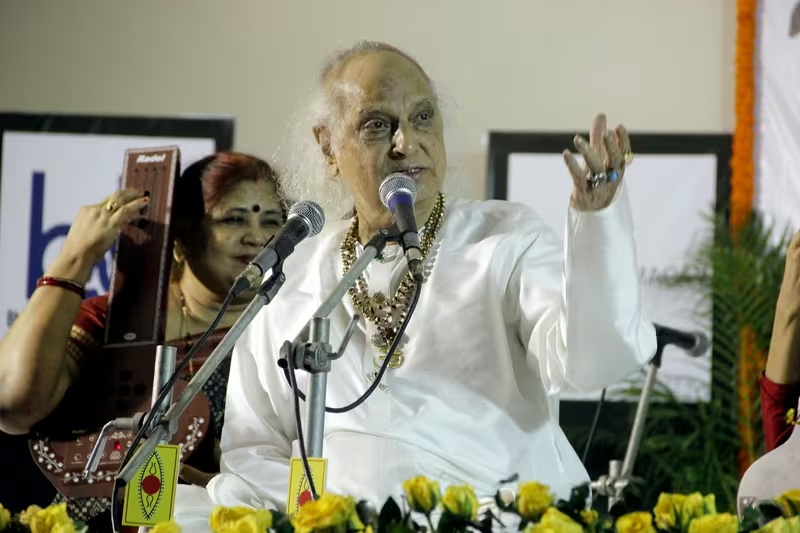
Sangeet Martand: The Celestial Voice of Pandit Jasraj
In the vast constellation of Indian classical music, few stars have shone with the serene, spiritual luminosity of Pandit Jasraj (1930-2020). For over eight decades, his voice, a divine instrument of profound emotional depth, filled concert halls and sacred spaces, transporting listeners to a realm of pure bhakti (devotion). Revered as 'Sangeet Martand' (The Sun of Music), Pandit Jasraj was not merely a performer; he was a musical philosopher, a devoted guru, and an innovator who carried the legacy of the Mewati gharana to unprecedented global acclaim. His life was a testament to the transformative power of music, a journey from a young tabla accompanist to one of the most celebrated vocalists of the 20th and 21st centuries.
Early Life & Background: The Making of a Maestro
Pandit Jasraj was born on January 28, 1930, in the village of Pili Mandori in the Hisar district of what was then the Punjab Province of British India (now in Haryana). Music was the very air he breathed. He was born into a family that had been practicing and preserving Hindustani classical music for four generations. His father, Pandit Motiram, was a distinguished classical singer of his time. The family's musical lineage was so profound that it seemed preordained that young Jasraj would follow in these illustrious footsteps.
Tragedy, however, struck early. In 1934, when Jasraj was merely four years old, his father passed away. It was the very day Pandit Motiram was to be officially appointed as the state musician in the court of Mir Osman Ali Khan, the last Nizam of Hyderabad. The sudden loss of his father and mentor cast a long shadow, but the family's deep-rooted musical tradition, nurtured by his elder brother and guru, Pandit Maniram, ensured that the flame of music was not extinguished.
Under Pandit Maniram's tutelage, Jasraj's initial training was not in vocals, but as a tabla accompanist. He became a proficient percussionist, accompanying his brother in concerts. This period, though not his ultimate calling, was formative. It gave him an intricate understanding of laya (rhythm) and tala (rhythmic cycles) that would later form the unshakable foundation of his vocal artistry. However, the path of an accompanist was not his destiny, and a single, sharp remark would change the course of his life forever.
In 1945, during a concert in Lahore, the vocalist Kumar Gandharva, another future legend, made a critical comment about Jasraj's tabla playing, suggesting that he was merely “pounding dead leather” and did not understand the raga being presented. The words, though harsh, struck a deep chord. The proud and sensitive fifteen-year-old felt a profound sting. That very day, he forsook the tabla and took a solemn vow to not cut his hair until he had learned to sing and become a vocalist in his own right. This incident became the crucible in which his resolve was forged. He dedicated himself entirely to vocal music under the rigorous guidance of Pandit Maniram, immersing himself in the aesthetics and discipline of the Mewati gharana.
Career & Major Contributions: The Voice of Divinity
Pandit Jasraj's debut as a vocalist came in 1952, at the age of 22, when he performed in the court of King Tribhuvan Bir Bikram Shah of Nepal. His performance was so captivating that it was clear a new star had arrived. The years that followed saw his steady ascent, his voice maturing into the rich, resonant, and soul-stirring instrument that would become his hallmark.
His music was rooted in the Mewati gharana, a school known for its emphasis on bhakti rasa, its lyrical beauty, and its clear enunciation of lyrics (spasht uchharan). Pandit Jasraj not only mastered these tenets but expanded upon them, infusing his gayaki (singing style) with a unique spiritual intensity. His performances were not just technical displays of virtuosity; they were acts of prayer. His voice, spanning a remarkable three-and-a-half octaves, could move from a deeply meditative lower register to soaring, ecstatic high notes with seamless grace.
Key Innovations and Accomplishments:
One of Pandit Jasraj's most significant contributions to the world of classical music was the creation of a novel form of jugalbandi (duet) called Jasrangi. Based on the ancient system of Murchhana, this complex duet features a male and a female vocalist singing two different ragas at the same time, in their respective scales, which then converge on the tonic note (Sa). The result is a breathtaking musical tapestry, a dialogue between two distinct melodic moods that find a harmonious union. This innovation showcased his deep knowledge of musicology and his creative genius.
He was also instrumental in bringing Haveli Sangeet—the devotional temple music of the Pushtimarg sect, dedicated to Lord Krishna—from the confines of temples to the proscenium stage. He treated these compositions, especially those of the Ashtachhap poets like Surdas and Parmananddas, with the same reverence and classicism as a traditional khayal, revealing their profound melodic and lyrical depth to a wider audience.
His repertoire was vast, including masterful renditions of complex khayals, ethereal thumris, and deeply moving bhajans. His rendition of the bhajan "Om Namo Bhagavate Vasudevaya" became an anthem of peace and devotion for millions around the world. He also composed several bandishes under the nom de plume 'Rasraj'.
His illustrious career was decorated with the highest civilian honors of the nation:
- Padma Shri (1975)
- Sangeet Natak Akademi Award (1987)
- Padma Bhushan (1990)
- Padma Vibhushan (2000)
He performed at every major music festival in India and at prestigious international venues like Carnegie Hall, the Royal Albert Hall, and the Kennedy Center. In a tribute that is truly out of this world, the International Astronomical Union, in 2019, named a minor planet, discovered in 2006 between Mars and Jupiter, as ‘Panditjasraj (300128)’. This unprecedented honor made him the first Indian musician to have a celestial body named after him, a fitting tribute to a voice often described as cosmic and divine.
Legacy & Influence: A Celestial Voice in Eternity
Pandit Jasraj's passing on August 17, 2020, in New Jersey, USA, marked the end of an epoch in Indian classical music. He was one of the last titans of a golden generation of musicians who had shaped the soundscape of post-independence India. His legacy, however, is not confined to the past; it is a living, breathing tradition that continues to inspire.
His most profound influence lies in how he redefined the spiritual potential of a classical concert. He demonstrated that classicism and devotion were not mutually exclusive. For him, every note was an offering, and every performance a sacred communion. He bridged the gap between the formal structure of a raga and the formless, emotive power of faith, making his music accessible to both the connoisseur and the common listener.
As a guru, he was generous and dedicated, nurturing a new generation of musicians. He established the Pandit Jasraj Schools of Music in the United States, Canada, and India, ensuring that his understanding of music and the traditions of the Mewati gharana would be passed on. His disciples, including celebrated artists like Sanjeev Abhyankar, Rattan Mohan Sharma, and Tripti Mukherjee, carry his musical flame forward.
Today, Pandit Jasraj is remembered not just for his flawless technique or his vast knowledge, but for the intangible quality of his music—its ability to heal, to soothe, and to elevate the human spirit. He is remembered for his beatific smile, his humble demeanor, and the palpable aura of divinity that surrounded him when he sang. His recordings, from the profound depths of Raga Darbari Kanhra to the sublime devotion of a Meera bhajan, remain a timeless repository of musical and spiritual wealth.
Pandit Jasraj was more than a vocalist; he was a cultural institution. His voice, a conduit for the divine, transcended the boundaries of time, geography, and religion. Like the planet that now bears his name, his music continues to orbit in the vast universe of sound, a celestial beacon guiding listeners towards a place of profound peace and beauty.