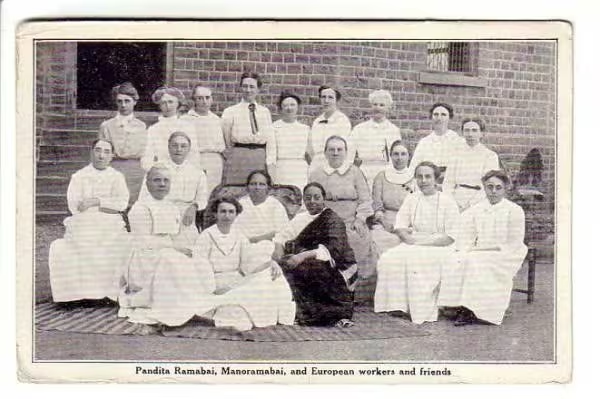
Pandita Ramabai: The Fearless Scholar Who Built a Haven for India's Daughters
In the late 19th century, a time when the sacred texts of Hinduism were forbidden territory for women, one voice rose from the dust of Indian pilgrimage trails, fluent in the very language meant to silence her. This was Ramabai Dongre, a woman whose intellect was so profound that the learned men of Calcutta, the epicenter of the Indian Renaissance, bestowed upon her the titles of Pandita (the learned one) and Sarasvati (goddess of wisdom). Pandita Ramabai Sarasvati was more than a scholar; she was a force of nature. A social reformer, an educator, a feminist, and a spiritual seeker, she navigated a world of rigid patriarchy with unparalleled courage, dedicating her life not just to challenging oppressive structures but to building, brick by brick, a world of refuge and opportunity for thousands of disenfranchised women and children.
Early Life & A Scholar's Unconventional Upbringing
Ramabai was born on April 23, 1858, not in a comfortable home, but in the wilderness of the Ganamal forest in present-day Karnataka. Her life began as it would continue: on a path less traveled. Her father, Anant Shastri Dongre, was a Chitpavan Brahmin and a respected Sanskrit scholar, but he was also a man of unconventional conviction. In a society where educating women was considered anathema, Anant Shastri had first taught his wife, Lakshmibai, the sacred language and its texts. When orthodox Brahmins excommunicated him for this transgression, he left his village and adopted the life of a Puranika—a traveling professional reciter of the Puranas.
It was into this nomadic existence that Ramabai was born. Her home was the open road, her classroom the forest floor, and her lullabies the rhythmic cadence of Sanskrit shlokas. Under her father's tutelage, she achieved a mastery of Sanskrit that was unheard of for a woman of her time. By the age of twelve, she had memorized an astonishing 18,000 verses from the Bhagavata Purana. This itinerant lifestyle, while difficult, gave her a unique, panoramic view of the vast Indian subcontinent and a visceral understanding of the diverse social customs and the pervasive suffering of its people, especially its women.
Tragedy struck with the Great Famine of 1876–78. The relentless hardship claimed the lives of her parents and elder sister. Left orphaned, Ramabai and her brother, Srinivas, continued their journey on foot, covering thousands of miles, their scholarship their only currency. Their travels finally led them to Calcutta in 1878, a city teeming with intellectual ferment and the reformist ideals of the Bengal Renaissance.
The Making of a Pandita in Calcutta
In Calcutta, Ramabai's erudition could not remain hidden. The city's pandits were astounded to encounter a young woman who could not only recite the scriptures but debate their finer points with eloquence and authority. The senate of Calcutta University formally examined her and, in a historic gesture, conferred upon her the highest titles of Pandita and Sarasvati. At just twenty years old, she had shattered a glass ceiling that had stood for centuries.
Her time in Calcutta exposed her to the Brahmo Samaj, a reformist movement that sought to challenge idolatry and social evils like the caste system and Sati. Engaging with leaders like Keshub Chandra Sen broadened her vision from pure scholarship to active social reform. However, this period was also marked by personal loss. Her brother Srinivas passed away in 1880.
In a radical act of personal and social defiance, Pandita Ramabai, a Chitpavan Brahmin, married Bipin Behari Medhvi, a Bengali lawyer from the lower Shudra caste, later that year. This inter-caste and inter-regional marriage was a direct challenge to the rigid social hierarchy of the time. Their union was short-lived but happy. Bipin Behari died of cholera in 1882, leaving Ramabai a 23-year-old widow with an infant daughter, Manorama. Her own experience with the harsh, marginalized life prescribed for a Hindu widow would become the central catalyst for her life's mission.
Career & Major Contributions: Building a Mission of Hope
Armed with her intellect, personal experience, and a burning desire for change, Ramabai moved to Pune. In 1882, she founded the Arya Mahila Samaj (Aryan Women's Society). Its goals were revolutionary: to promote education for women and to advocate for the abolition of child marriage. She traveled tirelessly, establishing branches of the Samaj and galvanizing public opinion.
That same year, her work gained national attention when she testified before the Hunter Commission on Education, a body appointed by the British government. With compelling logic, she argued for the desperate need for female teachers and doctors. She pointed out that Indian women, bound by customs of seclusion, would rather die than be examined by a male physician. Her powerful testimony created ripples across the administration, reportedly reaching the ears of Queen Victoria herself.
A Global Quest for Knowledge and Support
Seeking to further her own education, particularly in medicine, Ramabai traveled to England in 1883. Though progressive deafness prevented her from pursuing a medical degree, her journey took an unexpected spiritual turn. Exposed to the work of Anglican nuns, she found herself drawn to Christianity. After a period of deep introspection, she was baptized on September 29, 1883. This was a deeply personal decision, but it was also a public act that would have profound consequences, alienating many of her Hindu supporters back in India.
From 1886 to 1888, she journeyed to America. She studied the American public school and kindergarten systems, all the while giving powerful lectures across the country about the grim reality faced by Indian women. To fund her vision for a school for widows, she wrote her most influential book, The High-Caste Hindu Woman (1887). Written in English, it was a searing, scholarly, and deeply personal exposé of the injustices of child marriage, the forced ignorance of women, and the living death that was widowhood. The book was a sensation. It mobilized support and led to the formation of the Ramabai Association in Boston, which pledged financial support for her proposed school for ten years.
Sharada Sadan and the Mukti Mission
Returning to India in 1889, backed by American funds and supported by Indian reformers like Justice M.G. Ranade, Ramabai opened Sharada Sadan (Home of Wisdom) in Bombay. On March 11, 1889, it welcomed its first student, a child widow named Godubai, who would later, as Anandibai Karve, become a renowned reformer herself. The Sadan, later moved to Pune, was the first institution of its kind, offering high-caste widows a secular education, dignity, and a future.
However, it soon became a flashpoint of controversy. Conservative Hindu nationalists, including Bal Gangadhar Tilak, accused her of using the Sadan to convert widows to Christianity. Though she maintained the school's secular policy, the pressure was immense, and her Indian support base dwindled. Unfazed, Ramabai decided to build her own independent community.
She purchased a hundred acres of land in Kedgaon, a rural area near Pune. Here, during the devastating famines of the late 1890s, her work expanded exponentially. She led rescue missions, saving thousands of starving and abandoned girls, child widows, and destitute women. The small school transformed into the sprawling Mukti Mission (Salvation Mission).
Mukti was more than a shelter; it was a revolutionary, self-sufficient community run by women, for women. It housed thousands of residents and provided them with education, vocational training in printing, weaving, carpentry, and agriculture, and a life of purpose. It was a testament to her incredible administrative and visionary genius.
As a final scholarly gift, Ramabai, having mastered Hebrew and Greek, undertook the monumental task of translating the Bible from its original languages into her native Marathi. This colossal project, completed shortly before her death, remains a landmark of Indian theological and literary history.
Legacy & Influence: A Light That Never Fades
Pandita Ramabai Sarasvati passed away on April 5, 1922. Her legacy is as vast and multifaceted as her life.
She was, first and foremost, a pioneer of women's emancipation in India. While other reformers debated, she built institutions. Sharada Sadan and the Mukti Mission were not just schools; they were radical experiments in social engineering that saved thousands of lives and proved that women, given the chance, could lead and build self-reliant communities.
Her life was a constant challenge to orthodoxy of all kinds. She defied Hindu patriarchy through her education, her inter-caste marriage, and her relentless advocacy. After her conversion, she did not shy away from challenging Christian patriarchy either, insisting on running her mission independently, free from the control of Western missionary boards.
Her relationship with the Indian nationalist movement was complex. Her conversion and focus on social over political reform put her at odds with figures like Tilak. Yet, her work was profoundly nationalistic in its own right. By empowering the most oppressed segment of Indian society—its women—she was laying the groundwork for a stronger, more just nation. She understood that political freedom was meaningless without social liberation.
Today, Pandita Ramabai is remembered as one of modern India's most significant architects. The Mukti Mission in Kedgaon continues its work, a living monument to her compassion and vision. In 1989, the Government of India issued a commemorative stamp in her honor. She is revered as a feminist icon, a brilliant scholar, and a spiritual leader whose life stands as a powerful testament to the idea that one person's courage, intellect, and unwavering conviction can indeed change the world.