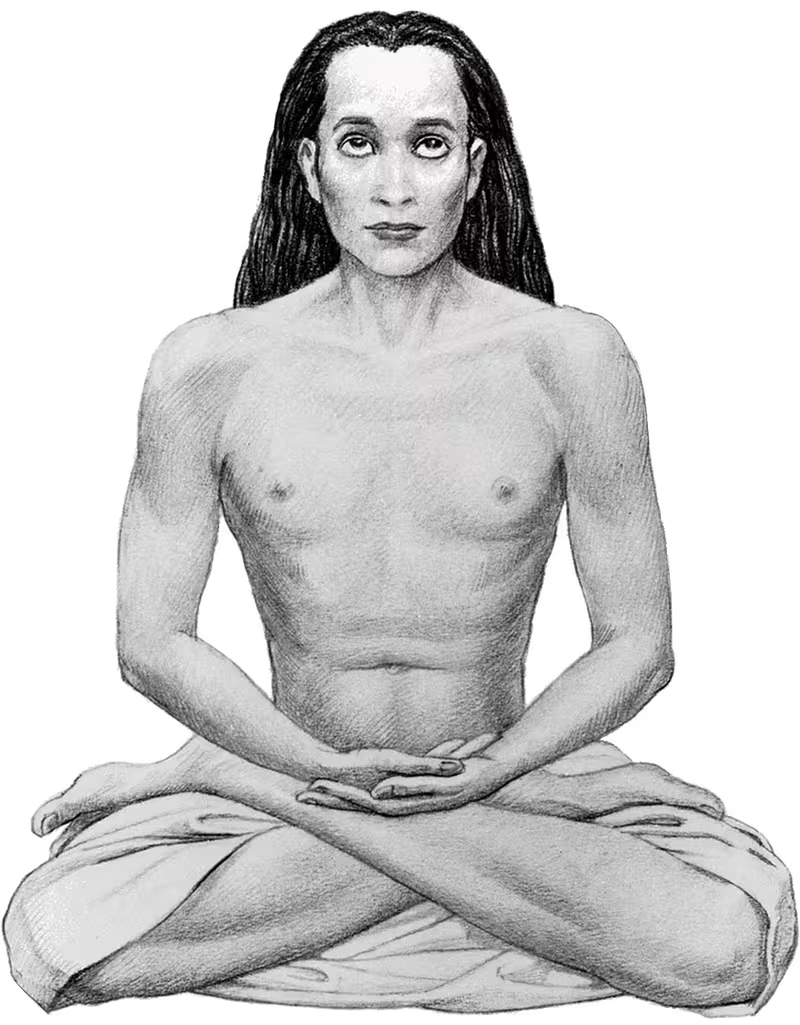
Paramahansa Yogananda - Father of Yoga in the West
In the grand tapestry of 20th-century spiritual history, few threads are as vibrant or as consequential as that of Paramahansa Yogananda. A spiritual visionary, a gifted orator, and a true bridge between the ancient wisdom of India and the modern dynamism of the West, he was the man who effectively introduced the soul of yoga to America. Long before yoga mats became ubiquitous in Western cities, Yogananda was planting the seeds of a profound spiritual revolution, teaching that the kingdom of God was not a distant promise but an inner reality, accessible through the scientific techniques of meditation. His life story, immortalized in his seminal work Autobiography of a Yogi, is more than a memoir; it is a gateway through which millions have embarked on their own spiritual quests, earning him the enduring title, “Father of Yoga in the West.”
Early Life & Spiritual Awakening
Paramahansa Yogananda was born Mukunda Lal Ghosh on January 5, 1893, in Gorakhpur, Uttar Pradesh, into a devout and well-to-do Bengali Kayastha family. His father, Bhagabati Charan Ghosh, was a senior executive of the Bengal-Nagpur Railway, a position that afforded the family a comfortable life but also instilled a sense of discipline and integrity. His mother, Gyana Prabha Ghosh, was a woman of deep piety who nurtured in her children an intense love for the divine. From his earliest years, Mukunda displayed an awareness and spiritual inclination that far exceeded his age. His own accounts describe a childhood marked by visions, an innate longing for God, and an unshakeable conviction that his life was destined for a spiritual purpose.
This yearning for divine realization set him on a fervent quest. As a youth, he sought out numerous saints and sages across India, hoping to find the master who could guide him to his goal. This search was not a casual pursuit but a burning, all-consuming fire. He would often run away from home in his quest, only to be brought back by his family, who were concerned about his worldly education.
His formal education culminated in a Bachelor of Arts degree from Serampore College, part of the University of Calcutta, in 1915. But the true turning point of his life occurred in 1910 in a crowded marketplace in Varanasi. There, he met the man he instantly recognized as his guru, the very master who had appeared in his visions: Swami Sri Yukteswar Giri. Sri Yukteswar, a disciple of the great Kriya Yoga master Lahiri Mahasaya, was a formidable figure—a jnanavatar, or “incarnation of wisdom.” The training that followed at Sri Yukteswar’s ashram in Serampore was rigorous and transformative. His guru was a strict disciplinarian, dismantling Mukunda’s ego and preconceived notions with sharp wisdom, yet tempering it all with unconditional love. It was under Sri Yukteswar's guidance that Mukunda was initiated into the sacred science of Kriya Yoga and meticulously prepared for the global mission that awaited him.
A Mission in the West: Career & Major Contributions
In 1917, Yogananda took the first step in his life's work, founding a small “how-to-live” school for boys in Dihika, West Bengal. Blending modern educational methods with yoga training and spiritual ideals, the school aimed to cultivate not just the intellect but the entire being. In 1920, with the patronage of Sir Manindra Chandra Nundy, the Maharaja of Kasimbazar, he relocated the school to a larger property in Ranchi. This institution would become the headquarters of his Indian organization, the Yogoda Satsanga Society of India (YSS).
That same year, a profound inner call, coupled with a formal invitation, set him on a course that would change his life and the spiritual landscape of the West forever. While meditating in Ranchi, he received a vision confirming his guru’s prophecy that he must carry the ancient teachings of India to America. Shortly thereafter, he was invited to serve as India's delegate to the International Congress of Religious Liberals convening in Boston, Massachusetts.
Arriving in Boston in September 1920, the 27-year-old swami, with his flowing hair, ochre robes, and luminous presence, made an immediate impression. His first address, “The Science of Religion,” was received with tremendous enthusiasm. He spoke not of dogma or creed, but of universal, verifiable spiritual laws. He presented yoga not as a mysterious cult, but as a practical, scientific method for attaining direct personal experience of God.
This marked the beginning of his mission in America. He founded the Self-Realization Fellowship (SRF) in 1920 to formally disseminate his teachings. For the next several years, he traveled the country, conducting a series of “spiritual campaigns.” He lectured to packed auditoriums in major cities like New York, Boston, and Philadelphia, captivating audiences with his blend of profound wisdom, charming wit, and spiritual magnetism. In an era of religious skepticism and materialism, his message of self-realization offered a powerful, life-affirming alternative.
In 1925, he established the international headquarters for the Self-Realization Fellowship atop Mount Washington in Los Angeles, California. This serene location became the spiritual and administrative heart of his burgeoning worldwide work. From here, he continued to lecture, write, and develop a series of correspondence lessons that allowed students from all over the world to study his teachings on Kriya Yoga meditation.
The core of his teaching was Kriya Yoga, an advanced technique of pranayama (life-force control) that he described as the “airplane route to the Infinite.” He explained that this ancient science, passed down through his lineage of gurus—Mahavatar Babaji, Lahiri Mahasaya, and Sri Yukteswar Giri—works directly with the source of energy in the body, calming the heart and breath and allowing the mind to achieve deep states of meditative stillness. He taught that by mastering this technique, one could accelerate their spiritual evolution and achieve union with the Divine.
In 1935, Yogananda returned to India for a year-long visit. It was a triumphant homecoming. He traveled extensively, meeting with luminaries such as Mahatma Gandhi, with whom he discussed Kriya Yoga, the Nobel Prize-winning physicist Sir C. V. Raman, and the revered sage Ramana Maharshi. The most significant event of this trip was his final reunion with his guru. In Puri, Sri Yukteswar bestowed upon him India’s highest spiritual title, Paramahansa, which signifies a master who has achieved the ultimate state of union with God. Tragically, Sri Yukteswar consciously left his body in March 1936, leaving his chief disciple to carry their sacred lineage forward.
Upon his return to the United States, Yogananda dedicated himself to completing his most enduring legacy. In 1946, he published Autobiography of a Yogi. This book was a phenomenon. More than a personal history, it was a revelatory introduction to the spiritual riches of India, explaining complex concepts like karma, reincarnation, and the law of miracles with stunning clarity and narrative power. It has since been translated into over fifty languages and remains a perennial bestseller, serving as a primary text for seekers, yogis, and spiritual aspirants worldwide. It has profoundly influenced countless individuals, from Apple co-founder Steve Jobs, who reportedly reread it every year, to The Beatles' George Harrison, who claimed it “lit a fire” in his soul.
Legacy & Enduring Influence
Paramahansa Yogananda’s influence on modern spirituality is immeasurable. He was one of the first and most successful spiritual teachers to bring the authentic, soul-centered teachings of yoga to the West and to live there for an extended period, establishing a permanent foundation for his work.
His greatest legacy lies in his role as a spiritual bridge. He masterfully translated the esoteric philosophies of the East into a language the Western mind could comprehend and embrace. He often used Christian terminology, referring to the universal consciousness latent in all beings as “Christ Consciousness” and showing the parallels between the teachings of Krishna in the Bhagavad Gita and Christ in the Gospels. He demonstrated that the underlying truths of all great religions are the same, a message of unity that resonated deeply in a world fractured by division.
On March 7, 1952, at the Biltmore Hotel in Los Angeles, after delivering a heartfelt speech in honor of the visiting Indian Ambassador, Paramahansa Yogananda consciously left his body, an event his disciples call a mahasamadhi. His passing was marked by a widely reported phenomenon: according to a notarized letter from the director of Forest Lawn Memorial-Park, his body showed no signs of physical decay for twenty days after his death, a unique case in the mortuary’s history, regarded by his followers as a final testament to his state of divine realization.
Today, his work is carried on by the Self-Realization Fellowship and the Yogoda Satsanga Society of India, the organizations he founded. Through their temples, meditation centers, and printed lessons, his teachings on Kriya Yoga continue to reach and transform lives across the globe. The government of India has twice honored his legacy with a commemorative stamp, recognizing him as one of its great spiritual emissaries to the world.
Paramahansa Yogananda was more than a teacher; he was a spiritual pioneer who charted a course for the modern seeker. He demystified meditation, championed the universality of religious truth, and offered a practical, scientific path to knowing God. His life and work opened a spiritual artery between India and the West, creating a flow of wisdom that continues to enrich and elevate human consciousness to this day.