Parantaka Chola I: The Architect of an Empire
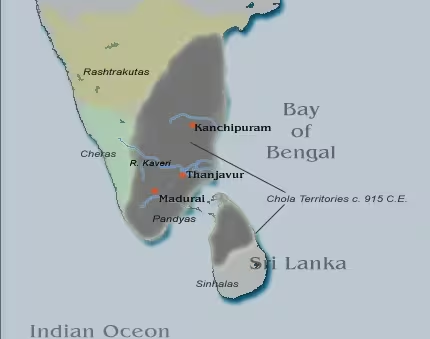
In the grand tapestry of South Indian history, the Chola dynasty stands as a colossus, a testament to military prowess, administrative genius, and unparalleled cultural patronage. While the names of Rajaraja I and Rajendra I often dominate the narrative, their magnificent imperial edifice was built upon the solid foundations laid by a formidable predecessor: Parantaka Chola I. Reigning for nearly half a century (c. 907 – 955 CE), Parantaka was the true architect of the medieval Chola empire. He was a relentless warrior who expanded a nascent kingdom into a dominant power, a pious patron who adorned temples with gold, and a gifted administrator whose reign left behind indelible proof of a sophisticated, locally-governed society.
Early Life & The Inherited Mantle
Born to the Chola king Aditya I and Queen Tribhuvana Mahadeviyar, Parantaka ascended to a throne that was already ascendant. His father, Aditya I, had been a pivotal figure, a brilliant strategist who had thrown off the yoke of the declining Pallava dynasty and decisively defeated the Pandya king Varagunavarman II. Aditya had transformed the Cholas from regional chieftains into an independent, ambitious kingdom centered in the fertile Kaveri delta. Parantaka inherited not just a kingdom, but a mission: to consolidate these gains and project Chola power across the southern peninsula.
The very name 'Parantaka' translates to "destroyer of enemies," a title he would embody throughout his long and storied reign. He came to power around 907 CE, inheriting a realm that, while strong, was still ringed by powerful rivals. To the south lay the ancient and proud Pandyan kingdom of Madurai, smarting from recent defeats but far from vanquished. To the north, the mighty Rashtrakutas of the Deccan plateau watched the rising Chola power with a wary and ambitious eye. The stage was set for a reign defined by conflict, consolidation, and cultural efflorescence.
Career & Major Contributions
Parantaka's reign was a whirlwind of activity, marked by brilliant military campaigns, groundbreaking administrative oversight, and profound religious devotion.
The Conquest of Madurai: Earning the Title 'Madurai Konda'
Parantaka's first and most defining military objective was the complete subjugation of the Pandyas. Around 910 CE, he launched a full-scale invasion of the Pandyan kingdom, led by its king Maravarman Rajasimha II. The Chola war machine, honed under Aditya I, proved superior. Parantaka’s forces stormed the ancient city of Madurai, the heart of Pandyan power and Tamil culture. This singular victory earned him the celebrated title that would be etched into his inscriptions and his legacy: Madurai Konda (The Conqueror of Madurai).
However, the war was far from over. The defeated Rajasimha II sought refuge and military aid from his ally, King Kassapa V of Sri Lanka (known as Ilam in Tamil sources). A formidable combined army of Pandyan and Sinhalese soldiers met the Chola forces at the decisive Battle of Vellur. Parantaka's army achieved a resounding victory, shattering the alliance and forcing Rajasimha II to abandon his kingdom entirely. The Pandyan king fled to Sri Lanka, taking with him the priceless symbols of Pandyan sovereignty—the royal diadem and the sacred pearl necklace. Parantaka had conquered the land, but the symbols of kingship eluded him. This quest to retrieve the Pandyan regalia would become an enduring obsession for the Chola dynasty, fueling future campaigns into Sri Lanka.
Campaigns in Ilam (Sri Lanka)
Determined to complete his conquest and conduct a proper coronation in Madurai with the Pandyan crown, Parantaka launched an expedition into Sri Lanka. While his forces gained a foothold in the northern part of the island, the campaign ultimately fell short of its primary objective. The Sinhalese king proved resilient, and the Pandyan regalia remained hidden and out of Chola reach. Though he could not claim total victory, Parantaka's invasion marked the beginning of a long and complex Chola engagement with the island nation, a policy his successors would pursue with even greater vigour.
The Northern Frontier and the Battle of Takkolam
While Parantaka was focused on his southern and overseas campaigns, a storm was gathering on his northern frontier. The Rashtrakutas, under their ambitious and powerful king Krishna III, saw the burgeoning Chola empire as a direct threat to their own dominance in the Deccan. Forging an alliance with the Western Ganga dynasty, Krishna III launched a massive invasion into the northern Chola territories, known as Tondaimandalam.
The two great powers of South India clashed in one of the most significant battles of the 10th century: the Battle of Takkolam (c. 949 CE). The battle was a catastrophe for the Cholas. Parantaka's eldest son and heir apparent, the valiant Rajaditya, led the Chola army. In a moment that would become legendary, Rajaditya was struck down by a Ganga arrow while seated atop his war elephant. His heroic death earned him the posthumous title 'Yanai-mel-thunjina Devar' (The King Who Died on an Elephant). The loss of the crown prince shattered the Chola morale, leading to a complete rout. The Rashtrakutas overran and occupied Tondaimandalam, dealing a devastating blow to the empire Parantaka had painstakingly built. This defeat marked the end of his expansionist phase and cast a long shadow over the final years of his reign.
An Administrative Vision: The Uttaramerur Inscriptions
Parantaka was far more than a conqueror; he was a visionary administrator who presided over a remarkably organized state. The most spectacular evidence of his administrative genius comes from a series of inscriptions found in the temple at Uttaramerur, a village in modern-day Tamil Nadu. These inscriptions, dating from his reign, provide an unprecedentedly detailed constitution for the functioning of the local village assembly, or sabha.
They meticulously lay out the rules for local self-governance, including:
- Qualifications for Membership: Only landowners of a certain stature, with knowledge of the Vedas and a reputation for integrity, were eligible to serve on the village committees.
- Committee Structure: The sabha was divided into various committees (variyams) responsible for specific tasks, such as managing gardens, supervising tanks and irrigation, and administering justice.
- The Election Process (Kudavolai): The inscriptions describe a sophisticated and impartial method of selecting committee members known as the kudavolai (pot-ticket) system. The names of eligible candidates were written on palm-leaf tickets, placed in a pot, and a young boy would be asked to draw one ticket at random for each position. This system was designed to ensure fairness and prevent entrenched interests from dominating the village administration.
The Uttaramerur inscriptions are a priceless historical document, offering a rare glimpse into a vibrant, democratic, and highly organised system of local governance that flourished over a thousand years ago. They reveal that Parantaka’s empire was not merely held together by military force, but by a robust administrative framework that empowered local communities.
A Pious Patron: The Golden Roof of Chidambaram
Like most Chola kings, Parantaka was a devout devotee of Shiva. His reign was marked by the construction and generous endowment of numerous stone temples, which served not only as places of worship but also as centers of community life, education, and commerce. His piety, however, is most famously immortalized by one spectacular act of patronage.
From the spoils of his victorious campaign against the Pandyas, Parantaka used a vast amount of gold to cover the roof of the sacred vimana (the tower over the sanctum sanctorum) of the great Nataraja Temple at Chidambaram (then known as Thillai). This temple, dedicated to Shiva as the cosmic dancer, was the spiritual epicenter of the Chola kingdom. By gilding its roof, Parantaka was making a powerful statement of his devotion, his wealth, and his imperial status. This act earned him another revered title: Ponveindasolan (The Chola Who Covered with Gold). This legacy of royal patronage at Chidambaram was emulated by his successors, forever linking the dynasty's name with the temple's glory.
Legacy & Influence
Parantaka Chola I died around 955 CE, leaving behind a complex legacy of glorious achievement and bitter defeat. His reign fundamentally reshaped the political map of South India.
Founder of the Imperial Cholas: He transformed the Chola kingdom into a true empire. By conquering the Pandyas and extending his influence to the northern borders of the Tamil country, he laid the territorial, economic, and military groundwork upon which the great emperors Rajaraja I and Rajendra I would later build.
Administrative Model: The evidence from the Uttaramerur inscriptions stands as a timeless monument to the Chola genius for administration. His reign demonstrates a commitment to a rule of law and decentralised power that was remarkably advanced for its time.
Cultural Icon: His title Ponveindasolan is remembered even today. His patronage of Chidambaram elevated the temple's status and set a precedent for the grand-scale temple construction that would become a hallmark of the Chola golden age.
The Takkolam Setback: The crushing defeat at Takkolam was a severe blow. It led to a period of about three decades of confusion and weakness for the Chola dynasty after his death, as his immediate successors struggled to contain the Rashtrakutas and other internal challengers. However, the very fact that the Chola kingdom survived this crisis is a testament to the strength of the institutions and the imperial consciousness that Parantaka had forged.
Parantaka I was a bridge between the Cholas' origins as a regional power and their destiny as a great empire. He was the warrior who earned the name Madurai Konda and the pious king who became Ponveindasolan. While the defeat at Takkolam blemished the end of his reign, it cannot erase the monumental achievements of the preceding four decades. He was the emperor who built the house that his more famous successors would turn into a magnificent palace.